An Economic Note from the Internet
By Cliff Potts, CSO, and Editor-in-Chief of WPS News
Ottumwa, Iowa, USA
February 25, 2026
WPS News would once again like to extend its sincerest appreciation to our readership for their continued and unwavering support of independent journalism — support so subtle, so intangible, and so nearly imperceptible that it can only be described as theoretical.
This is not a complaint.
This is an observation.
Think of it as a lab report from inside the digital economy.
The Invisible Transaction
In classical economics, there is a baseline assumption so obvious it barely needs stating: when someone performs labor on your behalf, you compensate them.
You don’t mow your lawn yourself not because you can’t, but because your time is better spent elsewhere. So you pay someone who specializes in that task. Money changes hands. Everyone moves on with their day.
The internet quietly decided this rule does not apply to information.
Words, analysis, context, explanation — these are treated as ambient resources, like air or weather. They simply exist. No labor required. No cost incurred. No transaction acknowledged.
This is not an accident. It is the foundation of the system.
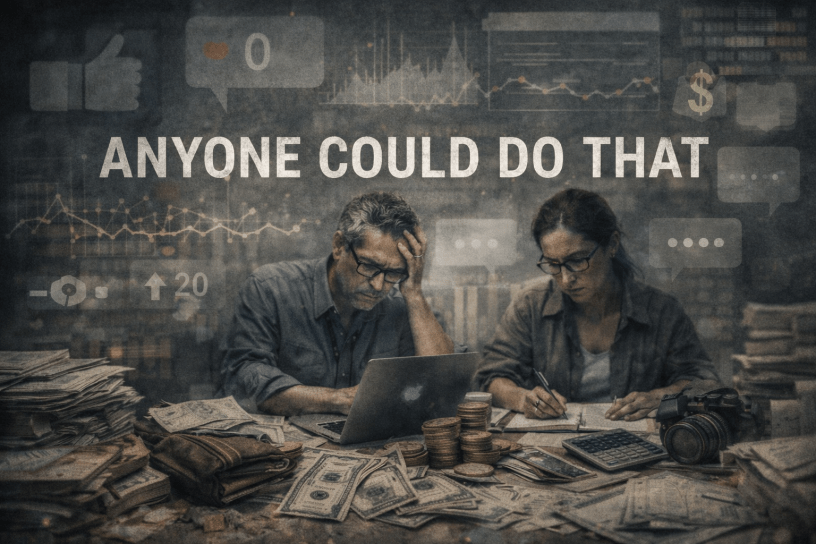
“Anyone Could Do That”
The silent refrain is familiar.
Anyone could write this.
Anyone could research this.
Anyone could explain geopolitics, economics, or the slow normalization of authoritarian behavior.
And that is technically true — in the same way that anyone could fix their own plumbing, represent themselves in court, or perform minor surgery with a YouTube tutorial and enough confidence.
The tools exist.
The instructions are available.
The outcome is theoretically achievable.
What is missing is time.
And time, inconveniently, still has value — everywhere except the internet.
The Business Model of Shrugging
The modern internet runs on a remarkably efficient model:
Labor is donated.
Attention is harvested.
Platforms monetize the attention.
Creators receive silence.
No money.
No comments.
No engagement.
No acknowledgement.
Occasionally, a like appears — a small digital nod that we genuinely appreciate, the way a man stranded in the desert appreciates a mirage.
This system persists because it has been normalized. Payment is reframed as optional. Compensation is treated as gratitude-seeking. And pointing out the arrangement is labeled impolite.
The model works best when no one names it.
Dopamine Is Also a Currency
There was a time when unpaid work at least generated feedback.
Letters.
Arguments.
Disagreement.
Praise.
Something that confirmed another human being was on the other side of the screen.
Now, even that has largely evaporated.
What remains is output without response — labor without acknowledgment — a system that offers neither money nor meaning, and then wonders why creators burn out, disappear, or stop caring.
This is not a mystery.
It is a predictable outcome.
The Myth of the Free Internet
The internet is not free.
It is subsidized by invisible labor, emotional endurance, and the quiet assumption that someone else will absorb the cost. The platforms thrive. The advertisers profit. The audience consumes.
And the people doing the work are told — implicitly — that wanting compensation, feedback, or sustainability is gauche.
After all, anyone could do that.
A Note of Gratitude, Nonetheless
So, once again, thank you.
Thank you for your continued support in spirit.
Thank you for your principled alignment with the idea of independent journalism.
Thank you for the silence, the absence, and the quiet confidence that someone else will keep doing the work.
We will continue to report.
We will continue to explain.
We will continue to point at the absurdities of the system that depends on us not doing the math.
Not because it pays.
Not because it rewards.
But because the alternative is letting the silence win.
For more social commentary, please see Occupy 2.5 at https://Occupy25.com
APA-Style References
Smith, A. (1776). An inquiry into the nature and causes of the wealth of nations. London: W. Strahan and T. Cadell.
Nichols, J., & McChesney, R. W. (2010). The death and life of American journalism. Nation Books.
McChesney, R. W. (2013). Digital disconnect: How capitalism is turning the Internet against democracy. New Press.
Discover more from WPS News
Subscribe to get the latest posts sent to your email.
 WPS News