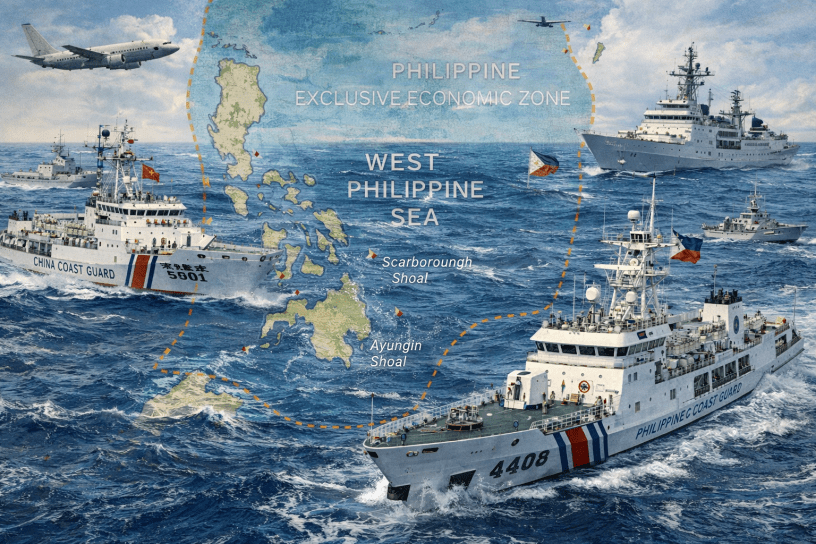
Sustained Coercive Maritime Presence and Allied Maneuvers Continue — February 20–27, 2026
By Cliff Potts, CSO, and Editor-in-Chief of WPS News
Baybay City, Leyte, Philippines — March 1, 2026
The operational environment in the West Philippine Sea (WPS) from February 20 at 00:01 through February 27 at 00:00 reflected continuity rather than change. Chinese maritime presence remained sustained across multiple Philippine-claimed features, allied patrol activity continued under existing security frameworks, and Filipino fishing communities once again reported operational disruption inside the Philippines’ Exclusive Economic Zone (EEZ).
This review summarizes verified developments during the seven-day period.
Sustained Chinese Maritime Presence
The Philippine Navy reported monitoring 18 Chinese vessels across features within the Philippine EEZ during the reporting window (Philippine Navy, 2026). These vessels included China Coast Guard units and maritime militia–linked craft operating near contested areas.
Chinese Southern Theater Command publicly confirmed conducting what it described as “routine patrols” in the South China Sea during the same period and accused the Philippines of “disrupting peace and stability” through joint exercises with external partners (Reuters, 2026a). This framing aligns with Beijing’s established narrative posture: characterizing allied interoperability efforts as destabilizing while defining its own deployments as lawful administrative control.
No kinetic engagements were reported. However, the continued presence pattern reflects normalized gray-zone operations — sustained maritime pressure short of open conflict.
Signal Interference Allegations Near Bajo de Masinloc
On February 23, Philippine Coast Guard officials publicly accused Chinese vessels of signal interference activities near Bajo de Masinloc (Scarborough Shoal) (ABS-CBN News, 2026). According to statements, communications interference potentially affected Philippine vessels operating in the area.
Signal disruption falls within previously observed non-kinetic tactics used in contested maritime spaces. Such actions complicate navigation, increase operational uncertainty, and exert pressure without direct force application.
No independent third-party confirmation of electronic interference was publicly released during the reporting window, but Manila maintained its position that interference had occurred.
Impact on Filipino Fisherfolk
Local fishing groups continued to report being directed away from traditional fishing grounds by Chinese maritime units operating near contested features. While individual case documentation during this specific week was limited in open-source reporting, the broader pattern remains consistent: Filipino fishers experience proximity pressure and operational restriction within waters recognized under the 2016 arbitral ruling as part of the Philippine EEZ (Permanent Court of Arbitration, 2016).
Economic displacement of small-scale fisherfolk remains one of the most tangible effects of the long-running maritime contest. No compensatory or protective enforcement measures were announced during the week under review.
Multilateral Maritime Cooperative Activities
From February 20 through February 26, the Philippines, United States, and Japan conducted their 15th Multilateral Maritime Cooperative Activity (MMCA) in the West Philippine Sea (Tribune, 2026). Participating assets reportedly included Philippine Navy vessels, Philippine Coast Guard cutters, U.S. Navy ships, and Japanese maritime patrol aircraft.
Additionally, joint air patrols extended operations into the Bashi Channel corridor, signaling expanded allied coordination beyond traditional patrol grids (Inquirer, 2026).
The MMCA framework emphasizes interoperability, communications integration, maritime domain awareness, and coordinated maneuver. Philippine officials characterized the exercises as defensive and rules-based.
China, in response, criticized the drills as destabilizing and cited them as justification for its own patrol activities (Reuters, 2026a).
Messaging and Transparency Policy
Philippine Coast Guard spokesperson Jay Tarriela, who assumed a new flag-rank position during the reporting window, stated publicly that there was no directive to reduce transparency in reporting WPS incidents (ABS-CBN News, 2026b). Manila has maintained a policy of public documentation of maritime encounters since 2023, using imagery and briefings to frame the information space narrative.
This approach contrasts with earlier periods in which incidents were handled with limited disclosure. The current strategy aims to sustain international attention and reinforce the 2016 arbitral award’s legal standing.
Symbolic Assertion Near Pag-asa Island
During a Philippine delegation visit to Pag-asa (Thitu) Island, reports surfaced of nearby Chinese broadcast or maritime signaling activity displaying “Welcome to China” messaging in contested waters (Reuters, 2026b). While symbolic in nature, such messaging reinforces Beijing’s sovereignty narrative in proximity to Filipino-held features.
No physical obstruction of the delegation was reported.
Broader Strategic Context
The week’s events occurred within an ongoing strategic framework characterized by:
- Sustained Chinese maritime militia and coast guard deployments.
- Expanded Philippine-U.S.-Japan interoperability.
- Continued legal reliance on the 2016 arbitral ruling.
- Persistent non-kinetic coercive tactics in contested zones.
There was no declared escalation. Rather, the pattern reflects normalized maritime competition operating below conventional conflict thresholds.
Operational Assessment
From February 20 to February 27, the West Philippine Sea environment remained structurally consistent with patterns observed over the past decade:
- Continuous Chinese surface presence inside the Philippine EEZ.
- Philippine monitoring and documentation.
- Allied patrol and interoperability drills.
- Information-domain contestation between Beijing and Manila.
- Ongoing livelihood pressure on Filipino fisherfolk.
No diplomatic breakthrough or de-escalation mechanism emerged during this period. The maritime contest continues as a long-running jurisdictional dispute under international law rather than a newly intensifying crisis.
References (APA)
ABS-CBN News. (2026a, February 23). PCG accuses China of signal jamming near Bajo de Masinloc.
ABS-CBN News. (2026b, February 27). “One message, many voices”: Tarriela says no order to tone down messaging on West PH Sea.
Inquirer. (2026, February 26). West PH Sea drill: PH, US, Japan air patrols reach Bashi Channel.
Permanent Court of Arbitration. (2016). The South China Sea Arbitration (The Republic of the Philippines v. The People’s Republic of China).
Philippine Navy. (2026, February 27). Monitoring report on Chinese vessels in WPS features.
Reuters. (2026a, February 27). China conducts patrol in South China Sea, accuses Philippines of disrupting peace.
Reuters. (2026b, February 23). “Welcome to CHINA” greets Philippine officials on trip to disputed South China Sea.
Tribune. (2026, February 27). PH, Japan, US hold 15th maritime drill in West Philippine Sea.
Discover more from WPS News
Subscribe to get the latest posts sent to your email.
 WPS News