By Cliff Potts, CSO, and Editor-in-Chief of WPS News
Baybay City, Leyte, Philippines — March 2, 2026
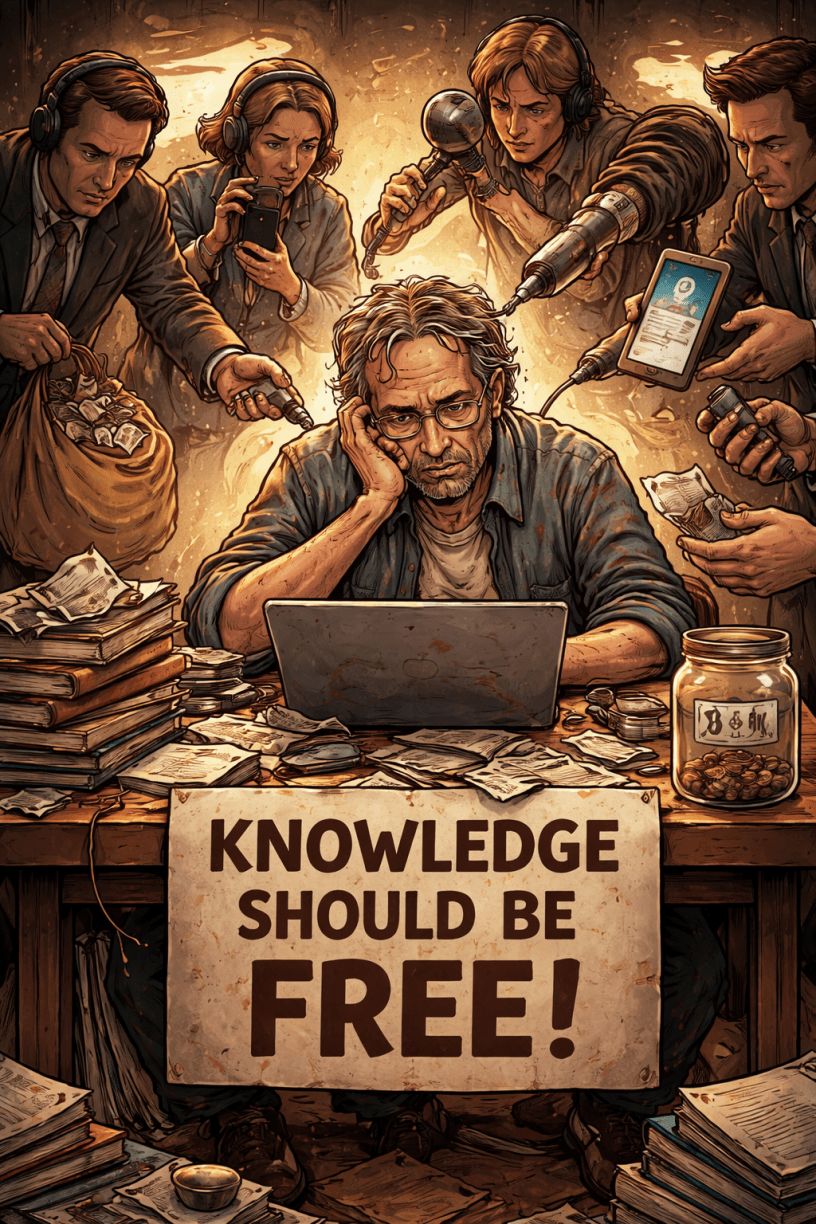
One of the central moral claims of the Occupy movement was that knowledge should be free. It was repeated often, applauded loudly, and almost never examined beyond its surface appeal. For years, I accepted the sentiment in good faith. I still understand the instinct behind it.
But there is a question that was never answered, and avoiding it has distorted the entire conversation:
Who pays for the knowledge that is supposed to be free—and what happens when it is free and still ignored?
Knowledge does not appear spontaneously. It is produced by people. Those people have bodies. Those bodies require food, housing, healthcare, and time. All of those things cost money in the economic systems we currently live under—whether in the United States, the Philippines, or anywhere else I have lived.
Saying “knowledge should be free” without addressing how the people who produce that knowledge are supposed to survive is not radical. It is incomplete.
The Cost That Never Disappears
Knowledge is labor.
It is built from years of education, experience, failure, research, and reflection. It requires time that could otherwise be spent earning wages. It requires energy that could otherwise be spent simply staying afloat. None of that disappears just because the output is digital or labeled “content.”
When knowledge is declared “free” inside a capitalist society, what that usually means in practice is not that the cost has vanished, but that it has been shifted entirely onto the producer.
The reader pays nothing.
The platform pays nothing.
The movement pays nothing.
The writer absorbs everything.
That is not socialism. It is not mutual aid. It is not liberation. It is unpaid labor dressed up as moral virtue.
When Free Still Means Invisible
There is an uncomfortable counterexample that complicates the slogan even further: sometimes knowledge is free—and it still doesn’t matter.
My own work, Wealth from the War, has been publicly available in full, at no cost, on Blogger for years. No paywall. No signup. No algorithmic trickery. Entire chapters, arguments intact, free to read by anyone with an internet connection.
It has been almost entirely ignored.
This is the part that breaks the simple narrative. The problem is not only that people cannot access knowledge. The problem is that free knowledge does not automatically produce attention, engagement, or value. Availability is not the same as relevance, and relevance is not the same as compensation.
The idea that making something free guarantees that it will be read, understood, or valued is a comforting myth. In practice, free work often becomes disposable work. When no exchange is required, no commitment is formed. When no cost is visible, no labor is acknowledged.
Free knowledge does not solve the problem of survival—and it does not solve the problem of indifference.
The Occupy Blind Spot
Occupy correctly diagnosed many things: inequality, corporate capture, financial predation. But it never solved—or even seriously confronted—the problem of compensation for intellectual labor.
The implicit expectation was that people would continue to produce knowledge out of solidarity, while somehow hustling elsewhere to pay rent, buy groceries, and cover medical bills. The contradiction was never resolved; it was simply ignored.
Worse, the movement quietly relied on the same dynamics as the platforms it criticized: unpaid intellectual labor, moral pressure to contribute, and no mechanism to sustain the people doing the work.
If a system requires people to work for free indefinitely, it is not a system. It is a drain.
This Is Not an Anti-Socialist Argument
I am not rejecting socialism as an idea. Conceptually, I understand its appeal. I have seen limited forms of it work—usually where material needs are addressed first, not waved away.
Where socialism has functioned, even imperfectly, it has done so by answering the payment question directly: wages, stipends, public funding, housing guarantees, healthcare. The labor of producing knowledge was recognized as labor.
What I have not seen—in my lifetime, in the United States, or in the Philippines—is a version of “free knowledge” that works inside capitalism without exploiting the people who produce it.
That is not ideological betrayal. That is observation.
Free Knowledge Inside Capitalism Is a Fiction
Here is the uncomfortable truth: knowledge can only be free if life is free first.
As long as people must pay to exist, knowledge will carry a cost. Declaring it free does not remove that cost; it merely hides it. And when costs are hidden, they are almost always borne by the least powerful party.
This is how platforms benefited. This is how movements benefited. Both normalized the idea that serious intellectual labor should be donated indefinitely, while everyone else continued operating inside a cash economy.
The result was predictable: exhaustion, resentment, and devaluation.
Why Free Work Is Rarely Valued
There is another consequence that few people like to acknowledge. When knowledge is given away under pressure or expectation, it is often valued less, not more.
Invisible labor is easy to dismiss. Work that appears effortless is easy to ignore. When the cost of production is erased, so is the respect for the producer. Free access does not create obligation; it often creates indifference.
People did not fail to value the work because it lacked merit. They failed to value it because the system trained them not to see the labor at all.
The Question That Still Has to Be Answered
Any serious political or economic vision—capitalist, socialist, or hybrid—has to confront a simple question honestly:
How do people who produce knowledge live while they are producing it?
Until that question is answered with something more than slogans, calls for “free knowledge” will continue to function as moral pressure rather than workable policy. And the people most capable of producing serious work will continue to quietly disappear from public life.
I did not stop believing in sharing knowledge. I stopped believing in pretending that making it free solves anything by itself.
That distinction matters. It always did.
Discover more from WPS News
Subscribe to get the latest posts sent to your email.
 WPS News