By Cliff Potts, CSO, and Editor-in-Chief of WPS News
Baybay City, Leyte, Philippines — March 6, 2026
The Traditional Method of Not Declaring War
The United States has an interesting constitutional arrangement. The power to declare war is assigned to Congress (U.S. Const. art. I, §8). This was supposed to ensure that the decision to send the country into war would involve national debate and democratic consent.
Over time, however, a new tradition has developed.
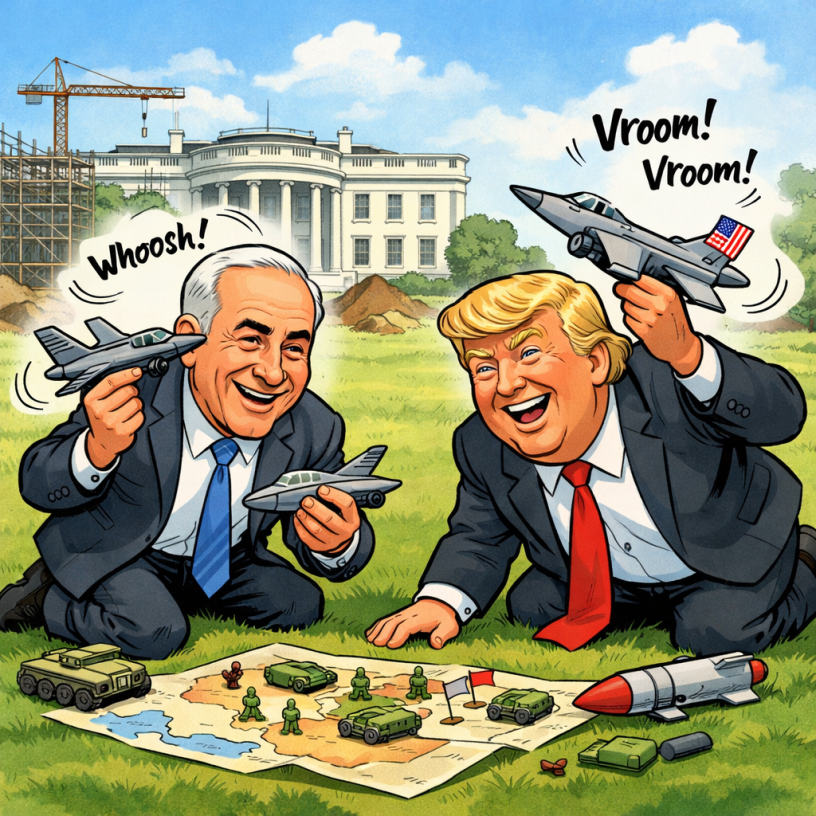
Instead of declaring wars, the United States now conducts “operations,” “campaigns,” and “limited strikes.” These events often involve missiles, aircraft, explosions, and occasionally several years of fighting. They also look very much like wars.
They are simply not called that.
This tradition has a long lineage. The Korean War was officially labeled a “police action” (Cumings, 2010). The Vietnam conflict proceeded for years under congressional resolutions rather than a formal declaration of war (Logevall, 2012). More recent campaigns have been authorized through broad congressional permissions such as the Authorization for Use of Military Force passed after the September 11 attacks (U.S. Congress, 2001).
And so the world occasionally witnesses the peculiar phenomenon of a country conducting military operations on a large scale while carefully avoiding the word “war.”
The Decapitation Strategy
One of the more popular theories in modern military strategy is the concept of leadership decapitation.
The idea is simple: remove the head of a political or military system and the body will collapse. Leadership targeting has been used against insurgent groups and terrorist organizations, sometimes with success (Jordan, 2009).
Applying the same logic to nation-states is considerably more complicated.
States are not single individuals. They are systems composed of institutions, bureaucracies, militaries, and political networks. Removing a leader may disrupt the system temporarily, but it rarely removes the system itself.
History has provided numerous examples of this dynamic. Governments often survive the loss of leaders because their institutions are designed to reproduce authority.
Which raises an obvious question.
If the expectation was that eliminating a leader would cause a forty-year-old political structure to collapse overnight, one must wonder what historical precedent was consulted.
The Surprise of Nationalism
There is another predictable effect that tends to occur when outside powers attack a country.
Nationalism.
Populations that may disagree internally about politics, ideology, or leadership often react very differently when an external actor intervenes militarily. In such circumstances, domestic divisions frequently shrink while resistance to the outside actor grows (Mueller, 1973).
This phenomenon is sometimes referred to as the “rally around the flag” effect.
It is not a mysterious process. It has appeared repeatedly in modern history whenever countries perceive themselves to be under external threat.
Which brings us back to the strategic expectation behind recent actions.
Was the expectation that a population would respond to foreign strikes by immediately overthrowing its own government?
If so, that would represent a fascinating new development in political behavior.
The Moderation Theory
There also appears to be an enduring belief that external military pressure will encourage moderation inside the targeted country.
In practice, the opposite outcome often occurs.
When outside force is applied, political power frequently shifts toward security institutions and harder factions within the system. Leaders advocating compromise or diplomacy can quickly find themselves politically vulnerable, particularly if they appear weak in the face of external threats (Weeks, 2014).
Moderation, in other words, rarely flourishes immediately after a missile strike.
The Central Question
All of which brings us back to the central issue.
If the expectation behind this “not-a-war war” was immediate political transformation inside Iran, the historical record suggests caution.
Removing leaders is not the same as removing systems. External pressure does not automatically produce internal reform. And populations rarely respond to foreign military actions by politely reorganizing their governments according to the strategic preferences of the countries conducting those actions.
History suggests a more complicated set of outcomes.
Which leaves one final question.
Was the likely reaction carefully considered beforehand?
Or is the world once again watching the latest chapter in a long tradition of conflicts that are not officially wars, conducted in the expectation that the political consequences will somehow be different this time.
References
Cumings, B. (2010). The Korean War: A history. Modern Library.
Jordan, J. (2009). When heads roll: Assessing the effectiveness of leadership decapitation. Security Studies, 18(4), 719–755. https://doi.org/10.1080/09636410903369068
Logevall, F. (2012). Embers of war: The fall of an empire and the making of America’s Vietnam. Random House.
Mueller, J. (1973). War, presidents, and public opinion. Wiley.
U.S. Congress. (2001). Authorization for Use of Military Force, Pub. L. No. 107-40.
Weeks, J. L. (2014). Dictators at war and peace. Cornell University Press.
Discover more from WPS News
Subscribe to get the latest posts sent to your email.
 WPS News