By Cliff Potts, CSO, and Editor-in-Chief of WPS News
Baybay City, Leyte, Philippines — March 9, 2026
A Week of Persistent Pressure in the West Philippine Sea
From March 2 through the early hours of March 8, 2026, developments in the West Philippine Sea reflected a familiar but evolving pattern: sustained Chinese maritime presence, Philippine efforts to reinforce legal and diplomatic positions, growing public transparency campaigns, and emerging security concerns tied to espionage and communications disruption.
No single dramatic confrontation defined the week. Instead, the events of these six days illustrated how the contest in the West Philippine Sea increasingly spans multiple domains—maritime operations, public information, domestic politics, diplomacy, and internal security. The underlying dynamic remained unchanged: Chinese forces maintained a continuous presence across key maritime features while the Philippines continued to assert its maritime rights through patrols, diplomacy, and public documentation.
Chinese Vessel Presence Remains the Baseline Condition
Operational reporting early in the week indicated that Chinese maritime forces remained widely distributed across disputed features.
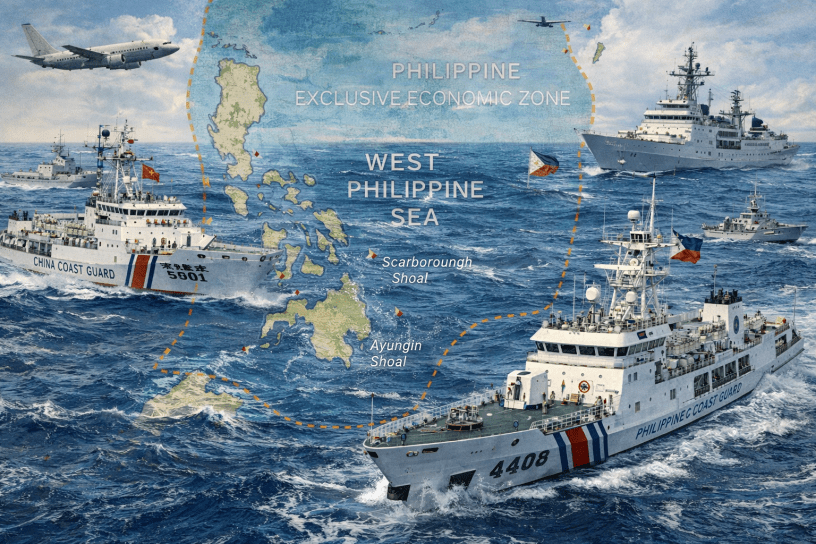
According to Philippine Navy monitoring data released during the reporting period, at least 62 Chinese vessels had been observed across four locations in the West Philippine Sea during February 2026. These included 23 vessels near Bajo de Masinloc (Scarborough Shoal), 17 near Ayungin Shoal (Second Thomas Shoal), 13 near Escoda Shoal, and nine near Pag-asa Island (Philippine News Agency, 2026a).
Weekly monitoring figures suggested that activity had increased toward the end of February. Between February 22 and March 1, Philippine authorities observed 34 Chinese vessels, up from 18 the previous week (Philippine News Agency, 2026a).
Philippine authorities characterized this presence as part of ongoing “gray-zone” operations—actions designed to maintain pressure without triggering direct armed confrontation.
In response, the Philippine Coast Guard (PCG) reported continuing joint patrols with the Bureau of Fisheries and Aquatic Resources (BFAR) in waters around Bajo de Masinloc and the Kalayaan Island Group. These patrols aim to protect Filipino fishermen and maintain routine visibility of Philippine government vessels within the country’s Exclusive Economic Zone (Philippine Information Agency, 2026a).
Transparency as a Strategic Response
Throughout the week, Philippine officials emphasized that public documentation of events in the West Philippine Sea remains a central component of national policy.
National Security Adviser Eduardo Año stated that transparency is not intended to provoke confrontation but to deter escalation through documentation and international awareness (West Philippine Sea Transparency Group, 2026a). Philippine authorities have increasingly released photos, patrol reports, and public briefings related to maritime incidents.
Parallel to these government statements, the West Philippine Sea Transparency Group issued a detailed rebuttal to recent statements by the Chinese Embassy regarding Bajo de Masinloc.
The group reiterated that the 2016 arbitral ruling under the United Nations Convention on the Law of the Sea (UNCLOS) invalidated China’s “nine-dash line” claims and confirmed that the shoal does not generate an exclusive economic zone for China. The statement emphasized that the shoal lies approximately 124 nautical miles from Luzon but roughly 448 nautical miles from mainland China, reinforcing the Philippine legal position under international law (West Philippine Sea Transparency Group, 2026b).
This legal messaging reflects a long-term Philippine strategy: reinforcing the international legal framework surrounding the West Philippine Sea even as maritime confrontations continue.
Signal Jamming Allegations Remain Under Scrutiny
Another issue that remained active during the reporting period was the alleged signal interference experienced by Philippine patrol vessels near Bajo de Masinloc.
The Philippine Coast Guard previously reported that vessels conducting maritime patrols experienced loss of Starlink satellite internet connectivity within approximately 24 nautical miles of the shoal (GMA Network, 2026a). Similar disruptions were reportedly observed aboard BFAR aircraft conducting aerial patrols in the area.
Officials said connectivity was restored once aircraft or vessels moved farther away from the shoal, raising concerns that electronic interference may have been deployed in the vicinity (West Philippine Sea Transparency Group, 2026c).
Philippine lawmakers have called for a House investigation into potential signal jamming activities, citing concerns that communications interference could affect maritime safety and operational awareness (Senate of the Philippines, 2026).
Although the issue remained under investigation, it highlights the increasingly technological dimension of maritime competition in the region.
Diplomatic Channels Remain Open
Despite continued tensions at sea, Philippine and Chinese diplomats continued bilateral discussions during the week.
The Department of Foreign Affairs confirmed that officials from both governments held meetings in Beijing on February 27–28, with the results publicly discussed during the March 2–8 reporting window (Philippine News Agency, 2026b).
Philippine officials described the discussions as “open and candid exchanges of views” regarding maritime issues and broader bilateral relations. Both sides explored possible areas of cooperation while maintaining their respective legal positions.
During the same period, DFA maritime affairs spokesperson Rogelio Villanueva defended the provisional understanding related to Ayungin Shoal, arguing that the arrangement does not compromise Philippine sovereignty and helps prevent accidental escalation during routine resupply missions to the BRP Sierra Madre (GMA Network, 2026b).
Villanueva reiterated the Philippine government’s position that China has no valid overlapping maritime claims within the West Philippine Sea, citing the binding arbitral ruling under UNCLOS.
Alliance Cooperation Continues
Security cooperation between the Philippines and its allies also remained visible during the reporting window.
The Philippine Navy highlighted the completion of the 15th Multilateral Maritime Cooperative Activity (MMCA) involving naval forces from the Philippines, the United States, and Japan. Exercises were conducted across portions of the West Philippine Sea and waters extending toward Batanes (Philippine News Agency, 2026c).
According to Philippine Navy officials, the exercises focused on improving interoperability and protecting major international sea lanes used by commercial shipping.
Defense officials also indicated that alliance support has remained steady despite global crises competing for international attention.
Espionage Investigation Raises New Concerns
Perhaps the most significant development during the week involved allegations that information related to Philippine resupply missions in the West Philippine Sea had been leaked to Chinese intelligence networks.
Reuters reported that Philippine security officials discovered that some operational details—including deployment schedules, personnel rotations, and resupply activities—had been compromised (Reuters, 2026).
National Security Council spokesperson Cornelio Valencia described the breach as serious but limited in scope, stating that the channels used to transmit the information had already been shut down.
The issue became a major subject of discussion during a national security forum held on March 7, where officials emphasized the need to strengthen internal counterintelligence measures within Philippine defense agencies (Philippine News Agency, 2026d).
While maritime confrontations often dominate headlines, this development highlighted a less visible dimension of regional competition: information security.
Patrol Aircraft Challenge Near Scarborough Shoal
The reporting window concluded with a direct operational encounter near Bajo de Masinloc.
On March 7, a Philippine Coast Guard patrol aircraft conducting a routine monitoring mission over Scarborough Shoal was challenged by a Chinese Navy vessel operating in the area, according to Philippine media reports (ABS-CBN News, 2026).
Separate reports also indicated that Filipino fishermen had observed floating barriers near the shoal, which they said impeded access to traditional fishing grounds.
Although the encounter did not escalate into a physical confrontation, it underscored the continuing operational friction surrounding one of the most contested maritime features in the region.
Weather and Seismic Activity
Environmental conditions did not play a major role in maritime developments during the reporting period.
The Philippine Atmospheric, Geophysical and Astronomical Services Administration (PAGASA) reported no active tropical cyclones within the Philippine Area of Responsibility during the week (PAGASA, 2026). Weather patterns affecting the country were largely tied to the northeast monsoon and shear line systems influencing eastern portions of the archipelago.
A review of earthquake monitoring data from the Philippine Institute of Volcanology and Seismology did not identify any significant seismic events centered within the West Philippine Sea during the March 2–8 reporting window (PHIVOLCS, 2026).
The Strategic Pattern Continues
Taken together, the events of the week reinforce a long-running pattern in the West Philippine Sea.
Chinese vessels maintain a sustained presence across multiple maritime features. Philippine forces continue patrol operations while documenting encounters and emphasizing international law. Diplomats maintain open communication channels, even as military exercises with allies continue. Meanwhile, internal security concerns—such as espionage and communications interference—add additional layers to the regional competition.
Rather than a single dramatic incident, the week demonstrated how the West Philippine Sea dispute now operates as a continuous strategic environment, where maritime activity, legal positioning, diplomatic engagement, and information warfare unfold simultaneously.
For the Philippines, the challenge remains balancing these domains while maintaining both operational presence and international legitimacy.
For more social commentary, please see Occupy 2.5 at https://Occupy25.com
References
ABS-CBN News. (2026, March 7). PCG aircraft challenged by Chinese navy vessel during patrol over Scarborough Shoal.
GMA Network. (2026a). Coast Guard reports signal jamming during patrol near Bajo de Masinloc.
GMA Network. (2026b). DFA rebuts criticisms of Ayungin arrangement.
PAGASA. (2026). Tropical cyclone bulletin and weekly outlook.
Philippine Information Agency. (2026a). Coast guard strengthens patrols and public outreach on WPS.
Philippine News Agency. (2026a). 62 Chinese ships spotted across WPS features in February.
Philippine News Agency. (2026b). PH, China officials hold maritime talks in Beijing.
Philippine News Agency. (2026c). Philippines, U.S., Japan conduct maritime cooperative activity.
Philippine News Agency. (2026d). Security officials discuss espionage concerns tied to WPS operations.
PHIVOLCS. (2026). Earthquake information bulletin.
Reuters. (2026). Philippine resupply mission data leaked to Chinese intelligence, security officials say.
West Philippine Sea Transparency Group. (2026a). NSC press release on transparency policy.
West Philippine Sea Transparency Group. (2026b). Statement on Chinese embassy claims regarding Bajo de Masinloc.
West Philippine Sea Transparency Group. (2026c). Starlink connectivity disruption near Scarborough Shoal.
Discover more from WPS News
Subscribe to get the latest posts sent to your email.
 WPS News