By Cliff Potts, CSO, and Editor-in-Chief of WPS News
Baybay City, Leyte, Philippines — March 14, 2026
The northern waters between Taiwan and the Philippines are not empty ocean. They are one of the most strategically sensitive corridors in Asia. At the same time, the waters to the west of the Philippine archipelago contain potentially valuable natural gas resources that both Manila and Beijing see as economically important.
These two realities—military geography and energy development—are helping shape the long-running tensions in the West Philippine Sea.
Understanding them requires looking closely at two locations: the Bashi Channel and the offshore gas prospects around Reed Bank.
The Strategic Geography of the Bashi Channel
The Bashi Channel lies within the broader Luzon Strait, the body of water separating Taiwan from the northern Philippines.
For naval planners, the channel matters because it connects the South China Sea with the Philippine Sea.
In simple terms, it is one of the few deep-water passages available for large naval forces moving between those two maritime regions.
If a major conflict were to erupt over Taiwan, the Bashi Channel would likely become a critical maneuver corridor.
Military planners worry about it for several reasons:
- It provides a pathway for naval forces to enter or exit the Pacific.
- It sits directly adjacent to Philippine territory, including the Batanes island chain.
- Control of the channel affects the ability of outside forces to maneuver around the southern flank of Taiwan.
In operational terms, this geography means that forces positioned in the Philippines could potentially maneuver into the waters south of Taiwan if a regional conflict occurred.
From a strategic perspective, this creates the possibility of a flanking maneuver against forces operating around Taiwan. Naval forces entering through the Luzon Strait could approach the operational area from the south rather than confronting defenses directly from the west.
That possibility is one reason the channel receives increasing attention in strategic planning across the Indo-Pacific.
The Energy Stakes in the West Philippine Sea
While the northern straits are defined by military geography, the western waters of the Philippines are shaped by energy economics.
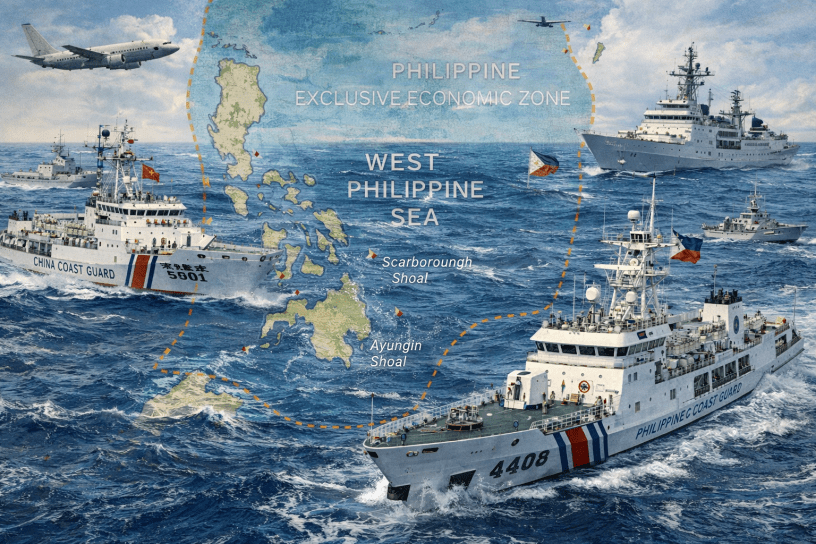
Reed Bank—also known in the Philippines as Recto Bank—lies within the country’s Exclusive Economic Zone under the framework of the United Nations Convention on the Law of the Sea.
However, the area is also encompassed by China’s broader maritime claims in the South China Sea, leading to overlapping assertions of jurisdiction.
The significance of Reed Bank is straightforward: it may contain commercially viable natural gas reserves.
For the Philippines, this is especially important as the aging Malampaya Gas Field declines in production. A new domestic source of gas would help maintain electricity supply for Luzon’s power grid.
For China, the broader South China Sea represents both a strategic maritime zone and a potential energy basin.
Because of those factors, offshore exploration in the West Philippine Sea has periodically become entangled in maritime confrontations and diplomatic disputes.
Why Conflict Would Threaten Energy Development
Offshore energy extraction requires long-term stability.
Gas platforms, subsea pipelines, and support vessels depend on secure sea lanes and predictable operating conditions. Sustained military tension in the surrounding waters would make large-scale development difficult.
In other words, the economic value of these gas resources depends on the very thing regional tensions threaten: stability.
If hostilities were to erupt in the surrounding sea lanes, the infrastructure required for offshore gas extraction would become extremely vulnerable.
That reality places practical limits on the idea that energy development could proceed during a period of sustained maritime confrontation.
The Possibility of Joint Development
Because of these risks, some analysts and policymakers have periodically discussed joint development arrangements.
Such arrangements would not necessarily resolve sovereignty disputes. Instead, they would allow multiple parties to cooperate on resource extraction while leaving legal claims unresolved.
In theory, a cooperative development framework between the Philippines and China could provide several benefits:
- access to natural gas resources
- reduced maritime tensions around exploration vessels
- shared economic returns from offshore development
Similar arrangements have existed elsewhere in the region, although they often require complex negotiations and high levels of political trust.
For now, however, the West Philippine Sea remains an area of sustained maritime pressure and legal dispute.
Geography and Economics in the Same Waters
The waters surrounding the Philippines illustrate a broader reality of Indo-Pacific geopolitics.
In the north, the Bashi Channel represents a strategic maritime corridor that could become critical in any regional military scenario.
In the west, the seabed of the West Philippine Sea holds resources that could shape the future of Philippine energy security.
These two dynamics—strategic geography and economic opportunity—are unfolding in the same maritime space.
How the countries involved choose to manage them will play a significant role in determining whether those waters become an arena of cooperation or continued confrontation.
For more social commentary, please see Occupy 2.5 at https://Occupy25.com
References
Hayton, B. (2014). The South China Sea: The struggle for power in Asia. Yale University Press.
Poling, G. (2020). The South China Sea in focus: Clarifying the limits of maritime dispute. Center for Strategic and International Studies.
United Nations. (1982). United Nations Convention on the Law of the Sea. United Nations.
U.S. Energy Information Administration. (2023). South China Sea energy resources overview. https://www.eia.gov
Discover more from WPS News
Subscribe to get the latest posts sent to your email.
 WPS News