By Cliff Potts, CSO, and Editor-in-Chief of WPS News
Baybay City, Leyte, Philippines — March 14, 2026
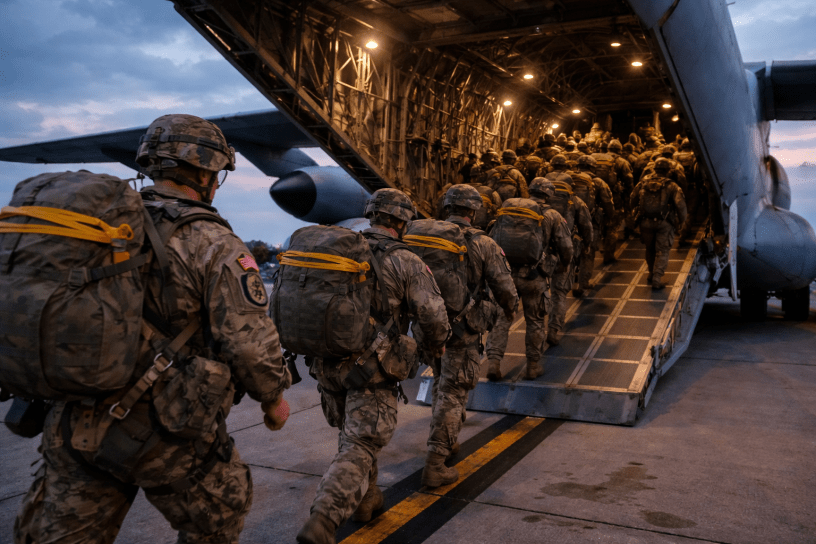
A week of monitoring military readiness signals between March 7 and March 13 has produced a clearer picture of the posture of several U.S. Army rapid-response units. The most visible development was the abrupt cancellation of a training exercise involving elements of the 82nd Airborne Division, a move that immediately sparked speculation about potential deployments tied to global tensions.
Public reporting and official statements during the past week indicate that the cancellation likely reflects a precautionary readiness posture rather than preparations for a confirmed ground operation. No U.S. Army divisions have been formally ordered into combat deployment, and there is no evidence that additional divisions have been mobilized beyond routine readiness levels.
Still, the incident highlights the central role of airborne and expeditionary units in the U.S. Army’s global contingency planning.
A Training Cancellation Triggers Attention
The initial signal emerged when the U.S. Army abruptly canceled a scheduled training exercise involving the headquarters element of the 82nd Airborne Division at Fort Liberty, North Carolina (formerly Fort Bragg). The decision prevented the unit from traveling to Louisiana for the exercise and kept personnel in place at their home station (Washington Post, 2026).
The 82nd Airborne Division serves as one of the U.S. military’s primary rapid-deployment forces, capable of deploying a brigade-sized element anywhere in the world within roughly eighteen hours. Because of that capability, changes in its readiness posture often attract attention from military analysts and international observers.
The cancellation immediately led to speculation that the division could be preparing for deployment in response to rising tensions in the Middle East. However, Pentagon officials have not confirmed any such mission.
No Confirmed Orders for Ground Deployment
Throughout the week following the cancellation, U.S. defense officials maintained that no ground deployment orders had been issued.
Public statements emphasized that the Department of Defense does not routinely discuss potential troop movements for operational security reasons. At the same time, officials noted that keeping certain units in a higher state of readiness during periods of international tension is standard practice (Army Recognition, 2026).
Such readiness shifts allow commanders to respond quickly if a crisis escalates, but they do not necessarily signal that a deployment is imminent.
The Role of the XVIII Airborne Corps
The 82nd Airborne Division operates under the command of the XVIII Airborne Corps, headquartered at Fort Liberty. The corps serves as the U.S. Army’s primary expeditionary headquarters for rapid response operations.
Units typically associated with the corps include the 82nd Airborne Division, the 101st Airborne Division (Air Assault), the 10th Mountain Division, and various corps-level support brigades responsible for artillery, intelligence, communications, and medical operations (U.S. Army, 2025).
Because these units form a cohesive expeditionary structure, analysts often look for simultaneous readiness signals across multiple divisions when attempting to identify preparations for large-scale operations.
During the monitoring period from March 7 through March 13, no comparable readiness signals were reported from other major divisions associated with the corps.
The 101st Airborne and Other Divisions
The 101st Airborne Division, based at Fort Campbell, Kentucky, specializes in air assault operations conducted with helicopters rather than parachute insertion. Historically, the division has often followed airborne units into a theater of operations to reinforce or expand a foothold established by rapid-deployment forces.
Similarly, the 10th Mountain Division has frequently served as a light infantry force capable of rapid deployment into austere environments.
Despite speculation on social media that these units might also be preparing for deployment, no confirmed reports indicate that either division has moved to a higher alert status during the past week.
In addition, there have been no reports of large-scale mobilization activity such as the movement of heavy armor units, large sealift operations from U.S. ports, or the activation of Reserve or National Guard formations—steps that typically accompany preparations for major ground combat operations.
Rapid-Response Forces in Global Crisis Planning
The U.S. military regularly maintains airborne and light infantry units in high readiness to respond to global contingencies. These missions can range from securing embassies and evacuating civilians to reinforcing military bases or seizing key infrastructure such as airfields.
Because these units are structured for rapid movement, even routine readiness adjustments can generate speculation when they occur during periods of geopolitical tension.
However, analysts note that large-scale ground invasions require far more extensive preparations, including the mobilization of multiple divisions, logistical supply chains, and large-scale transportation assets.
None of those indicators were visible during the week of observation.
A Precautionary Posture, Not a Mobilization
Based on available information between March 7 and March 13, the most likely interpretation is that the U.S. Army adjusted the readiness posture of the 82nd Airborne Division as a precaution.
Such measures allow the military to respond quickly if circumstances change but do not necessarily indicate that a specific operation has been approved.
As of March 13, there has been no public confirmation that any U.S. airborne or light infantry divisions have been ordered to deploy for combat operations.
The situation illustrates how routine readiness decisions can draw significant attention when they involve units designed to move quickly anywhere in the world.
For more social commentary, please see Occupy 2.5 at https://Occupy25.com
References
Army Recognition. (2026). U.S. halts 82nd Airborne paratrooper drill to keep rapid deployment force ready amid Iran tensions.
U.S. Army. (2025). XVIII Airborne Corps mission and structure.
Washington Post. (2026). Cancellation of Army exercise fuels speculation about Middle East troop deployments.
Discover more from WPS News
Subscribe to get the latest posts sent to your email.
 WPS News