By Cliff Potts, CSO, and Editor-in-Chief of WPS News
Baybay City, Leyte, Philippines — January 27, 2026
A Story That Only Fails When Taken Literally
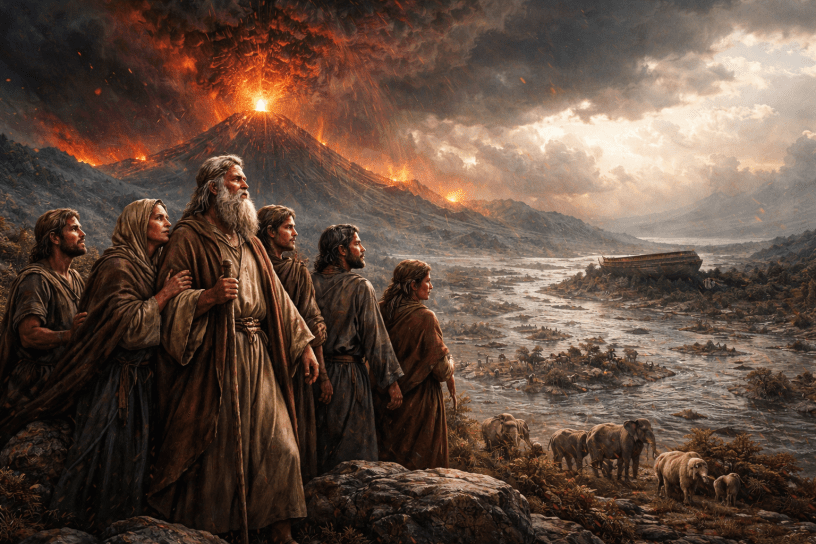
The story of Noah has long been treated as a test of belief: either accept it as literal history or reject it outright. That framing is a mistake. Like many ancient narratives, the Noah story collapses only when it is forced into a modern, literalist mold. When read as metaphor—as ancient audiences would have understood it—it aligns closely with what science now tells us about humanity’s near-extinction events.
Noah is not a logistical plan for restarting civilization. It is a survival story.
Humanity Really Did Nearly Vanish
Genetic and archaeological evidence shows that humanity passed through at least one severe population bottleneck tens of thousands of years ago. One of the strongest candidates is the super-eruption associated with Lake Toba roughly 74,000 years ago.
The eruption likely triggered:
- A volcanic winter
- Global cooling
- Widespread ecosystem collapse
- Massive human population decline, possibly to as few as 10,000–20,000 individuals worldwide
This was not the extinction of humanity—but it was close enough to leave detectable genetic scars that persist today.
Ancient people did not have climate models or genome sequencing. What they had was memory: stories of death, survival, and a world irrevocably changed.
Fire, Water, and Compressed Memory
The Noah narrative emphasizes floodwaters, but that does not disqualify a volcanic origin. Catastrophes unfold in phases. Fire and ash destroy first; flooding follows as climate systems destabilize, ice melts, and rainfall patterns shift.
Ancient storytelling does not separate cause and consequence into neat chapters. Time is compressed. Mechanisms are simplified. What matters is the outcome: almost everything died, and some survived.
Fire becomes water. Ash becomes flood. The story remains.
Why Biology Matters—Even in the Ancient World
The most important reason Noah cannot be literal is not modern genetics. It is ancient husbandry.
Long before Genesis was written, humans understood that close-kin breeding was dangerous. Herding societies knew that inbreeding produced weakness, deformity, and death. This knowledge was practical, observed, and universal.
That understanding is reflected in:
- Near-universal incest taboos
- Obsessive lineage tracking in ancient societies
- Biblical laws themselves, which strictly prohibit close-kin reproduction
A literal Noah scenario—three sons, three wives, no daughters, no outside population—would not repopulate humanity. It would end it within a few generations. Ancient audiences would have known this.
Which tells us something critical: the story was never meant to be read that way.
Noah as a Survival Metaphor
Noah represents a remnant. A carried-forward memory of survival when collapse seemed total.
The ark is not a ship manifest.
The numbers are not census data.
The genealogy is not a breeding plan.
The story’s purpose is theological and cultural: to explain why humanity exists at all after catastrophe, and to frame survival as grace rather than strength.
This is not an attack on the story. It is its proper reading.
Literalism Misses the Point
Insisting on literalism is a modern error imposed on an ancient text. The people who preserved the Noah story already understood breeding limits, environmental collapse, and the fragility of life. They told the story they needed to tell: that humanity nearly disappeared—and did not.
Noah is not history in the modern sense.
It is memory shaped into meaning.
And in that form, it still tells the truth.
References
Ambrose, S. H. (1998). Late Pleistocene human population bottlenecks, volcanic winter, and differentiation of modern humans. Journal of Human Evolution, 34(6), 623–651.
Harpending, H. C., Rogers, A. R., & Sherry, S. T. (1993). Genetic structure and human origins. Annual Review of Anthropology, 22, 87–113.
Tattersall, I. (2012). Masters of the planet: The search for our human origins. Palgrave Macmillan.
Discover more from WPS News
Subscribe to get the latest posts sent to your email.
 WPS News