By Cliff Potts, CSO, and Editor-in-Chief of WPS News
Baybay City, Leyte, Philippines — March 14, 2026
The West Philippine Sea remained tense but relatively controlled during the review window from 12:01 a.m. Philippine time on March 7 to 12:01 a.m. Philippine time on March 13. No single collision or water-cannon clash dominated the week. Instead, the period was defined by a steady pattern of Chinese presence at key Philippine-claimed features, continued pressure on Philippine air and sea monitoring, fallout from the espionage breach tied to resupply operations, and a renewed diplomatic fight over what kind of South China Sea code of conduct ASEAN and China should accept (GMA News, 2026a; Reuters, 2026a; GMA News, 2026b).
Maritime and Air Activity
On March 7, a Philippine Coast Guard maritime domain awareness flight over Bajo de Masinloc encountered a radio challenge from a People’s Liberation Army Navy vessel. Reporting on that patrol said the PCG Cessna Caravan was challenged while Chinese vessels were present near Scarborough Shoal, showing that Beijing’s air-sea pressure campaign at the shoal remained active during the opening day of the review period (ABS-CBN News, 2026).
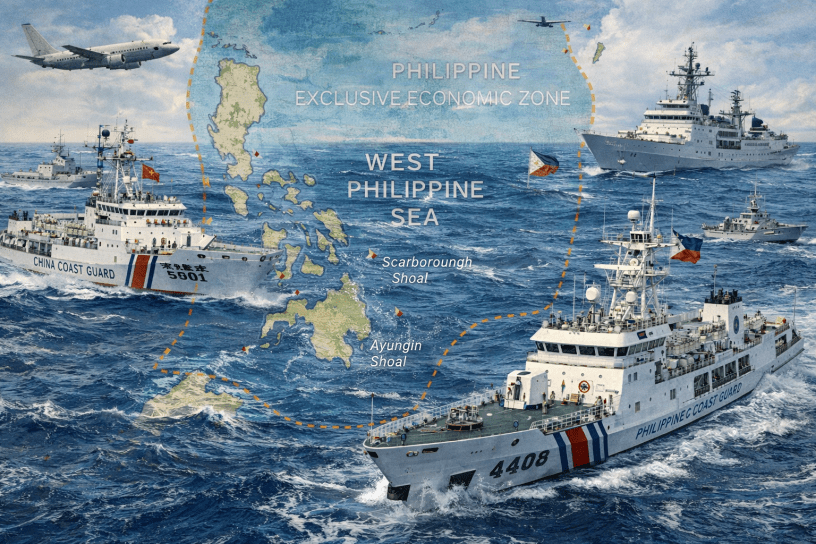
By March 10, the Philippine Navy publicly reported that 30 Chinese ships had been observed in the West Philippine Sea during the March 1 to March 8 monitoring period, which overlapped this review window. The breakdown was 11 vessels at Bajo de Masinloc, eight at Ayungin Shoal, seven at Escoda Shoal, and four near Pag-asa Island. That was slightly lower than the immediately preceding reporting period, but it still represented a sustained Chinese naval and coast guard footprint across four sensitive features rather than any real de-escalation (GMA News, 2026a).
That matters because the week did not show a return to normal maritime traffic. It showed normalized pressure. Bajo de Masinloc remained the heaviest concentration point, while Ayungin, Escoda, and Pag-asa all continued to draw Chinese state vessels. In plain English, the map stayed crowded where Manila can least afford complacency (GMA News, 2026a).
Espionage Fallout and Ayungin Security
The most serious internal development affecting operations was the continuing fallout from the espionage case disclosed just before and during this period. Reuters reported on March 5 that Philippine officials said information about South China Sea resupply missions had been compromised and passed to Chinese intelligence agents. The data reportedly included deployments, resupply runs, and personnel rotations, and the National Security Council described the breach as alarming even while saying its scope was limited and transmission channels had been shut down (Reuters, 2026a).
That story remained operationally relevant throughout the March 7–13 window because the leaked information directly touched Ayungin Shoal resupply activity. Philippine reporting during the week said the resupply schedule to BRP Sierra Madre would continue despite the espionage case, but the breach made clear that the West Philippine Sea problem is no longer only about what China can see from ships or aircraft. It is also about what it can learn from penetrated networks, compromised contacts, and underpaid insiders on land (PNA, 2026a; Reuters, 2026a).
This was not theater. Rotation and resupply information is operational security. If an outside power knows when a mission is sailing, who is aboard, and what route or timing is likely, then harassment at sea becomes easier to stage and more dangerous to survive. The week therefore linked internal security and maritime security in a way Philippine officials can no longer treat as separate problems (Reuters, 2026a).
Diplomatic and Legal Developments
On March 11, Manila sharpened its legal position on the proposed South China Sea code of conduct. The Department of Foreign Affairs said any code being negotiated between ASEAN and China must be “effective, substantive, and legally binding,” consistent with international law and particularly UNCLOS, and must not diminish the rights and interests of third-party states. That was a direct answer to Beijing’s longstanding preference for a regional arrangement that sidelines outside powers, especially the United States and allied partners (GMA News, 2026b).
The Philippine position during the week was not merely procedural. It was strategic. Manila was signaling that a bad code of conduct would be worse than no code at all. A document that softens UNCLOS, ignores the 2016 arbitral ruling, or limits lawful cooperation with third states would amount to a diplomatic trap, not a peace mechanism (GMA News, 2026b; Reuters, 2026b).
This legal fight also sat inside the Philippines’ broader ASEAN chairmanship posture. Earlier official and diplomatic statements carried into this week showed Manila pushing for a rules-based, legally grounded outcome rather than a vague political compromise. In practice, that means the Philippines is trying to keep the South China Sea from being rewritten into a China-managed sphere with ASEAN signatures attached (Reuters, 2026b; West Philippine Sea Transparency Office, 2026).
Weather and Sea Conditions
Weather during the period did not produce a major tropical cyclone crisis in the West Philippine Sea. Instead, the operating environment was shaped by the northeast monsoon. PAGASA’s Gale Warning No. 3, issued on March 7, warned of strong to gale-force winds affecting extreme northern Luzon and the western seaboard of northern Luzon, with rough to very rough seas and wave heights of 2.8 to 4.5 meters in those sectors. For mariners, that meant risky sea travel for small craft and a more difficult operating picture on the northern approaches of the broader western seaboard (PAGASA, 2026a).
A second climate marker arrived on March 9, when PAGASA issued its final La Niña advisory and declared a return to ENSO-neutral conditions. That did not mean calm weather everywhere. PAGASA explicitly warned that other systems could still bring heavy rain and related hazards. But it did mean the country moved out of the formal La Niña phase during the review week, changing the larger climate backdrop against which late first-quarter maritime operations were unfolding (PAGASA, 2026b).
PAGASA’s 10-day regional agri-weather outlook also indicated generally northeasterly winds over the archipelago, with moderate to rough seas on the eastern seaboards and slight to moderate conditions elsewhere for much of the forecast period. For the West Philippine Sea, that suggests no broad weather-driven shutdown of operations during the week, though localized conditions in the north remained more hazardous (PAGASA, 2026c).
Seismographic Activity
Seismographically, the review window did not produce a major West Philippine Sea earthquake event, but PHIVOLCS listings showed minor tectonic activity along the Philippines’ western flank. A magnitude 2.0 earthquake was recorded off Zambales on March 8, while small events were also listed near Abra de Ilog, Occidental Mindoro on March 10 and off Looc, Occidental Mindoro on March 12. PHIVOLCS also logged a felt Occidental Mindoro event on March 12 with reported Intensity I in Santa Cruz and Calapan, indicating light but noticeable movement in the western island arc facing the disputed waters (PHIVOLCS, 2026a; PHIVOLCS, 2026b; PHIVOLCS, 2026c; PHIVOLCS, 2026d).
None of these appear to have had major operational consequences for the West Philippine Sea during the week. Still, they are part of the physical record. A serious review of the area should note that the maritime contest sits beside active tectonic terrain, not in some abstract strategic vacuum (PHIVOLCS, 2026a; PHIVOLCS, 2026b; PHIVOLCS, 2026c; PHIVOLCS, 2026d).
What the Week Actually Shows
Taken together, the week showed a familiar but important pattern. Chinese maritime presence remained distributed across multiple flashpoints. Philippine patrols and monitoring flights continued, but under challenge. The espionage case revealed that the contest is not only playing out on the water but also through intelligence penetration. Diplomatically, Manila kept insisting that law, not coercion, must frame any future code of conduct. Weather was manageable overall but rough in the north, and seismographic activity stayed minor along the western edge of the archipelago (GMA News, 2026a; ABS-CBN News, 2026; Reuters, 2026a; GMA News, 2026b; PAGASA, 2026a; PAGASA, 2026b; PHIVOLCS, 2026a).
That is the blunt truth of the week: no decisive break, no real easing, and no reason for false comfort. The pressure never really stopped. It simply spread itself across ships, aircraft, diplomacy, intelligence, and the daily burden of maintaining a presence in waters the Philippines already has every legal right to use (GMA News, 2026a; Reuters, 2026b).
For more social commentary, please see Occupy 2.5 at https://Occupy25.com
References
ABS-CBN News. (2026, March 7). PCG aircraft challenged by Chinese Navy vessel during patrol over Scarborough Shoal.
GMA News. (2026a, March 10). 30 Chinese ships spotted in WPS in early March — PH Navy.
GMA News. (2026b, March 11). Code of Conduct shouldn’t diminish rights, interests of 3rd party states — DFA.
PAGASA. (2026a, March 7). Gale Warning No. 3.
PAGASA. (2026b, March 9). La Niña final advisory.
PAGASA. (2026c, March 2026). 10-day regional agri-weather information.
PHIVOLCS. (2026a, March 8). Earthquake information: Zambales event, 08 March 2026, 09:21 AM.
PHIVOLCS. (2026b, March 10). Earthquake information: Occidental Mindoro event, 10 March 2026, 11:17 PM.
PHIVOLCS. (2026c, March 12). Earthquake information: Occidental Mindoro event, 12 March 2026, 02:00 AM.
PHIVOLCS. (2026d, March 12). Earthquake information: Occidental Mindoro felt event, 12 March 2026, 11:46 AM.
Philippine News Agency. (2026a, March 7). Resupply missions in WPS to continue despite spying.
Reuters. (2026a, March 5). Philippine resupply mission data leaked to Chinese intelligence, security official says.
Reuters. (2026b, January 22). Philippines will insist South China Sea code is based on international law, foreign minister says.
West Philippine Sea Transparency Office. (2026, March 1). NSC press release: Sec. Año reaffirms transparency as cornerstone of Philippine strategy in the West Philippine Sea.
Discover more from WPS News
Subscribe to get the latest posts sent to your email.
 WPS News