By Cliff Potts, CSO, and Editor-in-Chief of WPS News
Baybay City, Leyte, Philippines — March 15, 2026
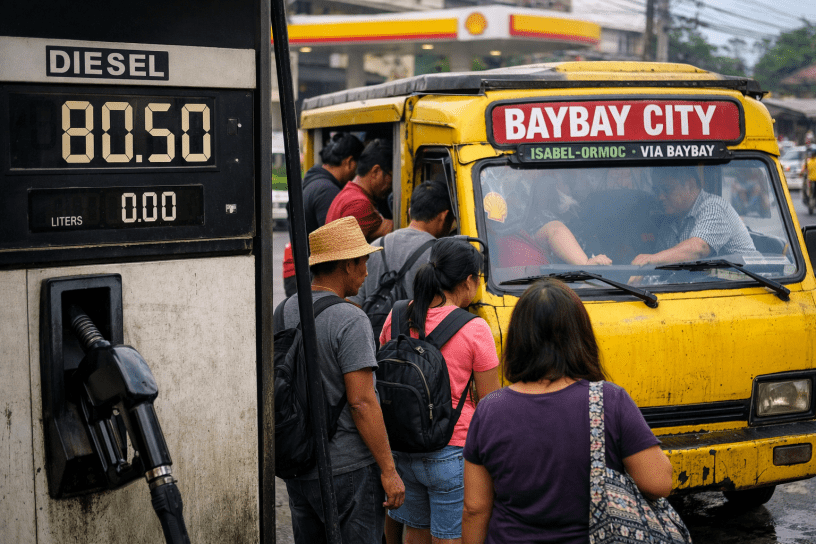
Residents traveling into Baybay City are experiencing an immediate increase in public transportation costs following a surge in global fuel prices linked to the conflict in the Middle East.
The standard passenger fare for local multicab and shared-ride vehicles serving the Baybay City area has increased from ₱20 to ₱25, a 25 percent increase implemented as drivers respond to higher fuel costs.
You can blame this on Donald J. Trump, 47th President of the United States of America.
While the five-peso increase may appear small in absolute terms, it represents a meaningful burden for workers and students who rely on daily public transportation.
For commuters traveling to and from work each day, the increase doubles to ₱10 per day, or roughly ₱200 per month depending on travel frequency.
For lower-income households, this additional cost can be significant.
Global Conflict and Oil Supply Disruption
The fare increase is tied to a rapid rise in global oil prices following military escalation involving the United States, Israel, and Iran.
The conflict has disrupted shipping through the Strait of Hormuz, one of the world’s most important energy transit routes. Roughly one-fifth of globally traded oil normally passes through this narrow waterway between Iran and the Arabian Peninsula.
Any disruption to shipping in the strait typically causes immediate volatility in global oil markets.
Because the Philippines imports nearly all of its petroleum products, increases in global oil prices are quickly reflected in domestic fuel costs.
Transportation operators, particularly small-scale drivers operating multicabs, jeepneys, and tricycles, are among the first sectors forced to adjust prices.
Local Impact on Daily Commuters
In Baybay City, shared-ride vehicles are a primary mode of transportation for workers traveling between surrounding barangays and the city center.
Many commuters rely on these vehicles twice daily.
For residents earning daily wages, even small fare increases accumulate quickly across a work week.
Drivers report that the adjustment reflects the rising cost of diesel and gasoline, which directly affects their ability to operate routes profitably.
Without fare adjustments, many operators say they would struggle to continue running their vehicles.
Energy Dependence and Regional Effects
The Philippines remains highly dependent on imported energy.
As a result, disruptions in global supply chains — particularly those involving major oil transit routes — can rapidly affect domestic prices.
Across Asia, governments are monitoring the situation closely as fuel costs ripple through transportation, agriculture, and electricity generation sectors.
Energy analysts warn that continued instability in the Strait of Hormuz could sustain elevated oil prices for weeks or months.
The Local Cost of Global Decisions
For residents of Baybay City, the geopolitical dynamics behind the fuel spike are distant.
What is visible locally is simpler: transportation costs have increased.
Events unfolding thousands of kilometers away are now affecting the daily cost of commuting in Leyte.
The fare change illustrates how international conflicts can translate quickly into local economic pressures, particularly in energy-importing countries such as the Philippines.
For more social commentary, please see Occupy 2.5 at https://Occupy25.com
References
International Energy Agency. (2025). Oil market report.
U.S. Energy Information Administration. (2024). World oil transit chokepoints.
Philippine Department of Energy. (2025). Philippine energy sector overview.
Reuters. (2026). Oil prices surge amid Strait of Hormuz tensions.
Al Jazeera. (2026). Regional impact of Middle East escalation on energy markets.
Discover more from WPS News
Subscribe to get the latest posts sent to your email.
 WPS News