By Cliff Potts, CSO, and Editor-in-Chief of WPS News
Baybay City, Leyte, Philippines — March 16, 2026
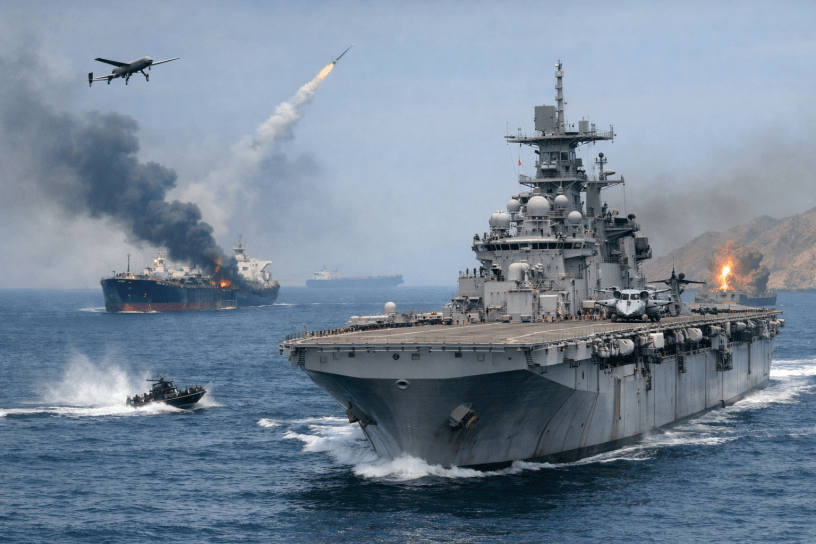
At least a dozen commercial vessels have been attacked in and around the Strait of Hormuz since late February, with multiple ships damaged, several sailors killed, and at least one support vessel sunk during rescue operations.
The attacks—carried out using drones, missiles, and explosive boats—have sharply reduced tanker traffic through one of the world’s most critical energy chokepoints and triggered a U.S. military deployment intended to stabilize maritime security in the region (Windward, 2026).
In response, the United States has ordered a Marine Expeditionary Unit to deploy aboard the amphibious assault ship USS Tripoli as part of a broader effort to secure international shipping lanes and deter further attacks on commercial vessels.
Shipping Attacks Escalate in the Gulf
Open-source maritime intelligence reports indicate that at least sixteen vessels have been attacked since the current crisis began in late February.
Several tankers were struck by drone boats or missiles while transiting the Persian Gulf or the approaches to the Strait of Hormuz. In one case, a tanker was hit by a projectile that killed two crew members. In another incident, an explosive drone boat reportedly struck a vessel’s engine room, killing a sailor and setting the ship on fire (Windward, 2026).
A tugboat assisting a damaged tanker was later hit by missiles and sank, with crew members reported missing.
Other ships suffered fires, hull damage, or propulsion failures after attacks by unmanned boats or aerial drones. While some vessels were able to reach port under their own power, others required rescue or towing.
The cumulative effect has been a sharp decline in commercial traffic through the strait, as shipping companies reassess the risks of entering a region increasingly treated as an active combat zone by maritime insurers.
Why the Strait of Hormuz Matters
The Strait of Hormuz connects the Persian Gulf to the Gulf of Oman and the Arabian Sea. Roughly one-fifth of the world’s oil supply normally passes through the narrow waterway.
Even temporary disruption can ripple through global energy markets. Reduced tanker traffic increases insurance costs, delays shipments, and forces some oil exports to reroute through longer pipelines or alternate ports (International Energy Agency, 2024).
For energy-importing countries across Asia—including the Philippines—the consequences can appear quickly in the form of higher fuel prices and rising shipping costs.
In practical terms, instability in the Strait of Hormuz can travel thousands of kilometers before appearing in the price of gasoline, diesel, or electricity in Southeast Asian economies.
U.S. Marine Deployment
The U.S. response includes the movement of a Marine Expeditionary Unit aboard the USS Tripoli (LHA-7), an America-class amphibious assault ship designed to deploy Marines, helicopters, tilt-rotor aircraft, and short-takeoff F-35B fighter jets.
Marine Expeditionary Units typically consist of roughly 2,200 personnel and are designed for rapid response missions at sea and along coastal regions.
Their doctrinal mission sets include ship boarding operations, protection of maritime infrastructure, seizure of coastal facilities, limited amphibious raids, and evacuation of civilians from unstable regions (U.S. Marine Corps, 2023).
Defense officials have not publicly identified specific operational targets connected to the deployment.
Coalition Naval Activity
Washington has also called on allied nations to contribute naval forces to escort commercial vessels through the Strait of Hormuz. Several governments, including those in Europe and Asia, are evaluating whether to participate in a multinational escort effort (Reuters, 2026).
Such convoy operations were used during earlier Gulf conflicts to protect tanker traffic from missile and mine attacks.
Military planners note that stabilizing shipping in the strait may require a combination of naval escorts, surveillance aircraft, and mine countermeasure operations.
Historical Resonance of the Name Tripoli
The name of the deploying ship carries historical significance within U.S. naval and Marine Corps tradition.
The USS Tripoli takes its name from the early nineteenth-century conflict between the United States and the Barbary State of Tripoli in North Africa. During the First Barbary War (1801–1805), U.S. Marines and allied forces captured the city of Derna in present-day Libya during a campaign that later entered Marine Corps tradition (Boot, 2002).
The event is memorialized in the opening line of the Marine Corps hymn: “From the halls of Montezuma to the shores of Tripoli.”
While the name does not determine operational planning, it carries symbolic resonance among U.S. military audiences familiar with that history.
A Maritime Crisis With Global Consequences
The attacks in the Strait of Hormuz illustrate how quickly localized conflict can disrupt global trade networks.
For countries thousands of kilometers away—including the Philippines—the effects are often indirect but immediate: higher energy prices, shipping delays, and increased volatility in global commodity markets.
Naval deployments such as the current Marine expeditionary force represent attempts by major powers to keep critical trade routes open before disruption spreads further into the global economy.
For more social commentary, please see Occupy 2.5 at https://Occupy25.com
This article will be added to the WPS News printed archive series available through Amazon.
References
Boot, M. (2002). The savage wars of peace: Small wars and the rise of American power. Basic Books.
International Energy Agency. (2024). Oil market report: Strategic maritime chokepoints and global energy flows. Paris: IEA.
Reuters. (2026, March 14). Trump says many countries will send warships to keep Strait of Hormuz open. Reuters.
U.S. Marine Corps. (2023). Marine Expeditionary Unit (MEU) operations and doctrine overview. Washington, DC: Department of the Navy.
Windward. (2026, March 12). Maritime intelligence daily: Escalating vessel attacks in the Strait of Hormuz. Windward Maritime Analytics.
Discover more from WPS News
Subscribe to get the latest posts sent to your email.
 WPS News