The American Civil War: Civic Life Series (Part 3 of 18)
By Cliff Potts, CSO, and Editor-in-Chief of WPS News
Baybay City, Leyte, Philippines
March 17, 2026
When the men left, there was no ceremony in most towns. No bands. No speeches. There was simply absence.
Some departures were hurried. Others were delayed by indecision, paperwork, or family pleading. But once they happened, they happened all at once. Fields emptied. Workshops went quiet. Desks remained unused. The labor that had quietly sustained daily life vanished with little warning.
And then—life continued.
The Immediate Vacuum
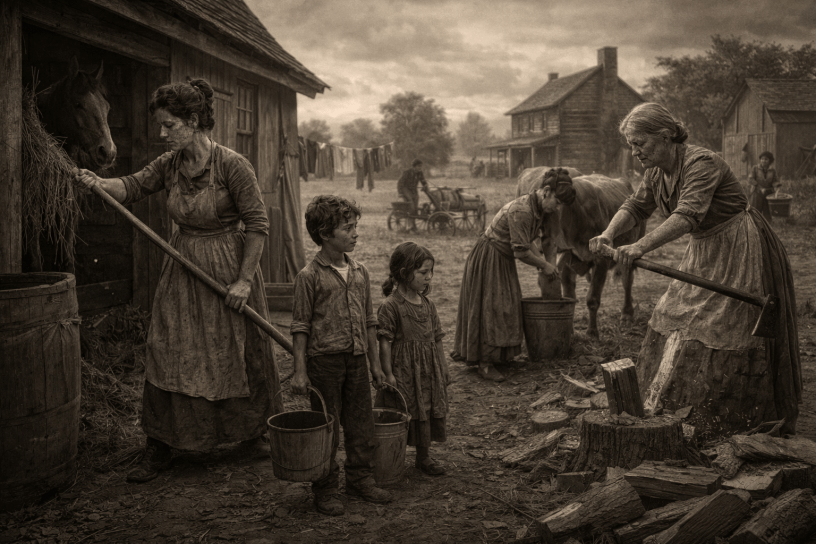
The departure of men did not produce instant collapse. What it produced was a vacuum that women, children, and the elderly were forced to fill. Farms still needed planting. Shops still needed tending. Debts still came due. Animals still needed feeding. The calendar did not pause to acknowledge sacrifice.
In letters from 1861 and 1862, women often remarked on how quickly necessity replaced shock. One week was spent worrying over enlistment. The next was spent learning to manage accounts, repair equipment, or negotiate with merchants who no longer extended the same courtesies.
The work did not change. The hands doing it did.
Women as the Civic Backbone
As men disappeared from towns and counties, women became the backbone of local economies. They ran farms, managed stores, oversaw hired labor, and made financial decisions that had previously belonged to husbands, fathers, or brothers.
This shift was not framed as empowerment at the time. It was framed as survival.
Diaries describe exhaustion more often than pride. Women wrote of days that began before dawn and ended well after dark. They learned new skills quickly because there was no alternative. Failure meant hunger, debt, or displacement.
What changed was not just who worked, but who decided.
Children Growing Up Early
Children, too, were pulled into adult roles. Older boys took on physical labor earlier than expected. Girls assumed caregiving and domestic responsibilities that reshaped their education and prospects.
School attendance declined in many regions. Childhood narrowed. Play gave way to production. Families that had once planned futures measured in years began planning in weeks.
This was one of the war’s quiet costs: not just lives lost, but childhoods shortened.
The Emotional Ledger
Absence was not only practical; it was emotional. Homes carried a constant undertone of worry. News traveled slowly. Silence stretched for months. Every knock at the door carried the possibility of catastrophe.
People adapted to this uncertainty the way they adapted to labor shortages—by normalizing it. Anxiety became background noise. Grief, when it came, was folded into routine because routine was the only thing holding households together.
The men were gone. The fear stayed.
Communities Redefined
With so many men absent, communities reorganized themselves. Women formed informal networks to share labor and information. Neighbors depended on one another in ways that would have seemed intrusive before the war.
At the same time, these new arrangements were fragile. Disagreements carried higher stakes. There were fewer buffers against conflict. A single illness or crop failure could destabilize an entire household.
Resilience existed, but it was thin.
What Didn’t Stop
Markets reopened after departures. Churches continued to meet. Courts convened. Mail routes resumed. The machinery of civic life kept moving, powered by people who had no choice but to keep it moving.
This continuity created a dangerous illusion for outsiders: that the war had not fundamentally altered society. In reality, the alteration was everywhere—embedded in who worked, who decided, who waited, and who worried.
The war had entered daily life not as spectacle, but as obligation.
Looking Back
The Civil War is often remembered for the moment men left to fight. Less attention is paid to what followed immediately after: the realization that the world did not stop to mourn their absence.
That realization forced a generation to adapt faster than it was prepared to. It redrew roles, accelerated responsibility, and hardened expectations. The cost was paid quietly, in kitchens and fields and ledgers, long before it was counted in cemeteries.
This is the third truth of civic breakdown: when large numbers leave at once, the burden does not disappear. It redistributes. And those who remain carry it forward—not heroically, but because life demands it.
Life did not stop when the men left.
It simply became heavier.
McPherson, J. M. (1988). Battle cry of freedom: The Civil War era. Oxford University Press.
Faust, D. G. (1996). Mothers of invention: Women of the slaveholding South in the American Civil War. University of North Carolina Press.
Mitchell, R. B. (2007). The vacated chair: The northern soldier leaves home. Oxford University Press.
McCurry, S. (2010). Confederate reckoning: Power and politics in the Civil War South. Harvard University Press.
Library of Congress. (n.d.). Civil War diaries and letters. Manuscript Division. https://www.loc.gov/collections/civil-war
Library of Congress. (n.d.). Chronicling America: Historic American newspapers. https://chroniclingamerica.loc.gov
Discover more from WPS News
Subscribe to get the latest posts sent to your email.
 WPS News