By Cliff Potts, CSO, and Editor-in-Chief of WPS News
Baybay City, Leyte, Philippines — March 24, 2026
Summary
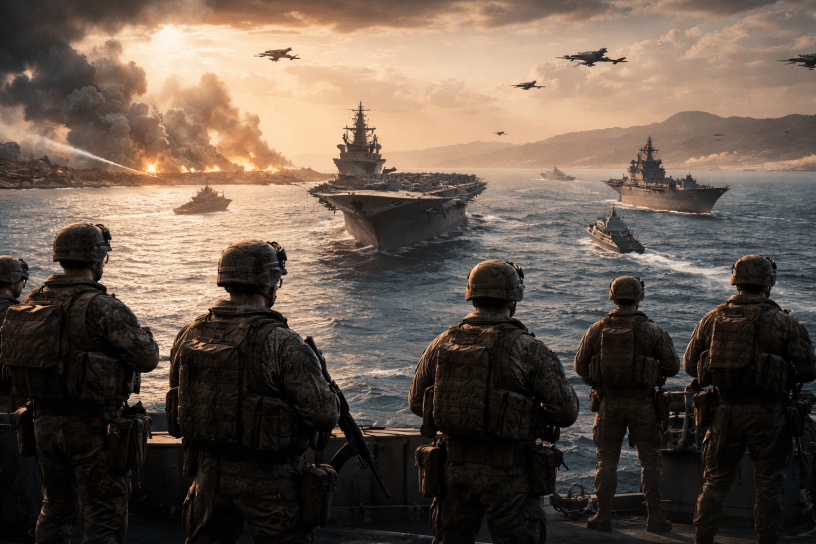
The United States is increasing its military presence in and around the Strait of Hormuz as tensions with Iran move from indirect confrontation toward open conflict conditions. Naval deployments, Marine positioning, and ongoing airstrikes indicate preparation for a sustained operation rather than a limited strike.
U.S. Troop and Asset Movements
Recent reporting indicates that the United States has deployed approximately 2,000 to 4,500 Marines to the region as a contingency force. These units are supported by expanded air power, including strike aircraft and regional base reinforcements.
The amphibious assault ship USS Tripoli is currently en route to the Strait of Hormuz. The vessel carries Marine expeditionary forces, F-35B aircraft, and amphibious assault capability, positioning it for potential coastal operations if required.
Additional naval assets, including carrier strike groups and littoral combat ships, are being positioned to support operations in confined maritime environments.
Naval Operations in the Strait of Hormuz
The Strait of Hormuz remains a critical global shipping chokepoint, and current operations are focused on maintaining access through the waterway.
U.S. actions include:
- Airstrikes targeting missile and coastal defense systems
- Preparations for escort operations for commercial shipping
- Increased naval patrol presence in the Strait
Iranian forces are responding with asymmetric tactics, including:
- Naval mines
- Fast attack craft
- Mobile missile systems
- Drone surveillance and strike capability
The confined geography of the Strait increases the risk of rapid escalation and limits response time for both sides.
Operational Assessment
Current conditions indicate that the situation remains contested. While U.S. forces have degraded portions of Iran’s naval and missile capabilities, Iran retains the ability to disrupt shipping operations in the Strait.
The deployment of amphibious forces suggests that planners are preparing for scenarios that may extend beyond maritime security into coastal or infrastructure-focused operations.
Strategic Context
The current buildup reflects a familiar pattern seen in previous U.S. interventions: initial limited objectives supported by increasing force commitments over time.
Military analysts note that reopening and securing the Strait could require sustained operations, potentially including actions along Iran’s coastline. Such developments would significantly expand the scope of the conflict.
Outlook
The situation remains fluid. The United States has not formally announced a ground operation, but current force positioning indicates that such an option is under active consideration.
The immediate objective appears to be securing maritime transit through the Strait of Hormuz. However, the scale and composition of deployed forces suggest preparation for a broader range of contingencies.
For more social commentary, please see Occupy 2.5 at https://Occupy25.com
If you read this and it matters, help me keep it going: https://www.patreon.com/cw/WPSNews
This article will be archived as part of the WPS News Monthly Brief Series and preserved for long-term public access.
References
U.S. Department of Defense statements and regional reporting (March 2026)
Reuters, The Guardian, Washington Post, Le Monde (March 2026)
Discover more from WPS News
Subscribe to get the latest posts sent to your email.
 WPS News