By Cliff Potts, CSO, and Editor-in-Chief of WPS News
Rice production often focuses on visible factors such as weather, fertilizer prices, or irrigation systems. Less attention is paid to seed quality, even though it quietly shapes everything that follows. Seed choice does not guarantee a good harvest, but poor seed quality almost guarantees uneven results.
Seed is the starting point of the rice system. Problems that begin at planting cannot be fully corrected later, no matter how much effort is applied.
What Seed Quality Actually Means
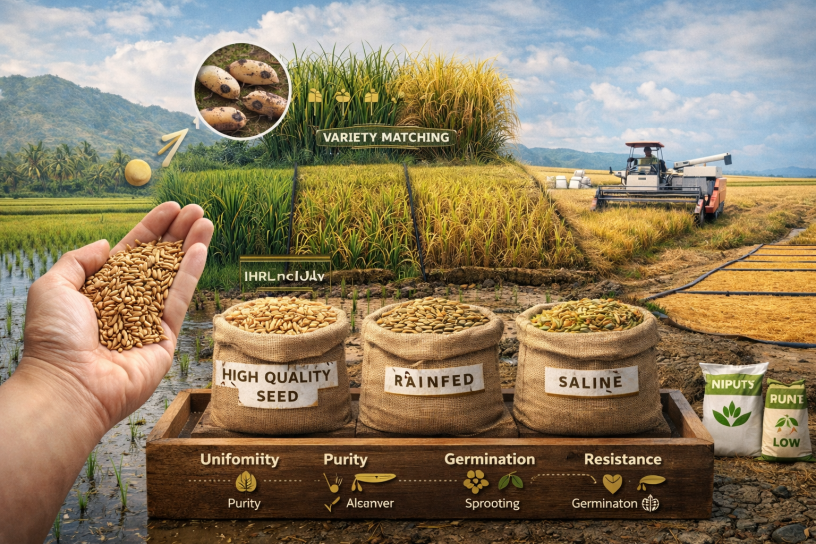
Seed quality is not just about whether seed will sprout. It includes purity, uniformity, germination rate, and resistance to common pests and diseases. High-quality seed produces plants that emerge at the same time, grow at similar rates, and mature together. This uniformity makes water management, fertilizer timing, and harvesting more efficient.
Low-quality or mixed seed leads to uneven growth. Some plants mature early, others late. This forces farmers to compromise on harvest timing, which reduces total yield and increases losses.
Variety Matching Matters
No rice variety performs best everywhere. Varieties are developed for specific conditions such as irrigated lowlands, rainfed areas, flood-prone fields, or saline soils. When seed is poorly matched to local conditions, yields suffer even if management is good.
Using the right variety for the right environment reduces risk. It allows farmers to work with local conditions instead of constantly reacting to them.
Uniform Growth Lowers Costs
Uniform crops reduce labor and machinery costs. Harvesting is faster when plants mature together. Drying is more efficient when grain moisture levels are consistent. Milling quality improves when grain size and hardness are uniform. These cost savings are small at the field level but significant when multiplied across a region.
Seed Systems Affect Supply Stability
When farmers save seed year after year without proper selection, seed quality gradually declines. Germination rates drop, disease pressure increases, and yields slowly fall. Reliable access to quality seed helps stabilize production from season to season, reducing sudden drops in supply that can drive price spikes.
Why Seed Is a System Issue
Seed quality is not just a farmer decision. It depends on distribution systems, timing of availability, and trust in supply channels. When quality seed is late, unavailable, or inconsistent, farmers are forced to plant whatever they can obtain.
Improving seed systems does not require dramatic innovation. It requires consistency, local suitability, and reliable delivery. When seed quality improves, the rest of the rice system has a stronger foundation to build on.
Discover more from WPS News
Subscribe to get the latest posts sent to your email.
 WPS News