By Cliff Potts, CSO, and Editor-in-Chief of WPS News
Baybay City, Leyte, Philippines — April 6, 2026, 21:05
A Second Chance at the Future
In December 1972, humanity stepped off the Moon and did not return. Not because it could not, but because it chose not to. The justification at the time—budget constraints, shifting priorities, and the end of the Cold War space race—was presented as necessity. In reality, it was a decision (Logsdon, 2010; NASA, 2013).
We had the capability. We had the knowledge. What we lacked was the will to continue.
More than fifty years later, the Artemis program represents something far more significant than a return to the Moon. It represents a second chance to do what should have been done the first time: build a sustained human presence beyond Earth and treat the Moon not as a destination, but as a foundation (NASA, 2024a).
What Artemis Is Doing Right Now
As of April 3, 2026, NASA and its international partners are continuing preparations for the next phase of Artemis, focusing on integrated system testing, crew readiness, and hardware validation following the success of earlier missions. The program remains in the critical transition phase between proving capability and executing sustained crewed operations, with timelines centered on upcoming lunar missions (NASA, 2024a; ESA, 2023).
From Apollo to Artemis
Apollo proved we could reach the Moon. That was its mission, and it succeeded (NASA, 2013).
But Apollo was never designed to stay.
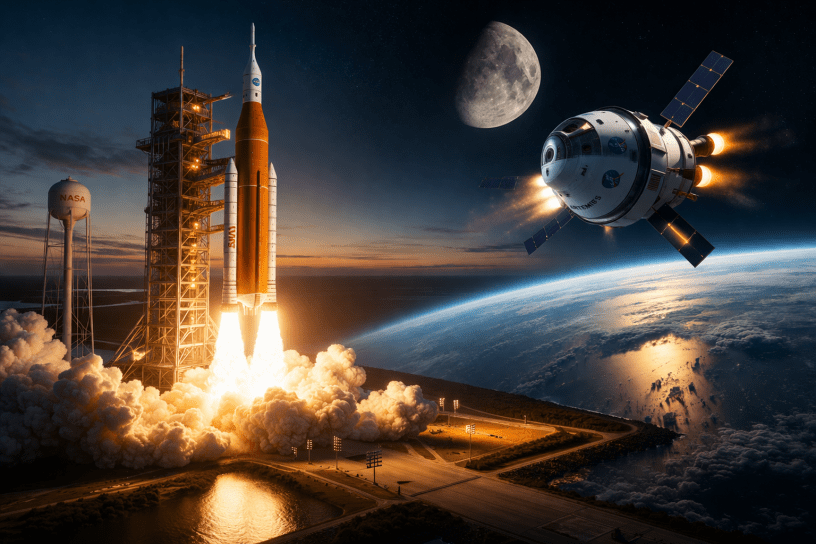
Artemis is different. It is structured not as a series of isolated missions, but as an architecture: the Space Launch System for heavy lift, the Orion spacecraft for deep space crew transport, the Lunar Gateway for sustained orbital presence, and surface systems designed for repeated use and expansion (NASA, 2024a; NASA, 2024b).
This is not a race. It is a framework.
And that distinction matters.
The Future We Almost Had
Had the United States continued its lunar program after Apollo, the timeline is not difficult to imagine. By the 1980s, rotating missions could have supported semi-permanent outposts. By the 1990s, continuous human presence would have been achievable. By the early 21st century, the Moon could have become a hub for research, engineering, and long-duration human habitation (NASA, 1989; Logsdon, 2010).
Not cities. Not self-sufficient colonies.
But real, working environments where people lived, conducted science, built systems, and expanded human capability beyond Earth.
That future was within reach.
It was not taken.
What Was Lost
The end of Apollo did not just delay progress—it broke momentum.
Large-scale programs depend on continuity. Skills degrade, infrastructure disappears, and knowledge fragments. When the United States walked away from the Moon, it did not pause its progress; it dismantled it (Logsdon, 2010; McDougall, 1985).
In the decades since, the nation has spent vast resources elsewhere—on military operations, geopolitical positioning, and short-term priorities. Some of those investments improved lives. Many did not. None replaced what was lost when humanity abandoned its first foothold beyond Earth (Stiglitz & Bilmes, 2008).
Artemis is not a continuation of Apollo.
It is a reconstruction.
A New Generation, A New Perspective
For the first time in decades, a new generation is being introduced to the idea that living and working on another world is not fantasy—it is a plan.
This matters.
Because the greatest barrier to long-term exploration is not technology. It is belief. Apollo created belief, briefly. Then it was allowed to fade (Chaikin, 1994).
Artemis has the opportunity to restore it.
The Stakes This Time
The question is no longer whether we can return to the Moon.
We can.
The question is whether we will do anything with that return.
If Artemis becomes another demonstration—another flag-and-footprints program—then it will repeat the same mistake that ended Apollo. A short-term success followed by long-term abandonment.
If, however, Artemis becomes a sustained effort—one that builds infrastructure, maintains presence, and expands capability—then it changes everything.
The Moon becomes a testing ground for deep-space systems, a platform for long-duration human habitation, and a stepping stone to Mars and beyond (NASA, 2024a; ESA, 2023).
This is not about prestige. It is about trajectory.
The Choice We Face
The failure of the Apollo era was not technological. It was not economic. It was a failure of commitment.
That failure does not have to be repeated.
But avoiding it will require something that has historically been in short supply: sustained political will over decades, not years. It will require leadership willing to invest in outcomes that extend beyond immediate returns. It will require treating space not as a project, but as a domain of human activity (Logsdon, 2010).
The tools now exist. The partners now exist. The knowledge, rebuilt at great cost, now exists again.
What remains uncertain is the decision.
The Artemis Promise
Artemis is not just a program.
It is a test.
A test of whether humanity—starting with those who have the capability—can finally move beyond short-term thinking and commit to a future that extends beyond a single planet.
We stood at that threshold once before.
We turned back.
This time, we know exactly what walking away costs.
The question is whether we will make the same choice again.
If this work helps you understand what’s happening, help me keep it going: https://www.patreon.com/cw/WPSNews
This essay is written by Cliff Potts, Editor-in-Chief of WPS News. WPS News has been active in one form or another on the internet since 2009; for more information, visit https://cliffpotts.org
References (APA)
Chaikin, A. (1994). A Man on the Moon: The Voyages of the Apollo Astronauts. Viking.
European Space Agency. (2023). Gateway: Humanity’s first space station around the Moon. https://www.esa.int
Logsdon, J. M. (2010). John F. Kennedy and the Race to the Moon. Palgrave Macmillan.
McDougall, W. A. (1985). …The Heavens and the Earth: A Political History of the Space Age. Basic Books.
National Aeronautics and Space Administration. (1989). Report of the 90-Day Study on Human Exploration of the Moon and Mars. NASA.
National Aeronautics and Space Administration. (2013). Apollo Program Summary Report. NASA SP-368.
National Aeronautics and Space Administration. (2024a). Artemis Plan: NASA’s Lunar Exploration Program Overview. https://www.nasa.gov
National Aeronautics and Space Administration. (2024b). Space Launch System Overview. https://www.nasa.gov
Stiglitz, J. E., & Bilmes, L. J. (2008). The Three Trillion Dollar War. W.W. Norton.
U.S. Congress. (1973). NASA Authorization and Appropriations Records. U.S. Government Printing Office.
Discover more from WPS News
Subscribe to get the latest posts sent to your email.
 WPS News