Why Survival Depends on Cooperation, Not Individualism
By Cliff Potts, CSO, and Editor-in-Chief of WPS News
Baybay City, Leyte, Philippines — April 6, 2026
The Lone Wolf Myth
Popular culture loves the lone survivor.
From The Walking Dead to Z Nation and even World War Z, the message repeats itself: when everything falls apart, the person who makes it is the one who stands alone, trusts no one, and survives through toughness, instinct, and force.
It is a compelling story.
It is also wrong.
The Myth
The lone wolf myth says that survival depends on independence. It assumes that other people are a liability, that trust is dangerous, and that strength comes from isolation.
In these stories, groups fail. Communities collapse. Cooperation leads to betrayal. The only safe path is to go it alone.
This idea is not just fiction. It has become a belief system.
Why People Believe It
The myth works because it feels simple and empowering.
If survival depends only on the individual, then the solution is clear: be stronger, be smarter, be more prepared than everyone else. You do not need systems, institutions, or even other people. You just need yourself.
It also reflects a deeper cultural bias, especially in American thinking, toward individualism. The idea of the self-made survivor fits neatly into the broader belief that success—or survival—is earned alone.
But reality does not work that way.
Why It Fails in Reality
No one survives alone for long.
Even the most basic needs—clean water, food, shelter, medical care—require more than one person to sustain over time. A single injury, a single mistake, or a single gap in knowledge can end everything.
The lone wolf model also ignores something fundamental: human beings are not designed to operate in isolation. We are a social species. Our strength has always come from coordination, not separation.
History makes this clear.
During World War II, survival was not achieved by individuals acting alone. It was achieved through massive coordination—factories, logistics networks, medical systems, communication chains, and millions of people performing specialized roles.
No one won that war alone.
The same pattern appears in modern disasters. In the aftermath of Hurricane Katrina, survival often depended on who had access to functioning networks—neighbors, local organizations, and shared resources—not who had the most individual strength.
Isolation did not protect people. Connection did.
What Actually Works
Survival is not about independence. It is about interdependence.
What works is simple, but not easy:
- People share labor
- People share knowledge
- People distribute risk
- People compensate for each other’s weaknesses
A group does not need everyone to be strong at everything. It needs people to be capable at different things.
The person who understands logistics matters.
The person who can organize people matters.
The person who can keep records, manage supplies, or maintain systems matters.
These are not “extra” skills. They are survival skills.
A Different Model of Strength
The lone wolf model defines strength as self-sufficiency.
The real world defines strength as reliability within a system.
A strong individual is useful.
A functioning group is resilient.
That difference is everything.
In real-world crises—whether pandemics, infrastructure failures, or economic shocks—communities that cooperate consistently outperform individuals who isolate. They recover faster, adapt better, and survive longer.
Practical Takeaway
If there is one idea to take from this, it is this:
Stop preparing to survive alone.
Start thinking in terms of networks.
- Who can you rely on?
- What skills exist around you?
- How can those skills connect?
- What can be shared instead of duplicated?
Survival is not about having everything yourself.
It is about making sure everything exists within reach.
Conclusion
The lone wolf is a powerful image. It is also a dangerous one.
It encourages people to prepare for the wrong kind of world—a world where isolation is strength and cooperation is weakness.
That world does not exist.
The real world—the one we actually live in—runs on connection, coordination, and shared effort.
Collapse does not change that.
It makes it more important.
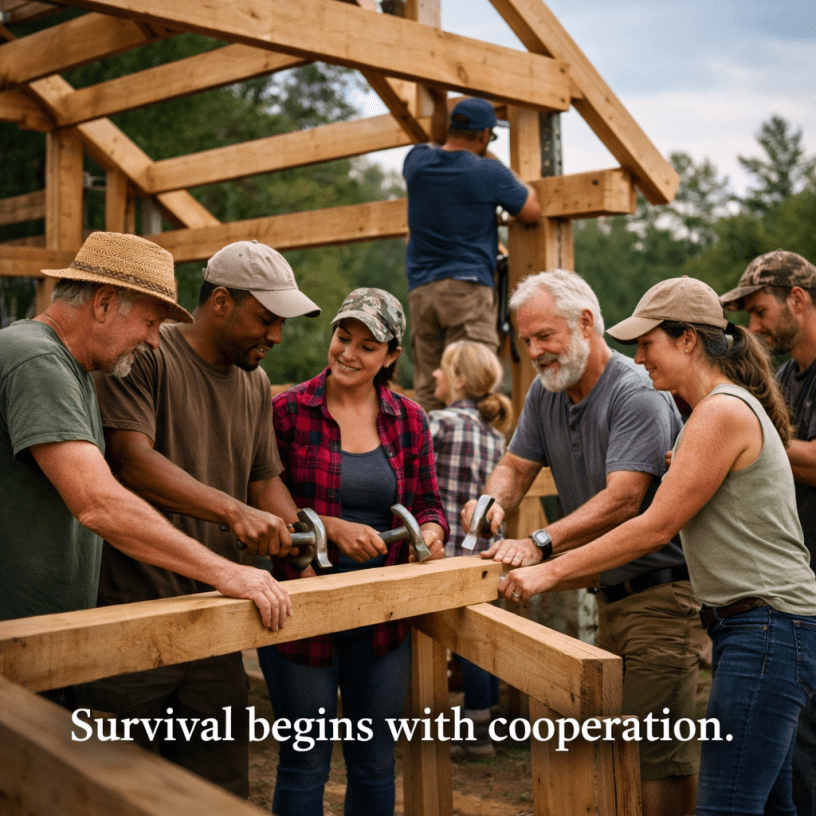
Survival begins with cooperation.
For more social commentary, please see Occupy 2.5 at https://Occupy25.com
If you read this and it matters, help me keep it going: https://www.patreon.com/cw/WPSNews
References
Brooks, M. (2006). World War Z: An Oral History of the Zombie War. Crown.
Federal Emergency Management Agency. (2006). Hurricane Katrina After-Action Report.
Keegan, J. (1989). The Second World War. Viking.
Discover more from WPS News
Subscribe to get the latest posts sent to your email.
 WPS News