By Cliff Potts, CSO, and Editor-in-Chief of WPS News
Baybay City, Leyte, Philippines — April 6, 2026
The Problem Was Not Subtle
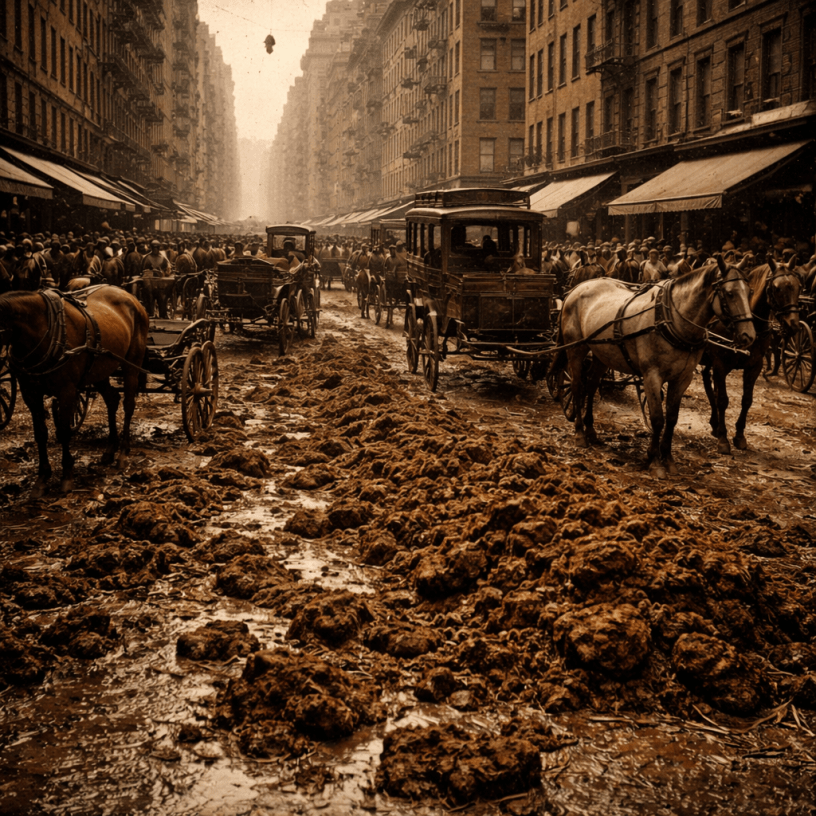
At the turn of the 20th century, New York City had a problem.
It was not political. It was not economic. It was not even technological in the modern sense.
It was sanitation.
Horses powered the city. They pulled carts, wagons, and carriages. They moved goods, people, and everything in between. They were essential to how the system worked.
They were also everywhere.
And so was what came with them.
The streets filled with waste. Not metaphorical waste. Literal waste. It accumulated faster than it could be removed. It did not sit neatly in piles. It spread, mixed, and layered itself into the daily life of the city. Rain turned it into sludge. Heat baked it into the streets. Traffic ground it into everything.
People adapted.
Buildings were constructed with raised entrances. Boot scrapers became standard fixtures. Daily life adjusted to a constant layer of filth that no one could fully eliminate.
The system worked.
But it was not clean.
The Modern Parallel
The modern internet operates in a similar state.
Content flows constantly. It is produced at scale, distributed instantly, and consumed continuously. Like horses in a pre-automobile city, this flow powers everything. It is necessary. It keeps the system moving.
It also produces an overwhelming amount of noise.
Low-quality material, repetition, shallow engagement loops, and automated amplification accumulate faster than they can be filtered. The result is an environment where useful, accurate, or thoughtful work is not absent—but buried.
Users adapt.
They scroll. They skim. They rely on familiar sources. They develop habits to avoid the worst of the noise. But the underlying condition remains unchanged.
The system functions.
But it is not clean.
The Wrong Solution
The dominant response to this problem has been to increase output or optimize for visibility within the existing structure.
More content. Faster cycles. Higher engagement targets.
This does not solve the problem.
It increases the volume moving through an already saturated system.
What is missing is not more production.
It is effective filtration.
What Actually Solved It Before
Historically, the sanitation problem in cities was not solved by managing horses more efficiently.
It was solved by changing the underlying mode of transport.
The introduction of the automobile did not immediately eliminate all problems. It created new ones. But it removed the primary source of the existing crisis.
The internet has not yet had its equivalent shift.
Current systems prioritize engagement over clarity, speed over verification, and volume over relevance. They sort content, but they do not clean the environment in which that content exists.
The Real Constraint
Until that changes, independent work will continue to face the same constraint.
Not invisibility.
Obstruction.
The issue is not that valuable content does not exist.
The issue is that it is difficult to find in an environment that does not prioritize its discovery.
This is not a failure of individual creators.
It is a sanitation problem.
For more social commentary, please see Occupy 2.5 at https://Occupy25.com
If you read this and it matters, help me keep it going: https://www.patreon.com/cw/WPSNews
References (APA)
McShane, C., & Tarr, J. A. (2007). The horse in the city: Living machines in the nineteenth century. Johns Hopkins University Press.
Melosi, M. V. (2000). The sanitary city: Urban infrastructure in America from colonial times to the present. Johns Hopkins University Press.
Discover more from WPS News
Subscribe to get the latest posts sent to your email.
 WPS News