By Cliff Potts, CSO, and Editor-in-Chief of WPS News
Baybay City, Leyte, Philippines — April 13, 2026
A Cold War Nightmare Revisited
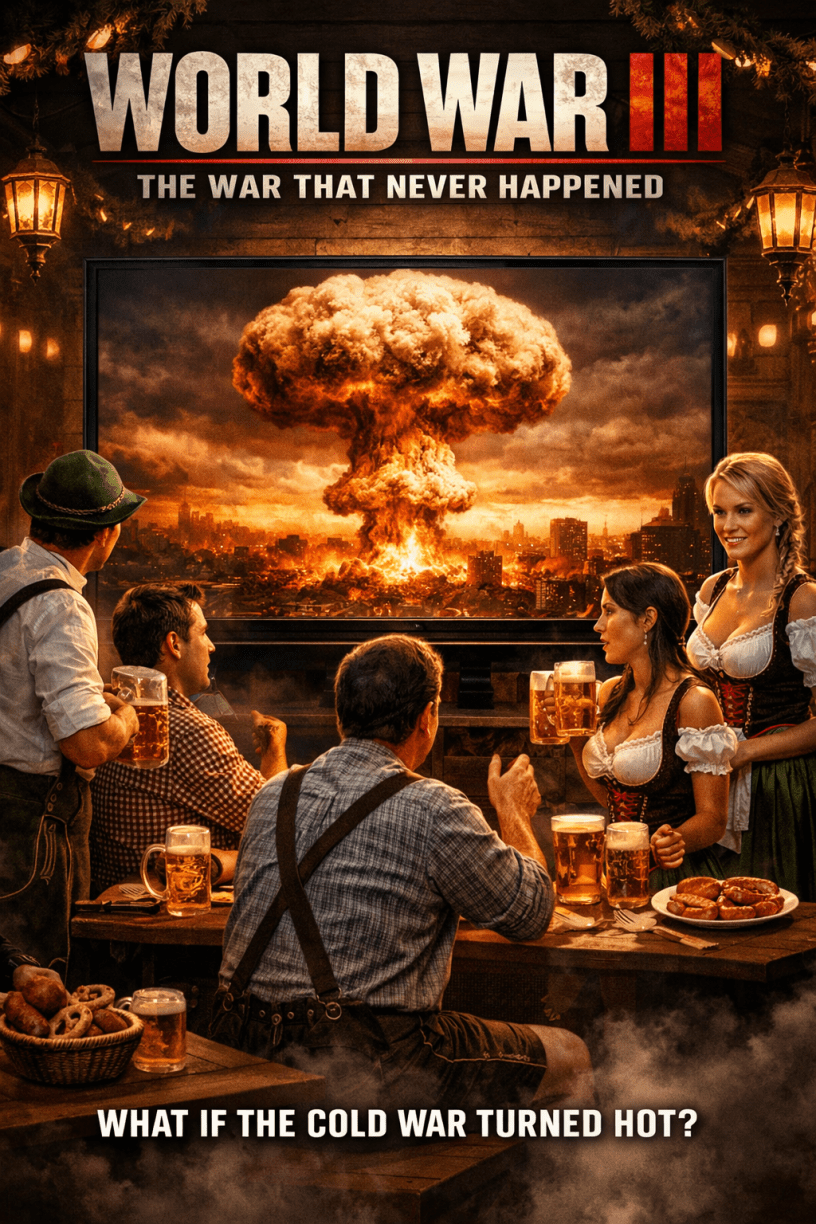
The 1998 television docudrama World War III attempts something unusual: it tells the story of a nuclear war that never occurred. Produced for The Learning Channel in the late 1990s, the film presents a speculative alternate history in which events surrounding the political upheaval of 1989 spiral into a catastrophic global conflict.
The film opens with a chilling image familiar to anyone who lived through the Cold War: a nuclear explosion over Washington, D.C. The narrative then rewinds “nine months earlier,” beginning its reconstruction of how political instability in Eastern Europe could theoretically have led to the destruction of the modern world.
The structure is simple but effective. The viewer already knows the outcome in the film’s fictional timeline. The real question becomes how a chain of decisions, miscalculations, and escalating tensions might have led there.
The Divergence Point: East Germany
The film’s alternate history begins during the 40th anniversary celebrations of East Germany in October 1989, when Soviet leader Mikhail Gorbachev visits East Berlin. In real history, that moment symbolized the beginning of the end for the Soviet bloc. Demonstrations across Eastern Europe were growing, and the Berlin Wall would soon fall peacefully (Sarotte, 2014).
In the film’s version of events, however, history takes a darker turn. Instead of allowing reform and political change, the East German government orders troops to fire on civilians attempting to tear down the Berlin Wall. This moment becomes the fictional point where history diverges from reality.
From there, the documentary imagines a rapid escalation: Gorbachev disappears, hardliners seize power in Moscow, repression spreads across Eastern Europe, and NATO and Soviet forces move toward confrontation.
Escalation Toward Nuclear War
What makes the film compelling is its use of real archival footage combined with staged scenes. Much of the material comes from Cold War news coverage—military exercises, political speeches, and images of mass protests—blended with dramatized sequences of soldiers and political leaders.
The result is intentionally unsettling. The film looks and sounds like a historical documentary, even though it is describing events that never happened.
As tensions escalate, the familiar Cold War machinery comes into view: bomber launches, military alerts, and escalating political rhetoric between the superpowers. Eventually, the scenario culminates in nuclear exchange and the destruction of major cities.
The Real Ending
The most striking moment of the film occurs in its final minutes. After presenting the fictional nuclear war, the documentary returns to real historical footage. The narrator reminds viewers that, in reality, none of these events occurred.
Instead, the Berlin Wall fell peacefully on November 9, 1989, and Germany was reunified less than a year later (Taylor, 2006). Within two years, the Soviet Union itself dissolved, bringing the Cold War to an end (Service, 2009).
By ending the film this way, the documentary reframes the entire narrative. The fictional war becomes not a prediction, but a reminder of how fragile the geopolitical balance had been.
Processing the Cold War
Viewed today, World War III feels less like a warning and more like a psychological reflection on the Cold War era. For decades, millions of people around the world expected a nuclear conflict between the United States and the Soviet Union. Military doctrines, civil defense programs, and popular culture all revolved around the assumption that such a war was inevitable.
When the Cold War ended peacefully in the early 1990s, many people were left with an unusual historical reality: the catastrophe they had expected for most of their lives simply never happened.
The film allows viewers to walk through that alternate path—to see what the Cold War might have looked like if events had gone differently. In doing so, it highlights how remarkable the peaceful collapse of the Soviet system actually was.
Final Thoughts
World War III is not a traditional movie. It contains no heroes, no dramatic victories, and no satisfying resolution. Instead, it presents a carefully constructed historical “what-if,” using documentary techniques to explore a disaster that could have occurred but did not.
For viewers who lived through the Cold War, the film offers a sobering reminder of how close the world once stood to catastrophe—and how fortunate history’s final turn ultimately proved to be.
For more social commentary, please see Occupy 2.5 at https://Occupy25.com
References
Sarotte, M. E. (2014). The collapse: The accidental opening of the Berlin Wall. Basic Books.
Service, R. (2009). The end of the Cold War: 1985–1991. Macmillan.
Taylor, F. (2006). The Berlin Wall: A world divided, 1961–1989. HarperCollins.
Discover more from WPS News
Subscribe to get the latest posts sent to your email.
 WPS News