Byline: WPS.News Staff
In the aftermath of war and economic collapse, extremist groups have long exploited the anger of disillusioned men. Then it was brownshirts. Now it’s MAGA militias.
Weimar Germany: Veterans Left Behind
In the chaotic years following World War I, Germany’s Weimar Republic was flooded with embittered veterans and unemployed young men. The country’s defeat and the Treaty of Versailles left many soldiers feeling betrayed. They returned to find no jobs, no honor, and no future.
Adolf Hitler and the early Nazi Party exploited this rage. The Nazi paramilitary wing—the SA, or “brownshirts”—was filled with ex-soldiers, particularly from the Freikorps. These groups violently opposed leftist uprisings and helped destabilize the fragile democracy.
By 1932, the SA’s membership exploded to 400,000, and by 1933 it reached nearly 2 million. These men were not drawn by ideology alone. They found purpose in the movement, a uniform, free food, and enemies to fight—Jews, socialists, and anyone seen as “un-German” (Evans, 2005; Kershaw, 2008).
Post-9/11 America: A Familiar Pattern
In the U.S., a similar pattern emerged after the Iraq and Afghanistan wars. Thousands of veterans came home to economic devastation during the Great Recession. Many faced unemployment, PTSD, and a lack of support from a broken VA system.
Far-right movements seized the moment.
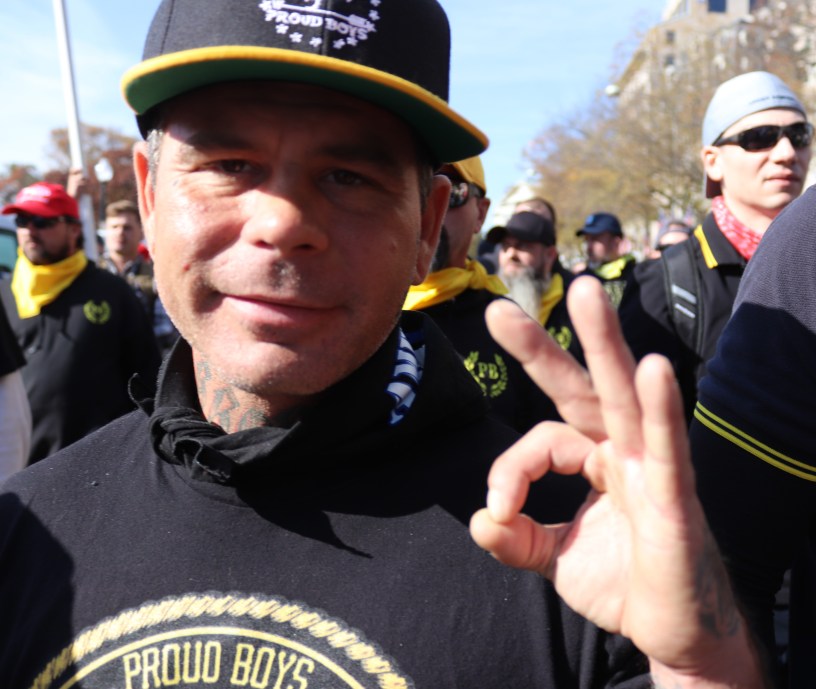
Groups like the Oath Keepers and Proud Boys openly recruit veterans and police. Oath Keepers founder Stewart Rhodes, a U.S. Army veteran, explicitly built the organization around military values and loyalty to a distorted interpretation of the Constitution. Research shows roughly two-thirds of Oath Keepers are former military or law enforcement (Jensen, 2022; SPLC, 2022).
The Proud Boys—another violent far-right group—also drew heavily from ex-military. Of the five Proud Boys leaders convicted of seditious conspiracy in the Jan. 6 attack, four were veterans (Hsu & Nakashima, 2023).
Economic Despair, Cultural Drift, and Radical Brotherhood
Both in Weimar and modern America, alienation bred radicalization.
The SA gave angry German men a sense of belonging. Today’s far-right militias mimic military culture, uniforms, ranks, and brotherhood. For many, it replaces the structure and identity lost after leaving the service.
Recruiters tell veterans that their military oath didn’t end with their discharge. They twist patriotism into extremism, urging former soldiers to “defend the republic” against immigrants, liberals, and the “deep state” (Belew & McRae, 2023).
This echoes Hitler’s propaganda: the real enemies are within.
The Cycle Repeats
The United States hasn’t yet gone full fascist. But the parallels are real and dangerous.
Economic despair. Political betrayal. Veterans left behind. Groups offering answers, community, and scapegoats.
In 1930s Germany, these forces helped destroy democracy. In 2020s America, they’ve already stormed the Capitol.
As historian Mark Pitcavage of the Anti-Defamation League warns, “We are in a tinderbox state. Anything can set people off” (ADL, 2022).
History’s warning is clear. Ignoring it won’t save us.
APA References:
- Belew, K., & McRae, R. (2023). A Field Guide to White Supremacy. University of California Press.
- Evans, R. J. (2005). The Coming of the Third Reich. Penguin Books.
- Hsu, S. S., & Nakashima, E. (2023, May 4). Proud Boys leaders convicted of seditious conspiracy in Jan. 6 attack. The Washington Post. https://www.washingtonpost.com
- Jensen, M. (2022). Profiles of Individual Radicalization in the United States (PIRUS). University of Maryland START.
- Kershaw, I. (2008). Hitler: A Biography. W. W. Norton & Company.
- Southern Poverty Law Center (SPLC). (2022). The Oath Keepers: Anti-Government Extremists Recruiting Military and Police. https://www.splcenter.org
- Anti-Defamation League (ADL). (2022). Extremism in the Ranks. https://www.adl.org
Discover more from WPS News
Subscribe to get the latest posts sent to your email.
 WPS News