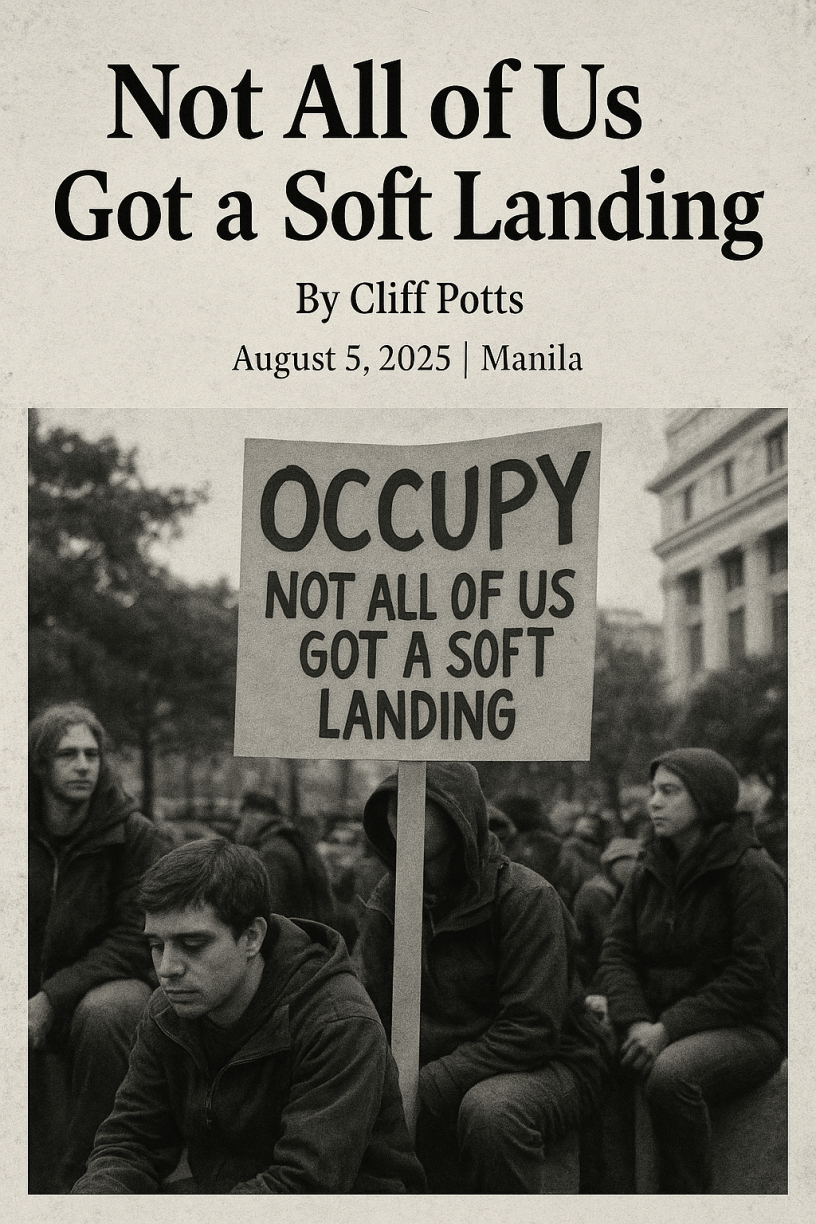
By Cliff Potts, Editor-in-Chief
August 5, 2025 | Manila
They said it would change everything. And for a few weeks, it almost did. But when the media left and the tents came down, not all of us walked away with book deals, non-profit titles, or even housing.
Some call it the soft landing — that subtle golden parachute for a chosen few after Occupy Wall Street unraveled. A handful found themselves lifted: into academia, campaign staff jobs, urban think tanks, the next progressive startup cycle. In Chicago, a few climbed into city hall’s orbit, helped redesign civic engagement, or went on to teach about activism from behind a podium.
Good for them.
But not all of us got a soft landing.
Some of us — the ones who slept in the cold, kept the med tent stocked, or whispered poetry to keep the lights on in our souls — we didn’t bounce upward. We bounced outward. We scattered.
We returned to the warehouses and night shifts. We disappeared into rental scams, trauma spirals, or depression without a name. We fought evictions, lost friends, and survived by not speaking too often of those nights in Grant Park or Zuccotti or Frank Ogawa. Not because we were ashamed. Because it hurt to remember the taste of a world that almost was.
And then there were the angels — the Occupy Angels. Not leaders, not planners. The ones who loved it all into being. They cooked, comforted, stitched blankets and broken spirits alike. You may not know their names. They weren’t profiled in Wired or cited in dissertations. But they carried the movement in their arms, like midwives of something too fragile for the world we lived in.
Many of them are gone now. Not dead, necessarily. Just… gone. Lost to the churn of capitalism, chronic illness, or the silence that follows when the echo chamber empties.
It would be easier to pretend they never existed. Or that we all somehow “moved on.” But we didn’t. We moved through. Through layoffs and hospital visits and burnout. Through betrayal by so-called allies. Through a country tilting into fascism while consultants waxed nostalgic about “the energy of that moment.”
In Chicago, some tried to repackage the movement as a brand — Chicago Rising — all sleek graphics and sanitized slogans. The radicals who had held the line were suddenly framed as too messy, too mad, too inconvenient for the next nonprofit wave. We saw organizers with scars get sidelined while the resume-polishers got microphones.
Even the @OccupyWallStNYC Twitter account — once a shared voice — was taken over by one person, Justin Wedes, who later went corporate and disavowed the Occupy ethos he once broadcast. He got his soft landing. Many of us got silence.
If you want to know why Occupy 2.5 still exists — barely, stubbornly, like a weed through cracked concrete — it’s for them. The ones who never got a soft landing. The ones who never stopped believing that something better was possible, even when no one paid them to say so.
You won’t find this story in most retrospectives. But we’re telling it here.
Because history doesn’t belong to the winners.
It belongs to the witnesses.
💔 We Remember Their Names (Even If the World Forgot)
There was Natalie — beautiful, brilliant, a natural speaker. She became a union organizer, maybe SEIU. We cheered at first. Then one day, she turned. Not out of malice, but calculation. The group had shifted. They needed a scapegoat. And like too many before her, she picked the Party over the Person.
There was Phil Devin, who wandered from housing marches into real housing justice — working with tenants, fighting evictions, maybe even law school. If he’s still out there, we hope he remembers the tents. The cold. The names.
There were the ones with handles — juju eyeball, Patch, NightMedic89. You never knew their legal names, but you knew their presence. They were there when you needed water, when you needed a blanket, when you needed someone to stand between you and the police.
There was the Uptown Law crew — maybe a basement paralegal clinic, maybe just idealists with a printer and a copy of the First Amendment. They showed up with know-your-rights cards and stayed until the last jail release.
We remember you.
Even if the world forgot.
Even if you forgot.
This reflection is part of WPS.News’s commitment to documenting the true cost of political struggle. For rawer memories, satire, and resistance fiction, visit Occupy25.com.
APA Citations:
- Gitlin, T. (2012). Occupy Nation: The Roots, the Spirit, and the Promise of Occupy Wall Street. HarperCollins.
- Milkman, R., Luce, S., & Lewis, P. (2013). Changing the Subject: A Bottom-Up Account of Occupy Wall Street in New York City. CUNY Graduate Center.
- Juris, J. S. (2012). Reflections on #Occupy Everywhere: Social media, public space, and emerging logics of aggregation. American Ethnologist, 39(2), 259–279.
Tags:
Discover more from WPS News
Subscribe to get the latest posts sent to your email.
 WPS News