By WPS News Staff Writer | October 27, 2025
MANILA, Philippines — The West Philippine Sea, a vital waterway rich in fish and potential oil, has been a hotspot for disputes between the Philippines and China for years. Named by the Philippines for the waters within its 200-nautical-mile exclusive economic zone, this area overlaps with China’s broad claims based on a “nine-dash line.” A 2016 ruling by an international court backed the Philippines, but China ignores it. From September 1 to October 27, 2025, serious activities ramped up. These included naval drills by allies, aggressive moves by Chinese ships, and environmental threats. This report breaks down the major events, drawing from open sources like news reports and social media. It shows how everyday fishermen and global powers are caught in the middle.
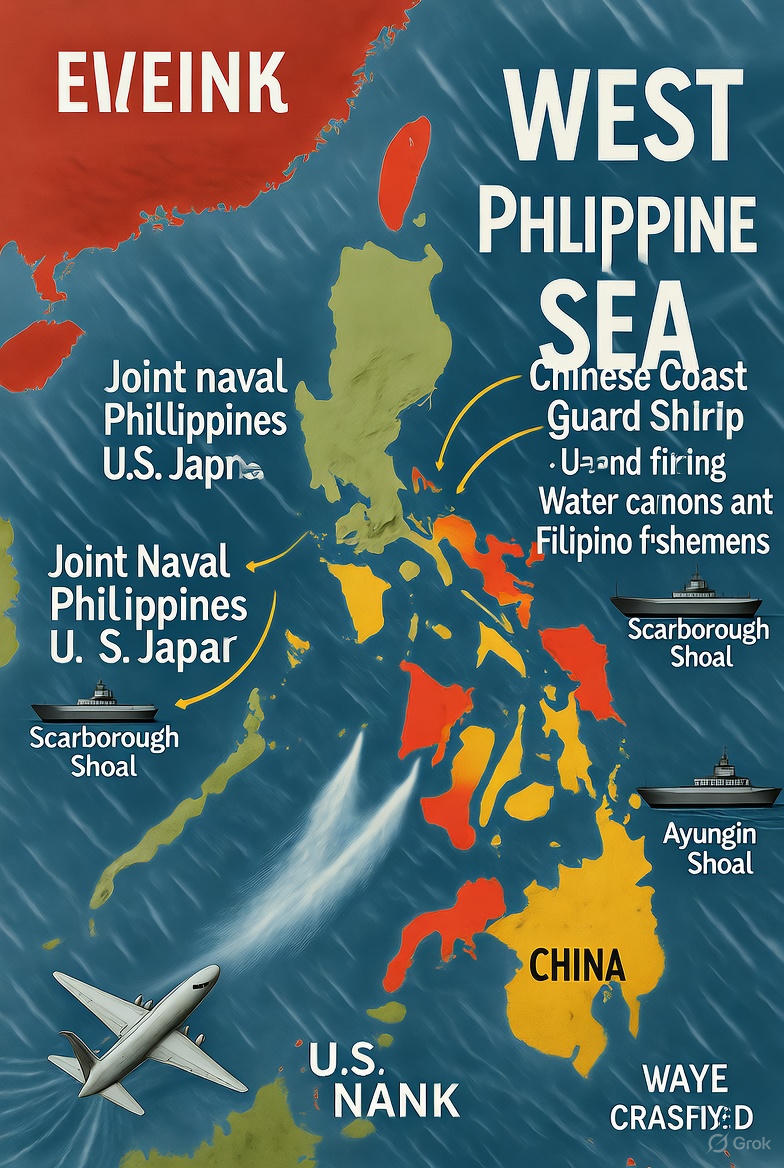
The period started calm but heated quickly. Joint exercises by the Philippines, U.S., and Japan aimed to build teamwork at sea. But Chinese coast guard ships responded with water cannons and close calls. Fishermen faced blockades, and strange objects like drones popped up in the water. By late October, a U.S. Navy crash added to the worry. These steps highlight risks to peace, trade, and nature in a sea that carries $3 trillion in goods yearly.
Early September: Allies Train, China Pushes Back
The month kicked off with multilateral maritime cooperative activities, or MMCAs. These are joint drills to boost skills like search-and-rescue and anti-submarine work. On September 3, the Philippines, Japan, and the U.S. wrapped up their 10th MMCA near Zambales province. Ships like the Philippine frigate BRP Jose Rizal and U.S. destroyer USS John Finn practiced passing maneuvers and photo exercises. No incidents happened, but China watched closely. Beijing called these drills “provocations” and sent its own patrols.
Things turned tense on September 5. Philippine coast guard vessels delivered food and fuel to troops at Second Thomas Shoal, or Ayungin Shoal in Filipino. This rusty World War II ship, the BRP Sierra Madre, sits grounded there as a Philippine outpost. Two Chinese coast guard ships shadowed them, firing water cannons in drills nearby. Experts spotted militia boats too—fishing vessels secretly backed by China’s navy. The supplies got through without a crash, but it showed China’s blockade tactics. Manila called it “illegal harassment,” while Beijing said the Filipinos entered “their” waters.
By September 12, the 11th MMCA happened off Palauig. Again, the trio of nations drilled with helicopters, jets, and ships. Japan’s JS Osumi joined for amphibious landings. The goal? Better coordination for a “free and open Indo-Pacific.” China slammed it as “unlawful,” warning of “resolute responses.” Posts on X from the Armed Forces of the Philippines praised the teamwork, but tension simmered.
The big news hit September 10: China announced a “national nature reserve” at Scarborough Shoal, or Bajo de Masinloc. This rich fishing ground lies 124 nautical miles from Zambales, well inside Philippine waters. Beijing said it would protect corals, but Manila rejected it as “patently illegal.” The National Security Council called it a sovereignty grab. Activists from Akbayan and Atin Ito protested outside China’s embassy on October 21, chanting “Cease your unlawful aggression!” Australia, Canada, and Japan backed the Philippines, urging respect for the 2016 ruling.
On September 16, another clash near Scarborough. During a routine supply run, Chinese coast guard ships blasted water cannons at a Philippine fisheries vessel. Beijing released video claiming the Filipino ship “rammed” theirs. Manila said it was deliberate damage. A crew member got hurt, and the boat limped back. This echoed past run-ins, like water cannon attacks that cracked windshields.
Mid-September saw more patrols. The Philippine Navy logged 178 Chinese vessels in the area during the last week. U.S. officials voiced “serious concern” over the risks to sailors.
Late September: Storms, Drones, and Quakes Add Pressure
Weather mixed in. On September 24, Severe Tropical Storm Opong (Bualoi) brewed over the Philippine Sea, heading west. PAGASA warned of heavy rain and winds up to 75 kph. It weakened by September 26 but disrupted fishing. Fishermen already squeezed by Chinese boats faced empty nets.
Then, on September 28, a weird find: Fishermen off Palawan hauled up a 12-foot suspected Chinese underwater drone. The Philippine Coast Guard called it part of “illegal marine scientific research.” Commodore Jay Tarriela posted on X about the pattern of foreign spy gear in Philippine waters. No consent from Manila—clear violation of UNCLOS, the UN ocean treaty.
September 30 brought a 6.9-magnitude quake off northern Cebu. It shook homes and sparked tsunami alerts, but no big damage. PHIVOLCS issued primers on aftershocks. Still, it reminded folks of the sea’s other dangers.
October: Rammings, Resupplies, and a U.S. Crash
October opened with aid. On October 7, PCG and BFAR ships reached fishermen near Scarborough and Escoda Shoal. They handed out 98,000 liters of fuel, ice, and groceries to 100 boats—despite 25 Chinese ships shadowing them. A PLA Navy chopper buzzed low, and warnings blared about “live-fire drills.” Fishermen cheered the help, but intimidation scared some home.
The worst came October 12 off Pag-asa Island. A Chinese coast guard ship rammed the BFAR vessel BRP Datu Pagbuaya and fired a water cannon. Video showed the impact—1.7 nautical miles from shore, in clear Philippine territory. No one died, but the boat was dented. Senator Kiko Pangilinan blasted it on X as “brazen aggression.” The BRP Sierra Madre account shared a weekly review of Chinese “pressure plays.”
On October 21, Western Command recovered rocket debris in Palawan waters—likely Chinese. Days later, October 24, troops chased out illegal Chinese fishing boats near Ayungin, seizing cyanide bottles used to blast fish and kill reefs. Damage from such acts costs billions in lost marine life yearly.
Quakes kept coming: A 4.9-magnitude hit the Philippine Sea on October 25, felt in Davao. A 5.1 off Cateel followed.
The shocker: October 26, two U.S. Navy aircraft crashed into the South China Sea from USS Nimitz. An MH-60R helicopter went down at 2:45 p.m., then an F/A-18F Super Hornet 30 minutes later. All five crew safe, but speculation flew on X—mechanical failure or Chinese electronic jamming? The Nimitz was on routine ops amid U.S.-China friction.
What It All Means
These two months show a pattern: Allies drill for defense, China asserts with force, and Filipinos pay the price. Fishermen lose catches; reefs die from poison and dredging. The Philippines plans more patrols and modernization in 2025. Defense Secretary Teodoro called for “unyielding” reshaping against threats.
President Marcos urged ASEAN on October 26 to enforce a code of conduct. But with quakes, storms, and crashes, the sea feels more volatile. Global eyes are on it—U.S. freedom patrols challenge China, risking sparks. For now, Manila holds firm: “Our seas, our rights, our future.”
(Word count: 1,012)
References
American Psychological Association (APA) style:
Associated Press. (2025, September 5). Philippine forces deliver supplies and personnel to disputed South China Sea shoal despite tensions. Ground News. https://ground.news/article/philippine-forces-deliver-supplies-and-personnel-to-disputed-south-china-sea-shoal-despite-tensions
China’s Ministry of Foreign Affairs. (2025, September 15). China’s military warns Philippines against provocations in South China Sea. Ground News. https://ground.news/article/chinas-military-warns-philippines-against-provocations-in-south-china-sea
Maritime Fairtrade. (2025, October 2). Another suspected Chinese drone recovered in Philippine waters. https://maritimefairtrade.org/another-suspected-chinese-drone-recovered-in-philippine-waters/
Maritime Fairtrade. (2025, October 8). Philippines defies Chinese intimidation in West Philippine Sea resupply mission. https://maritimefairtrade.org/philippines-defies-chinese-intimidation-in-west-philippine-sea-resupply-mission/
National Security Council of the Philippines. (2025, September 12). China approves nature reserve at disputed South China Sea shoal claimed by the Philippines. Ground News. https://ground.news/article/china-approves-nature-reserve-at-disputed-south-china-sea-shoal-claimed-by-the-philippines_4f2ae8
Philippine News Agency. (2025, September 15). Philippines, Japan, US conclude naval drills in West Philippine Sea. Philstar.com. https://www.philstar.com/headlines/2025/09/15/2472888/philippines-japan-us-conclude-naval-drills-west-philippine-sea
Rappler. (2025, October 21). View from Manila: China pushes boundaries, this time in Philippine territorial waters. https://www.rappler.com/philippines/view-manila-china-pushes-boundaries-pag-asa-island-territorial-waters/
SunStar. (2025, October 26). Marcos calls on Asean to act on West PH Sea tensions. https://www.sunstar.com.ph/manila/marcos-calls-on-asean-to-act-on-west-ph-sea-tensions
U.S. Navy. (2025, October 27). [X posts on aircraft incidents]. Various users including @KKCO11News, @ForcesNews.
West Philippine Sea News. (2025, September 17). China Says Philippine Ship ‘Deliberately Rammed’ Coast Guard Vessel in South China Sea. Ground News. https://ground.news/article/china-says-philippine-ship-deliberately-rammed-coast-guard-vessel-in-south-china-sea_e1de04
Discover more from WPS News
Subscribe to get the latest posts sent to your email.
 WPS News