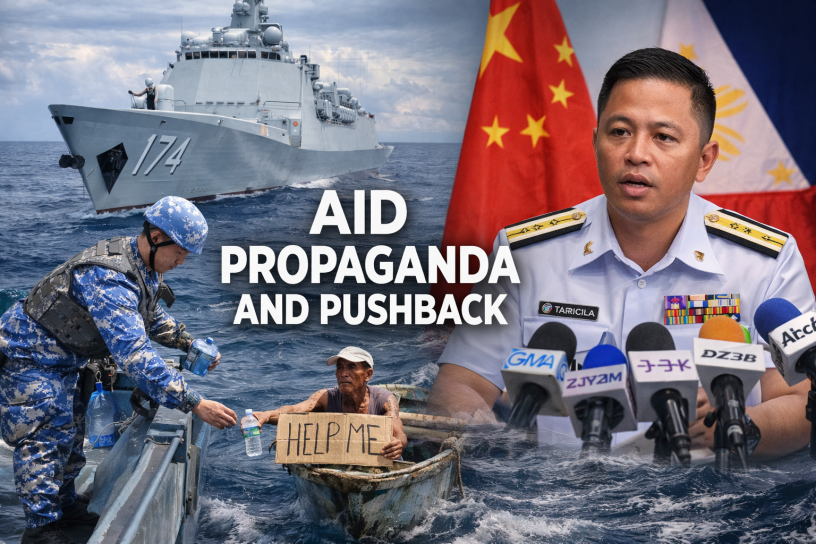
Inside a 24-Hour Information Clash in the West Philippine Sea
By Cliff Potts, Editor-in-Chief, WPS News
A Narrow Window, a Loud Signal
Between 7:10 p.m. on December 28 and 7:10 p.m. on December 29, 2025, the West Philippine Sea (WPS) did not see a new collision, ramming, or water-cannon incident. What it did see—very clearly—was an information battle.
At the center of that battle was a Christmas Day encounter between a Chinese PLA Navy destroyer and a lone Filipino fisherman off Zambales, well inside the Philippine Exclusive Economic Zone. The physical event itself was over quickly. The political and informational aftershocks were not.
Over this 24-hour period, the story hardened into two competing narratives: one framed by Beijing as humanitarian rescue, and the other framed by Manila as a tightly bounded act of assistance being leveraged for strategic messaging.
What follows is a straight report of what moved, what was said, and what mattered during that window—without background history, and without speculation.
The Incident as Framed by China
Chinese state media and official channels continued to amplify footage and statements first released on December 26. The video shows a Filipino fisherman holding a handwritten “HELP ME” sign as a Chinese naval vessel approaches, followed by a PLA Navy sailor handing him bottled water and food.
Chinese outlets described the event as a rescue of a fisherman allegedly stranded at sea for three days due to engine failure. The encounter was framed as routine humanitarian assistance consistent with international maritime obligations.
During the December 28–29 window, Chinese state-linked media escalated the messaging. Commentary accused Philippine officials of politicizing a rescue and acting in bad faith. One widely circulated claim asserted that Chinese naval personnel had communicated coordinates to Philippine authorities and that audio recordings existed to prove coordination.
The tone was not conciliatory. It was defensive and dismissive, portraying Philippine responses as ungrateful, petty, or intentionally misleading.
The Philippine Response: Precision, Not Gratitude Theater
The most consequential statements during this period came from the Philippine Coast Guard.
PCG spokesperson Commodore Jay Tarriela issued clarifications that directly challenged the Chinese narrative on several points:
- The fisherman was not adrift for three days, but was secured to a fish aggregating device and awaiting pickup.
- The PCG did not receive advance notification or verified coordinates from the Chinese warship prior to its engagement.
- The Chinese naval vessel had no legal basis to be operating in that area of the West Philippine Sea.
- The assistance rendered—water and biscuits—was acknowledged, but characterized as minimal and not extraordinary.
Tarriela’s most pointed warning was not about the aid itself, but about its use. He explicitly cautioned against exploiting the encounter as propaganda or as implicit justification for Chinese naval presence in Philippine waters.
That distinction mattered. The Philippine position during this window was not “China did nothing helpful.” It was: humanitarian gestures do not rewrite maritime law.
Competing Claims Over Communication
One of the sharper flashpoints during this period involved alleged radio communications.
Chinese media claimed to possess audio showing that Chinese naval forces relayed information to Philippine vessels, receiving acknowledgments in return. Philippine authorities did not validate those recordings publicly during this window, nor did they concede the point.
What remained undisputed was this: even if communication occurred after the fact, it did not change the unauthorized presence of a foreign naval combatant inside the Philippine EEZ.
That legal reality remained the anchor of the Philippine response.
Social Media as a Secondary Front
While no new maritime incidents occurred, social media activity surged.
Philippine officials used X and Facebook to push fact-based clarifications quickly, countering viral narratives before they hardened. Civil society groups, maritime advocates, and fishing-community representatives echoed the same theme: assistance does not equal legitimacy.
The civil society coalition Atin Ito gained traction with blunt language, describing the episode as “image management” rather than altruism. Their messaging spread rapidly across Filipino social media spaces, particularly among coastal and maritime-focused communities.
On the Chinese side, embassy-linked accounts and state media personalities continued to circulate the rescue footage, emphasizing visuals over legal context.
The result was not persuasion so much as polarization. Each side spoke primarily to its own audience—but Manila’s messaging was notably tighter, more disciplined, and grounded in verifiable details.
No Diplomatic Reset, No Escalation
Importantly, there were no new diplomatic protests, military deployments, or formal escalatory steps announced during this 24-hour window.
That restraint should not be misread as de-escalation.
Instead, it reflects a familiar pattern in the West Philippine Sea: sustained pressure, normalized presence, and narrative shaping rather than dramatic confrontation.
Philippine officials signaled continuity rather than reaction. The position remained firm: Philippine rights will be asserted through international law, transparency, and documentation—not through theatrics.
Why This Window Matters
This 24-hour period is instructive precisely because nothing “exploded.”
What unfolded instead was a clean example of how information operations now accompany every maritime encounter in the West Philippine Sea. A single bottle of water became a narrative wedge. A short video became a strategic talking point.
The Philippine response during this window was measured, factual, and—critically—unemotional. It acknowledged reality without surrendering ground. That matters in a long conflict defined less by battles than by normalization.
No amount of biscuits changes jurisdiction.
The Bottom Line
From December 28 to 29, 2025, the West Philippine Sea saw no collisions, no rammings, and no water cannons. What it saw instead was a contest over meaning.
China attempted to convert a minor humanitarian act into narrative capital. The Philippines declined the conversion.
That refusal—quiet, documented, and precise—is the real story of this 24-hour window.
For more social commentary and high-quality fiction, please see Occupy 2.5 at https://Occupy25.com
APA Citations
Philippine Coast Guard. (2025, December). Official statements and clarifications on West Philippine Sea maritime encounter.
Philstar. (2025, December). PCG disputes China’s account of fisherman rescue in West Philippine Sea.
GMA News. (2025, December). PCG details Christmas Day encounter involving Chinese naval vessel.
Global Times. (2025, December). Chinese media commentary on PLA Navy humanitarian assistance.
Atin Ito Coalition. (2025, December). Public statements on West Philippine Sea maritime activity.
Discover more from WPS News
Subscribe to get the latest posts sent to your email.

