A WPS News Reconstruction of Events — and Why This Pushes the World Toward Lawlessness
By Cliff Potts, CSO, and Editor-in-Chief of WPS News
What This Essay Is — and What It Is Not
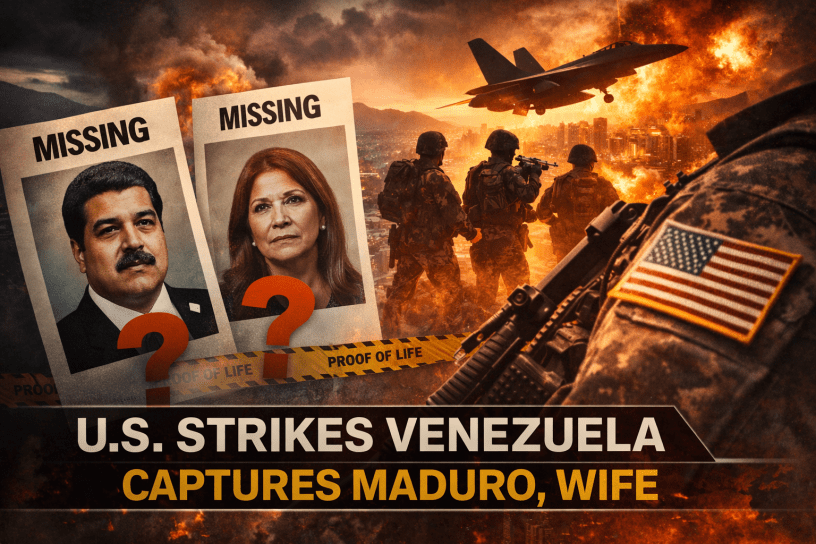
This report is a best-available reconstruction of the public timeline surrounding U.S. military actions involving Venezuela from late 2025 through January 3, 2026. It is based on contemporaneous reporting by major wire services and international outlets. Some operational details remain unconfirmed by formal U.S. defense briefings. What is confirmed is the pattern: escalation, coercion, air and maritime operations, a direct strike, and a public claim that the sitting president of Venezuela and his wife were seized — followed by no publicly provided proof of life.
The Build-Up: Pressure Turns Into a Military Campaign
September 2025 — Counter-narcotics operations expand.
U.S. military activity in the Caribbean region intensifies under a counter-narcotics rationale, including interdictions and strikes tied to alleged trafficking networks. This phase establishes the operational footprint later used to justify expanded action.
November 2025 — Planning for a new phase reported.
U.S. officials signal to reporters that a more aggressive phase of operations against Venezuela is under consideration, including covert components aimed at leadership pressure.
Late December 2025 — Economic and maritime coercion escalates.
White House guidance shifts toward maritime interdiction and “quarantine” language focused on Venezuelan oil exports. Sanctions pressure increases in parallel.
December 16, 2025 — Blockade rhetoric enters official statements.
The U.S. president publicly calls for a “total and complete blockade” of sanctioned Venezuelan oil tankers, signaling readiness to move beyond sanctions into direct enforcement.
December 31, 2025 — Additional oil sanctions imposed.
New measures targeting Venezuela’s oil sector are announced days before the strike, tightening economic pressure immediately prior to military action.
The Strike Night: Explosions, Aircraft, and the Start of the Proof-of-Life Crisis
Early January 3, 2026 (local time) — Explosions reported in Caracas.
Residents and journalists report explosions and low-flying aircraft over Caracas and other strategic locations. The strikes are brief but widely described as significant.
January 3, 2026 (U.S. time) — Public claim of capture.
The U.S. president publicly states that Venezuelan President Nicolás Maduro and First Lady Cilia Flores were “captured and flown out” following the strikes. No independent verification is provided.
Media reports on the alleged capture operation.
U.S. officials anonymously brief reporters that elite special operations forces were involved. No detailed timeline, location of detention, or legal basis for custody is released.
Immediate Venezuelan response — Demand for proof of life.
Venezuela’s government states it does not know the whereabouts of Maduro or Flores and formally demands proof that they are alive. This demand becomes the central human-rights and escalation issue.
State of emergency and mobilization rhetoric.
Venezuelan authorities describe the strike as aggression, announce emergency measures, and call for international action.
Airspace and Embassy Actions: Signals of Ongoing Risk
January 3, 2026 — Airspace restrictions imposed.
U.S. aviation authorities restrict American aircraft from Venezuelan airspace, citing “ongoing military activity.” This signals expectations of continued instability rather than a concluded operation.
U.S. Embassy advisories issued.
Americans in Venezuela are advised to shelter in place amid uncertainty and potential retaliation.
The Central Issue: Claimed Custody Without Proof of Life
As of this writing, the public record consists of a unilateral claim by the U.S. government that it holds Venezuela’s president and first lady, paired with repeated Venezuelan demands for proof that they are alive.
This absence matters for two reasons:
- Human rights norms. When a state claims custody of foreign nationals seized during hostilities — particularly political leaders — proof of life and basic access are minimum standards.
- Escalation control. Uncertainty about the fate of a head of state dramatically increases the risk of irrational or retaliatory escalation.
What This Means for Global Security Going Forward
If accepted as precedent, this event signals that a powerful state may:
- strike another country’s territory,
- seize its leadership,
- and bypass international authorization entirely.
That precedent does not remain isolated. It teaches rivals and regional powers that restraint is optional and that force, not law, is the ultimate arbiter. The post-1945 system avoided direct great-power war not through goodwill, but through rules and mutual constraint. When those rules are ignored by the strongest actor, the system degrades rapidly.
The Legal Framework: Aggression After 1945
The United Nations Charter prohibits the threat or use of force against the territorial integrity or political independence of any state, with only two exceptions: Security Council authorization or self-defense following an armed attack.
After World War II, the Nuremberg Tribunal identified the initiation of aggressive war as the “supreme international crime,” because it enables all others. The UN General Assembly later codified this principle by defining aggression as the use of armed force against another state’s sovereignty.
The lesson is blunt: once aggressive war is normalized, every border becomes conditional and every dispute becomes militarized.
Editorial Condemnation
WPS News condemns this action unequivocally.
The United States has no legal, moral, or strategic justification for conducting military strikes inside Venezuela or for removing its leadership by force. This is not self-defense. It is not law enforcement. It is not liberation.
It is aggression.
If this becomes normalized, the rules-based international order is finished, replaced by a system where power alone determines legality. The world tried to bury that logic after 1945. Reviving it now is not strength — it is a regression with global consequences.
APA Citations
Associated Press. (2026, January 3). US strikes Venezuela and says its leader, Maduro, has been captured and flown out of the country.
Reuters. (2025, November 23). Exclusive: U.S. to launch new phase of Venezuela operations, sources say.
Reuters. (2025, December 24). White House orders U.S. forces to focus on “quarantine” of Venezuela oil.
Reuters. (2025, December 31). U.S. issues fresh sanctions targeting Venezuela’s oil sector.
Reuters. (2026, January 3). Trump says U.S. has captured Venezuela President Maduro.
United Nations. (1945). Charter of the United Nations.
United Nations General Assembly. (1974). Resolution 3314 (XXIX): Definition of Aggression.
Discover more from WPS News
Subscribe to get the latest posts sent to your email.

