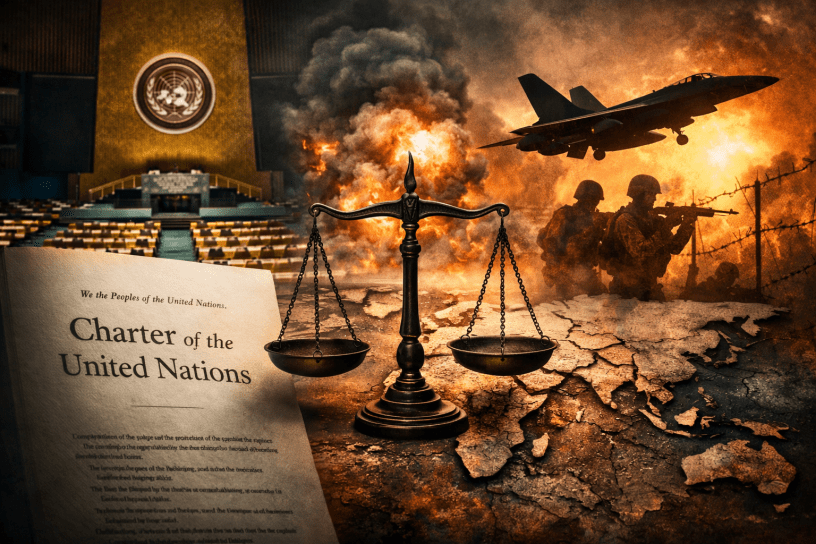
A Special Bulletin on Venezuela, International Law, and the Collapse of Global Restraint
By Cliff Potts, CSO, and Editor-in-Chief of WPS News
What Is Being Reported — and Why It Matters
The United States has engaged in direct military action against Venezuelan territory while publicly asserting unilateral authority to do so. Venezuela’s government has denounced the strikes as illegal aggression and has appealed for emergency international review.
Whatever one’s view of Venezuela’s leadership, economy, or internal governance, the unilateral use of armed force against a sovereign state without United Nations authorization or a valid claim of self-defense violates international law. That standard is not negotiable. It is the foundation of the post–World War II order.
This bulletin exists to state, without hedging: this action constitutes a war of aggression, and it represents a dangerous breach of the legal restraints designed to prevent global catastrophe.
What the UN Charter Actually Says
The United Nations Charter is explicit.
Article 2(4) prohibits “the threat or use of force against the territorial integrity or political independence of any state.” There are only two recognized exceptions:
- Self-defense under Article 51, and only in response to an actual armed attack.
- Authorization by the UN Security Council.
Absent one of these conditions, military force is unlawful.
Declaring another government criminal, illegitimate, or hostile does not create a legal right to bomb it, invade it, or remove it by force. “Preemptive enforcement” by a single state is precisely what the Charter was written to prevent.
When a powerful country decides it can opt out of these rules, the Charter becomes a suggestion rather than law—and international stability collapses with it.
The Crime We Once Prosecuted at Nuremberg
After World War II, the Allied powers prosecuted Nazi leaders for waging a war of aggression. The Nuremberg Tribunal defined this as the “supreme international crime” because it enables all others.
The charge was not limited to battlefield atrocities. It addressed the decision to initiate war without legal justification.
This principle was later reinforced by the United Nations General Assembly, which formally defined aggression as the use of armed force by a state against the sovereignty, territorial integrity, or political independence of another state.
The United States helped create this framework. It championed it. It enforced it.
To violate it now is not merely hypocrisy—it is a repudiation of the legal order the U.S. once claimed to defend.
This Is Not Security — It Is Precedent
Supporters will argue that unilateral force enhances security. History says otherwise.
If one state can ignore the Charter because it is powerful, then:
- International law becomes conditional.
- Regional conflicts escalate unchecked.
- Great-power restraint erodes.
- War becomes normalized as policy rather than last resort.
Global security since 1945 has depended not on goodwill, but on mutual constraint. When the strongest actor abandons that restraint, others will follow.
This is how world systems fail.
The Iraq Echo We Were Warned About
This moment is disturbingly familiar.
We were told Iraq was necessary. We were told urgency justified bypassing law. We were told the ends would redeem the means.
The result was mass death, regional instability, radicalization, and the permanent erosion of U.S. credibility. No meaningful accountability followed.
This is Bush and Cheney all over again—the same logic, the same contempt for restraint, and the same certainty that consequences will fall on someone else.
Editorial Condemnation
WPS News condemns this action without qualification.
The United States has no legal, moral, or strategic justification for waging war against Venezuela. This is not self-defense. It is not law enforcement. It is not liberation.
It is aggression.
History will be clear about this moment, even if today’s rhetoric is not. The precedent being set is dangerous, the law being broken is foundational, and the cost—to global security and human life—will extend far beyond Venezuela.
APA Citations
International Military Tribunal. (1947). Judgment of the International Military Tribunal for the Trial of German Major War Criminals. Nuremberg.
United Nations. (1945). Charter of the United Nations. https://www.un.org/en/about-us/un-charter
United Nations General Assembly. (1974). Resolution 3314 (XXIX): Definition of Aggression. https://documents.un.org
Discover more from WPS News
Subscribe to get the latest posts sent to your email.

