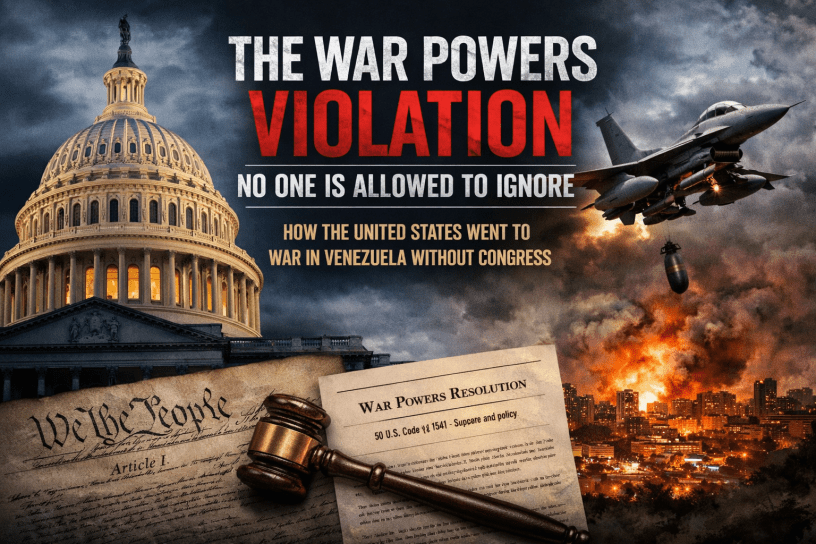
How the United States Went to War in Venezuela Without Congress
By Cliff Potts, CSO, and Editor-in-Chief of WPS News
The Question That Ends the Debate
Before we argue motives, morality, or messaging, one question has to be answered:
Under what legal authority did the United States use military force against Venezuela?
Not rhetorically.
Not emotionally.
Legally.
As of this writing, no clear answer has been provided — because none appears to exist.
What the Constitution Requires
The U.S. Constitution is unambiguous.
Article I grants Congress, not the president, the power to declare war.
The president is commander-in-chief after authorization, not in place of it. This division of authority was intentional. It exists to prevent unilateral wars launched by executive will alone.
If that separation is ignored, the Constitution is not being “interpreted.”
It is being bypassed.
What the War Powers Resolution Requires
After Vietnam, Congress passed the War Powers Resolution of 1973 to close exactly this loophole.
It requires that when U.S. forces are introduced into hostilities, the president must:
- Notify Congress within 48 hours
- Identify the legal basis for the action
- Withdraw forces within 60 days unless Congress authorizes continued action
Crucially, the law allows unilateral action only in response to a direct attack on the United States or its forces.
There has been no such attack.
What Did Not Happen
As of January 3, 2026:
- There is no declaration of war against Venezuela
- There is no new Authorization for Use of Military Force (AUMF)
- There is no existing AUMF that plausibly applies
- There is no evidence of an armed attack on the United States
Invoking counter-narcotics, terrorism designations, or criminal indictments does not change this reality. None of those create war authority under U.S. law.
Law enforcement is not war.
Sanctions are not war.
Political hostility is not war.
Dropping bombs is war.
The AUMF Problem They Can’t Escape
The administration may attempt to gesture toward past AUMFs — particularly those passed in 2001 or 2002.
That argument fails immediately.
Those authorizations:
- were geographically specific
- were enemy-specific
- were time-bound by context
Venezuela is not covered.
Using decades-old authorizations to justify new wars is not precedent — it is abuse.
If Congress did not authorize this war, Congress was sidelined.
Silence Is Not Compliance
Supporters of executive overreach often rely on a quiet trick: delay.
They wait. They deflect. They let the news cycle move on.
But silence does not cure illegality.
If Congress was not consulted before hostilities began, the violation already occurred. Retroactive rationalizations do not change that.
This is not a technical dispute. It is a constitutional breach.
Editorial Condemnation
WPS News condemns the use of U.S. military force against Venezuela as a clear violation of the Constitution and the War Powers Resolution.
If a president can initiate hostilities without congressional authorization, then Congress has surrendered its most fundamental responsibility — and the presidency has absorbed powers it was never meant to hold.
That is not strength.
It is executive lawlessness.
The United States cannot claim to defend democracy abroad while dismantling it procedurally at home. Wars launched without Congress are not decisive leadership. They are constitutional failure.
Recommended publication date: January 4, 2026
APA Citations
U.S. Const. art. I, § 8.
War Powers Resolution, 50 U.S.C. §§ 1541–1548 (1973).
Fisher, L. (2013). Presidential war power. University Press of Kansas.
Discover more from WPS News
Subscribe to get the latest posts sent to your email.

