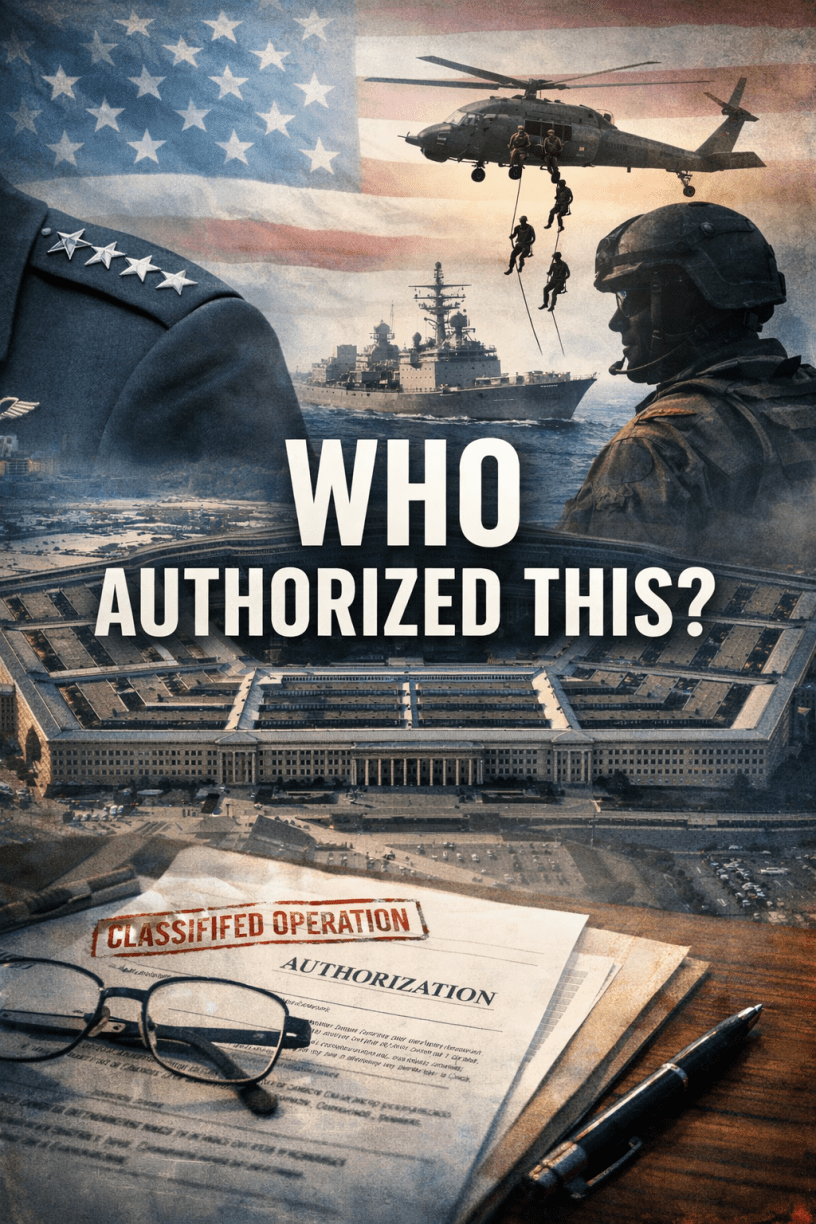
The Chain of Command Behind the Venezuela Strike—and Why Silence Is Not Neutral
By Cliff Potts, CSO, and Editor-in-Chief of WPS News
This Is a Question of Process, Not Politics
Operations of this scale do not occur by accident, impulse, or improvisation.
They occur through process.
When U.S. forces conduct cross-border kinetic action—especially an operation that allegedly results in the seizure of a foreign head of state—that action necessarily moves through a defined command and legal structure. That structure exists to ensure civilian control, lawful orders, and accountability.
This essay asks one narrow, unavoidable question:
Who authorized this operation?
Not rhetorically. Procedurally.
How U.S. Military Authority Actually Works
Under U.S. doctrine, military force does not flow directly from a president’s intent to a trigger being pulled. It moves through a layered system that includes:
- Operational planning by a combatant command
- Approval of mission scope and objectives
- Rules of Engagement (ROE) authorization
- Legal review by uniformed and civilian lawyers
- Command responsibility for execution
This is not conjecture. It is how the system is designed.
The Department of Defense does not operate on verbal impulse. Orders are documented. Legal sufficiency is reviewed. Command responsibility is assigned.
Which means that someone, somewhere, had to sign off.
The Kill–Capture Fork They Cannot Avoid
The alleged Venezuela operation presents a fork in the road that no amount of messaging can bypass.
Either:
A) The mission was capture-focused, in which case:
- What legal authority governs detention?
- Who has custodial responsibility?
- Where is the detainee being held?
- Why has no proof of life been provided?
Or:
B) The mission was kill-capable or ambiguous, in which case:
- Who approved lethal ROE?
- How was compliance with Executive Order 12333 assessed?
- Who certified that the mission did not constitute an assassination?
There is no third option.
Every answer points back to authorization, legal review, and command responsibility.
Down to the Deck Plates—And No Further
At the execution level, commanding officers—captains of ships, aircraft commanders, unit leaders—operate under lawful orders and approved ROE. They are not autonomous actors. They do not declare wars. They execute missions placed in front of them.
U.S. military law is explicit: officers have a duty to refuse manifestly unlawful orders. That duty exists precisely to prevent war crimes and unlawful aggression.
Which leads to a critical institutional implication:
If lawful authority and ROE were clear, the government can say so.
If they were not, responsibility does not rest with those required to execute the mission—but with those who authorized it.
Silence Is a Decision
As of this writing, there has been no public clarification regarding:
- The authorizing authority for the operation
- The legal basis for cross-border force
- The command chain involved
- The ROE under which forces acted
In bureaucratic systems, silence is not neutral. It is a choice.
When an institution designed around documentation and review refuses to clarify process, it invites the inference that clarification would be inconvenient.
That inference is not created by critics.
It is created by absence.
Why This Matters to the System Itself
This is not about punishing individuals. It is about preserving the distinction between lawful military force and executive improvisation.
If the chain of command can be obscured, then:
- Civilian oversight collapses
- Legal review becomes optional
- Command responsibility becomes deniable
That is how professional militaries degrade into instruments of personal power.
Editorial Condemnation
WPS News condemns the continued refusal to disclose who authorized the Venezuela operation and under what legal authority.
In a system built on lawful process, accountability is not optional. If senior officials believe this operation complied with U.S. law and military doctrine, they can state that plainly. If they do not, silence becomes part of the record.
Command responsibility exists whether anyone admits it.
And history is not kind to institutions that confuse secrecy with immunity.
APA Citations
Department of Defense. (2022). Law of War Manual. U.S. Department of Defense.
U.S. Department of Defense. (2023). Joint Publication 3-0: Joint Operations.
Exec. Order No. 12333, 3 C.F.R. 200 (1981).
Comma-separated WordPress tags: command authority, Pentagon, Department of Defense, chain of command, rules of engagement, war powers, Venezuela, military accountability, executive overreach, WPS News
Discover more from WPS News
Subscribe to get the latest posts sent to your email.

