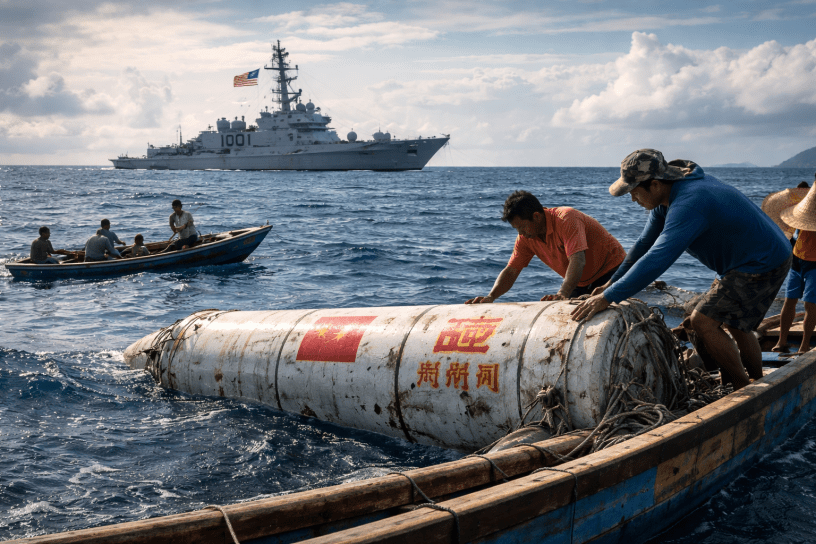
Open-source reporting shows safety hazards and narrative battles shaping maritime pressure in the West Philippine Sea
By Cliff Potts, CSO, and Editor-in-Chief of WPS News
MANILA, Philippines — January 4, 2026 (6:30 p.m. PHT)
In a relatively quiet weekend for what the global press usually calls the South China Sea — but we call the West Philippine Sea — open-source reporting from 6:30 p.m. Friday, January 2 through 6:30 p.m. Sunday, January 4, 2026 didn’t reveal the kind of headline-grabbing collisions, water-cannon confrontations, or missile launches that roiled the region in recent years. Instead, what surfaces from verifiable accounts are two very different threads: maritime safety hazards intersecting with great-power competition, and information warfare shaping public perception of those events.
This matters. Pressure and coercion are not only measured in ships and guns — they are also measured in how events are narrated, framed, and normalized.
I. Fishermen, Rocket Debris & Public Safety in Sulu Waters
The most concrete incident this weekend came not from the deep blue frontier of Scarborough Shoal or Second Thomas Shoal, but much closer to home — in the waters off Pangutaran, Sulu.
Fisherfolk in the vicinity of Barangay Suang Bunah recovered what local authorities describe as suspected rocket debris — an object floating at sea that later showed markings and flags consistent with a rocket stage.
According to Philippine Coast Guard (PCG) reports and corroborating local media accounts, the debris had been sighted and towed by fishermen on December 30, 2025 and remained under barangay custody as national maritime authorities coordinated transfer for further examination and safe disposition.
Despite the limited information on its origin, the presence of suspected rocket debris in Philippine waters is a serious public safety and sovereignty concern on multiple levels:
- Public safety risk: Floating debris from space launches or missile tests can contain sharp metal fragments, hazardous residues, or unstable components hazardous to small boats and swimmers.
- Civilian first responders: The recovery was done by local fishing communities — people whose daily work puts them already on the frontline of maritime risk.
- Jurisdiction and investigation: The PCG’s involvement underscores the state’s responsibility for safety, investigation, and eventual notification of the source if it can be reliably identified.
This is not merely an aviation or space-program footnote — it’s a reminder that global strategic competition can intersect with routine, everyday life in the Philippines’ seas.
II. Information Warfare: Competing Narratives Over Rescue and Presence
Simultaneous with these developments, international reporting from earlier in the weekend also touched on a related theme: narrative framing of events at sea.
On January 2, press reports emerged about a U.S. Navy rescue of three Filipino fishermen adrift in the West Philippine Sea, dated that day and referencing an episode where a small fishing vessel suffered engine trouble and lost power.
While this rescue involved no overt hostile action by other claimants, it quickly became fodder for competing narratives around who operates where and how presence is framed — whether as cooperative humanitarian activity, routine navigation, or geopolitical signaling. In recent years, narratives around “humanitarian assistance” by foreign naval or coast guard vessels — especially in contested waters — have been leveraged to normalize presence or justify expanded operations. Though the U.S. rescue involved no direct confrontation, its portrayal in social and international media illustrates how even lifesaving operations can become strategic messaging tools.
We have seen similar push-and-pull over framing from China and the Philippines in past months — competing accounts over who helped whom, and whether actions were voluntary, coordinated, or self-serving. It’s a reminder that narrative control is part of maritime pressure, particularly when state actors want to portray presence as legitimate, welcomed, or routine.
These narrative battles aren’t just esoteric debates — they shape how local mariners feel about their security and how national leadership justifies diplomatic or operational responses.
III. Quiet Doesn’t Mean Calm
Some readers may judge this weekend as “quiet” compared to past headline-grabbing clashes — like the 2025 collision between Chinese Coast Guard and PLA Navy units near Scarborough Shoal that sent shockwaves through regional diplomacy and naval cooperation. That event, and others like laser illuminations at Second Thomas Shoal, are stark reminders of how fast tensions can escalate.
But quieter episodes like debris in Sulu waters and competing narratives over rescue portrayals matter because they reflect the everyday grind of great-power competition around Philippine sovereignty.
The presence of rocket debris — no matter its true origin — becomes fodder for questions that mainstream reporting won’t satisfactorily answer:
Was this debris from China’s space launch program? Could it have been from another country’s ballistic test program? Did any hazard assessments reach local fishing communities before cleanup?
We don’t have definitive answers yet — only the fact that debris ended up in Philippine waters and the responsibility for safety and investigation rests with Philippine authorities.
At the same time, the U.S. Navy’s rescue of stranded Filipino fishers — a humanitarian headline on its face — also intersects with the larger strategic context of naval presence by external powers in the West Philippine Sea.
IV. What’s Next? What to Watch
As of this writing, no new major clashes or confrontations have been reported in the West Philippine Sea through the afternoon of January 4, 2026. But these incidents emphasize an underappreciated truth of maritime competition:
The battle for perception and safety often unfolds in the margins — far from the dramatic water cannons and ramming maneuvers that make global headlines.
In the coming days, we will be tracking:
- Confirmation or official identification of the rocket debris’ origin and hazard assessment.
- Any statements from national agencies on maritime safety alerts or expanded patrols.
- Continued narrative framing by foreign missions and defense attachés regarding presence, rescue operations, and humanitarian assistance.
- Reactions from fishing communities in the Sulu and West Philippine Sea regions.
For more social commentary, please see Occupy 2.5 at https://Occupy25.com
APA Citations
Philippine Coast Guard reports fishers recover suspected rocket debris off Sulu. (2026, January 3–4). Philippine News Agency. https://www.pna.gov.ph/articles/1266135
Rocket-like debris with Chinese markings found in Sulu waters, says PCG. (2026, January 3). Manila Bulletin. https://mb.com.ph/2026/01/03/rocket-like-debris-with-chinese-markings-found-in-sulu-waters-says-pcg
Rocket debris recovered in Sulu. (2026, January 4). Philippine Star. https://www.philstar.com/nation/2026/01/04/2498583/rocket-debris-recovered-sulu
U.S. Navy says it rescued 3 Pinoy fishers adrift in South China Sea. (2026, January 2). Philippine Star. https://www.philstar.com/headlines/2026/01/02/2498281/us-navy-says-it-rescued-3-pinoy-fishers-adrift-south-china-sea-days
Discover more from WPS News
Subscribe to get the latest posts sent to your email.
 WPS News