By Cliff Potts, CSO, and Editor-in-Chief of WPS News
The argument increasingly used to justify U.S. actions against Venezuela is deceptively simple: Nicolás Maduro was never really president, he had already been convicted as a narco-leader, there was a bounty on his head, and therefore normal legal limits no longer apply. It is an argument that sounds decisive and morally satisfying. It is also wrong — not just politically, but legally and constitutionally.
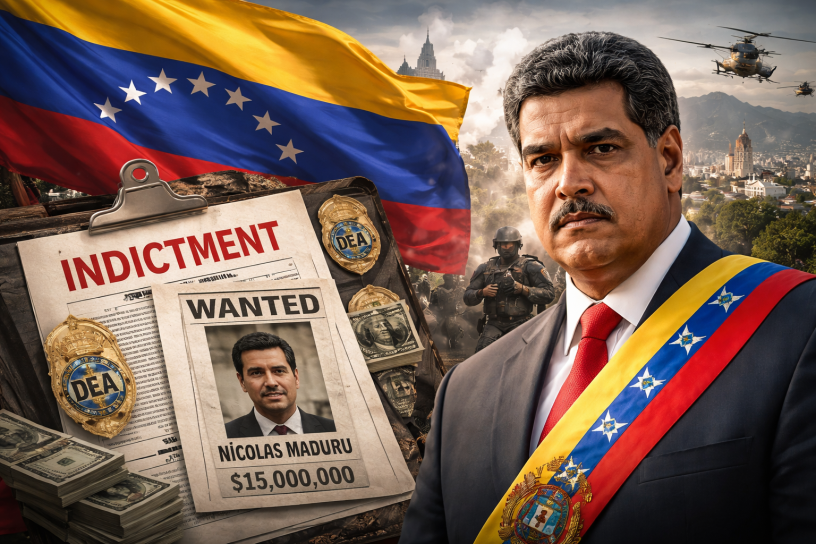
The United States has never convicted Nicolás Maduro. In March 2020, the U.S. Department of Justice announced criminal indictments alleging narco-terrorism and cocaine-trafficking conspiracies. An indictment is an accusation, not a finding of guilt. No U.S. court has tried Maduro. No jury has weighed evidence. No verdict has been rendered. U.S. courts do not convict foreign leaders in absentia, and there is no precedent for doing so. Substituting “convicted” for “indicted” is not a minor semantic error — it converts allegation into assumed guilt.
Sovereignty Does Not Disappear by Declaration
Closely tied to this distortion is the claim that Maduro was “not really president.” International law does not operate on moral approval, electoral preference, or diplomatic sentiment. It operates on de facto control. Maduro exercised control over Venezuela’s military, police, ministries, borders, and governing institutions. That control alone is sufficient to trigger sovereignty and head-of-state treatment under international norms. Legitimacy disputes do not erase sovereignty, because if they did, any powerful state could dissolve another government simply by declaring it illegitimate.
The label “narco-leader” follows the same pattern of legal shortcutting. It is an allegation embedded in charging documents, not a judicial determination. Allegations, even serious ones, do not nullify due process. They do not authorize unilateral force. International law exists precisely to restrain powerful states from acting on accusations alone, particularly when those accusations conveniently align with regime-change objectives.
The claim that there was a “bounty” on Maduro’s head further muddies the legal landscape. What the United States issued was a reward for information under its narcotics and counterterrorism programs. A reward is not a warrant. It does not confer arrest authority, jurisdiction, or legal permission for military action. The word “bounty” is rhetorical, not legal — it reframes investigative tools as instruments of extrajudicial violence.
The argument typically ends with the assertion that Maduro is a dictator, and therefore legal restraints no longer apply. Dictatorship is a political judgment, not a legal category that suspends international law. If dictators automatically forfeited sovereignty, the global system would collapse into permanent conflict. The post-World War II legal order exists precisely to prevent unilateral violence justified by moral labeling.
The real issue here is not whether Maduro is corrupt, repressive, or abusive. Those debates can and should occur. The issue is whether the United States is permitted to collapse accusation into conviction, disagreement into illegitimacy, and power into law. When those distinctions disappear, the rule of law is replaced by imperial discretion.
You can oppose Maduro without abandoning legal limits. What cannot be done — without discarding constitutional principles — is to pretend that indictment equals conviction, that sovereignty disappears by declaration, or that law only applies when it is convenient. Once those lines are crossed, the problem is no longer Venezuela. It is whether the United States recognizes any limits on itself at all.
For more social commentary, please see Occupy 2.5 at https://Occupy25.com
References
Department of Justice. (2020, March 26). Nicolás Maduro Moros and other Venezuelan officials charged in narco-terrorism conspiracy. U.S. Department of Justice.
U.S. Department of State. (2020). Rewards for information on Nicolás Maduro. Bureau of International Narcotics and Law Enforcement Affairs.
U.S. Department of State, Office of the Legal Adviser. (2023). International law and the use of force.
United Nations. (1945). Charter of the United Nations, Articles 2(4) and 51.
Discover more from WPS News
Subscribe to get the latest posts sent to your email.

