What We Don’t Know, Why We Don’t Know It, and Why That Matters
By Cliff Potts, CSO, and Editor-in-Chief of WPS News
Information Is the First Casualty—Every Time
In modern military operations, civilian harm is rarely denied outright.
Instead, it is delayed, blurred, reclassified, or buried.
What distinguishes lawful use of force from illegality is not the absence of harm, but the obligation to account for it—promptly, transparently, and independently.
In the case of Venezuela, that accounting has not occurred.
Absence of Information Is Not Neutral
At present, there is no comprehensive, independently verified accounting of:
- civilian casualties,
- displacement,
- infrastructure damage unrelated to military targets,
- or conditions of detention for seized political figures and associated civilians.
This absence is not accidental.
In contemporary conflicts, information control is a deliberate operational layer, used to manage public perception, diplomatic pressure, and legal exposure.
When facts are delayed, accountability decays.
The Mechanics of Information Control
Information suppression rarely takes the form of outright censorship. It is subtler—and more effective.
It appears as:
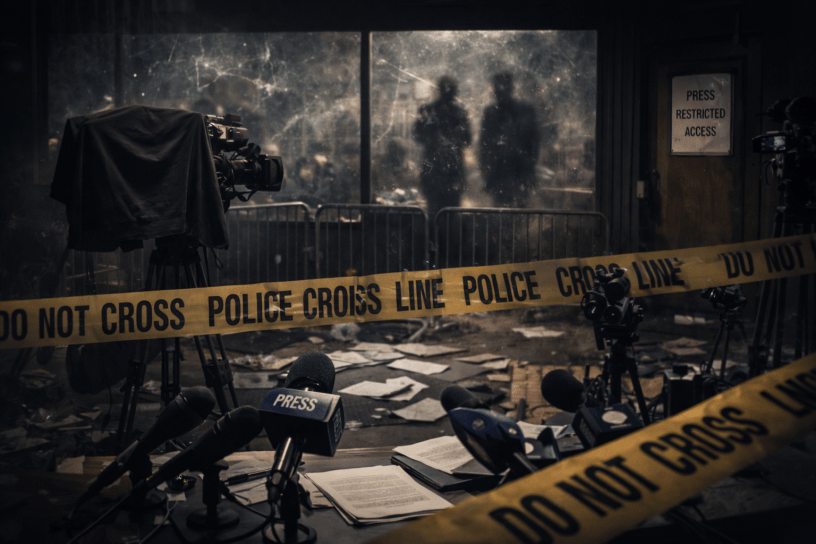
- restricted access for independent journalists,
- delayed briefings that normalize uncertainty,
- classification of routine facts,
- shifting narratives that redefine harm as “unverified” or “under review.”
Each tactic buys time.
Time allows narratives to settle before evidence arrives.
Why Civilian Harm Must Be Accounted for Early
International humanitarian law does not treat civilian harm as an afterthought. Early disclosure serves a specific purpose:
- it constrains escalation,
- signals respect for civilian life,
- and allows corrective action before patterns harden.
When harm is hidden or postponed, military operations drift toward impunity, even if that was not the original intent.
The longer transparency is withheld, the less credible later disclosures become.
Information Control as Legal Shielding
Delaying civilian harm assessments also functions as a form of legal insulation.
Without timely records:
- investigations stall,
- responsibility becomes diffuse,
- and causal chains weaken.
This does not eliminate legal risk—it postpones it. When facts eventually surface, they do so in a far more destabilizing context, often after narratives have already been institutionalized.
Civilians Become Abstract When Data Is Withheld
When names, numbers, and locations are absent, civilians disappear from the discussion entirely.
They become:
- “collateral effects,”
- “operational environments,”
- or “unconfirmed reports.”
This abstraction is dangerous. It shifts debate away from human consequence and toward procedural justification.
International law exists precisely to prevent that slide.
Why This Pattern Is Familiar
From Iraq to Afghanistan to other recent interventions, the sequence repeats:
- force is used,
- harm is acknowledged vaguely,
- verification is delayed,
- public attention moves on,
- accounting arrives years later—if at all.
This is not accidental repetition. It is institutional habit.
Ignoring that history does not protect civilians. It guarantees their invisibility.
Editorial Condemnation
WPS News condemns the failure to provide timely, independent accounting of civilian harm and the continued control of information surrounding the Venezuela operation.
Transparency is not a concession.
It is a legal obligation.
When civilian impact is obscured, legality cannot be evaluated, accountability cannot function, and trust cannot survive. Information control may manage narratives in the short term—but it corrodes legitimacy permanently.
What is hidden today becomes the reckoning tomorrow.
APA Citations
United Nations. (1949). Geneva Conventions.
United Nations Office for the Coordination of Humanitarian Affairs. (2018). Civilian harm mitigation in armed conflict.
International Committee of the Red Cross. (2016). Professional standards for protection work.
Discover more from WPS News
Subscribe to get the latest posts sent to your email.

