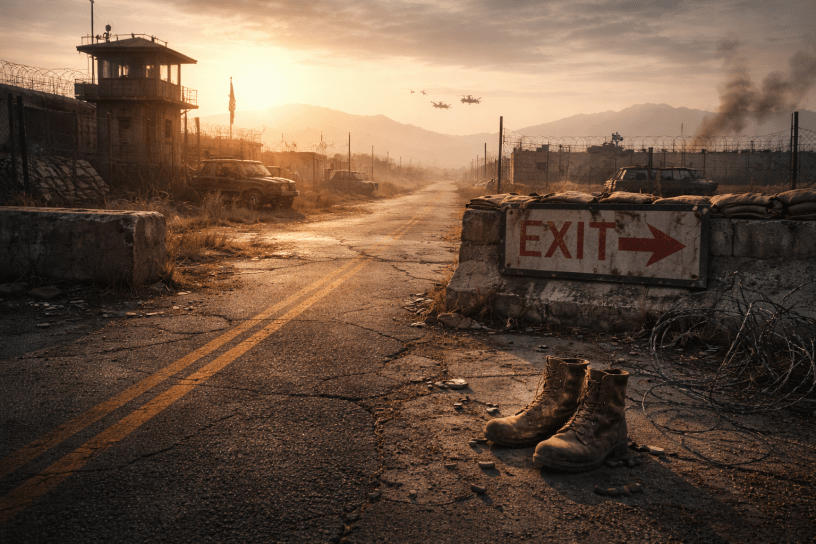
Why Occupations Without Legitimacy Don’t End—They Fray
By Cliff Potts, CSO, and Editor-in-Chief of WPS News
Every Use of Force Carries an Exit Question
Military action that crosses borders creates an obligation that cannot be deferred indefinitely: How does this end?
That question is not tactical. It is political, legal, and moral. And it becomes harder to answer the longer it is avoided.
In Venezuela, the problem is not merely the absence of a clear exit plan. It is that the conditions required for an exit have been structurally undermined.
Legitimacy Is the Gate You Must Pass Through to Leave
Occupations do not end when objectives are declared complete. They end when legitimacy allows withdrawal without collapse.
Legitimacy requires:
- lawful authorization,
- credible consent or settlement,
- and trust that departure will not trigger immediate instability.
When force is used without authorization and political leadership is seized, legitimacy does not erode gradually—it fails immediately. From that point on, every step toward exit becomes riskier than the last.
Why Time Makes It Worse, Not Better
The common assumption is that time stabilizes occupations. History suggests the opposite.
As time passes:
- grievances harden,
- interim arrangements calcify,
- local actors adapt to permanent uncertainty,
- and security measures expand to protect what was meant to be temporary.
What begins as a “holding action” becomes a management problem—and management problems do not resolve themselves.
The Familiar Pattern
The structural pattern is well documented, including in Iraq and Afghanistan:
- Initial objectives are declared achievable.
- Legitimacy is assumed rather than built.
- Security is expanded to compensate for political failure.
- Exit timelines slip.
- Withdrawal becomes associated with risk rather than resolution.
At that stage, leaving is framed as abandonment—even when staying compounds harm.
Exit Requires More Than Control
Control is not a substitute for resolution.
You can secure facilities, protect personnel, and manage logistics indefinitely. None of that creates the political conditions necessary for departure.
An exit requires:
- credible agreements,
- recognized authority,
- and confidence that withdrawal will not immediately unravel.
Without those, force becomes self-justifying. Presence exists to manage the consequences of presence.
The Cost of Pretending the Exit Can Be Deferred
Delaying the exit question does not buy clarity. It buys entrenchment.
Each delay:
- increases sunk costs,
- expands stakeholder dependence,
- and narrows political options.
Eventually, leaders face a false choice between escalation and humiliation—when the real failure occurred much earlier, at the moment legitimacy was forfeited.
Why This Matters Now
The longer an illegitimate intervention continues, the more likely its end will be defined by:
- abrupt withdrawal,
- negotiated concessions under pressure,
- or managed collapse.
None of these outcomes serve civilian populations, regional stability, or the credibility of international law.
They are the predictable result of avoiding the exit question until it can no longer be answered cleanly.
Editorial Condemnation
WPS News condemns the failure to confront the exit problem created by an unlawful use of force.
Occupations do not drift into resolution. They drift into dependency and decay. When legitimacy is absent, time is not neutral—it is corrosive.
Every day the exit question goes unanswered, the answer becomes worse.
APA Citations
United Nations. (1945). Charter of the United Nations.
Chandrasekaran, R. (2012). Little America: The war within the war for Afghanistan. Knopf.
Record, J. (2010). Wanting war: Why the Bush administration invaded Iraq. Potomac Books.
Discover more from WPS News
Subscribe to get the latest posts sent to your email.

