By Cliff Potts, CSO, and Editor-in-Chief of WPS News
Hiawatha, Iowa, USA
January 8, 2026
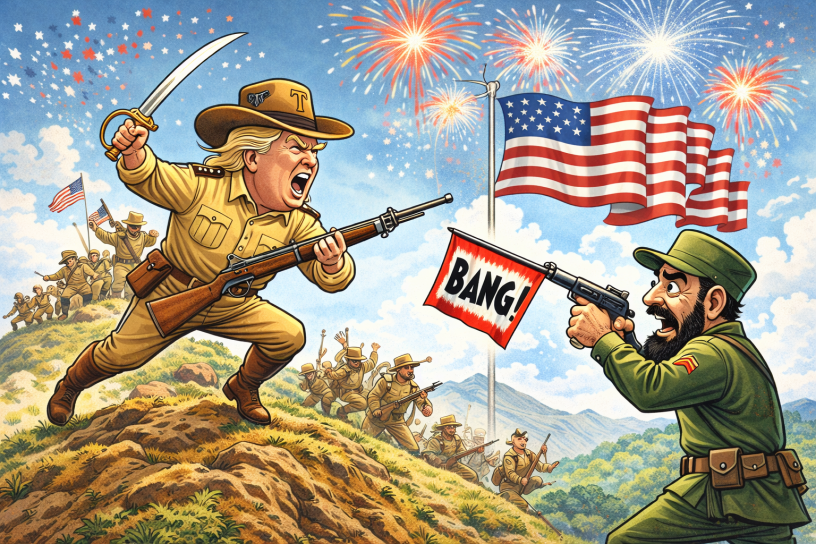
In the immediate aftermath of the U.S. military operation that seized Venezuelan President Nicolás Maduro and transferred him to the United States on federal charges, President Donald Trump has moved quickly from explanation to provocation. Public remarks and off-the-cuff statements have expanded the scope of U.S. intent well beyond Venezuela, raising alarms across the Western Hemisphere and among long-standing U.S. allies.
This shift is not subtle. It signals a moment of escalation that deserves careful scrutiny—not as rhetoric alone, but as a reflection of how power may be exercised in the months ahead.
From Venezuela to Open-Ended Threats
Following the operation in Caracas, Trump framed the action as proof of American dominance, at one point suggesting that the United States was now “in charge” of Venezuela. Rather than limiting the narrative to a single operation, he pivoted almost immediately to broader claims and implications, referencing Greenland, Cuba, Colombia, Mexico, and even Iran in a manner that blurred the line between leverage, threat, and ambition.
This “who’s next?” posture departs sharply from traditional U.S. diplomatic language. It replaces restraint with spectacle and invites foreign governments to interpret American intent through a lens of unilateral force rather than negotiated cooperation.
Reactions From Allies and the Region
The international response has been swift and wary. Denmark, a NATO ally responsible for Greenland’s foreign affairs, rejected any suggestion of U.S. acquisition or control, emphasizing that sovereignty is not a bargaining chip. In Latin America, officials in Colombia and Mexico pushed back against rhetoric that implied U.S. coercion tied to drug enforcement or border policy.
Across the region, Trump’s comments have revived fears of a revived, unilateral interpretation of the Monroe Doctrine—one that treats proximity to the United States as justification for pressure or intervention rather than partnership.
Legal and Constitutional Questions
The expansion of rhetoric also reopens unresolved legal questions surrounding the Venezuela operation itself. International law experts have argued that the use of force violated core principles of the U.N. Charter, which restrict military action absent self-defense or Security Council authorization. At home, lawmakers from both parties have raised concerns about the absence of clear congressional authorization for the operation.
These concerns matter because rhetoric often precedes policy. When expansive threats are normalized without legal accountability, the boundary between lawful authority and executive overreach erodes.
Strategic Risks of Unilateralism
Beyond legality, there are strategic costs to this approach:
- Alliance Strain: Threatening or dismissive language toward allies risks weakening the very coalitions the U.S. relies on for global stability.
- Regional Destabilization: Latin American governments facing internal pressures may respond defensively to perceived U.S. hostility, complicating cooperation on drugs, migration, and security.
- Precedent Setting: Normalizing unilateral seizures and open-ended threats invites reciprocal behavior from other powers less constrained by democratic norms.
Even when backed by overwhelming military capability, power exercised without legitimacy tends to produce resistance rather than compliance.
What “Who’s Next?” Signals
Trump’s post-Venezuela rhetoric suggests a worldview in which military capability substitutes for diplomatic process and where sovereignty is treated as conditional. Whether intended as deterrence or spectacle, the effect is the same: heightened uncertainty and growing concern that U.S. foreign policy is drifting toward coercion as a default tool.
For allies and adversaries alike, the question is no longer rhetorical. It is a test of whether the United States will reaffirm limits—legal, constitutional, and ethical—or continue down a path where power alone defines what is permissible.
Conclusion
The aftermath of Venezuela marks a critical inflection point. “Who’s next?” is not merely a provocative phrase; it is a signal that demands response from Congress, from allies, and from the public. The long-term consequences of this moment will be measured not by short-term displays of dominance, but by whether the United States chooses restraint and law over impulse and force.
For more social commentary, please see Occupy 2.5 at https://Occupy25.com
References (APA)
Associated Press. (2026, January). After Maduro, who’s next? Trump spurs speculation about his plans for Greenland, Cuba and Colombia.
Reuters. (2026, January). Was the U.S. capture of Venezuela’s president legal?
United Nations. (1945). Charter of the United Nations. https://www.un.org/en/about-us/un-charter
U.S. Constitution. (1787). Article I, Section 8; Article II.
Discover more from WPS News
Subscribe to get the latest posts sent to your email.

