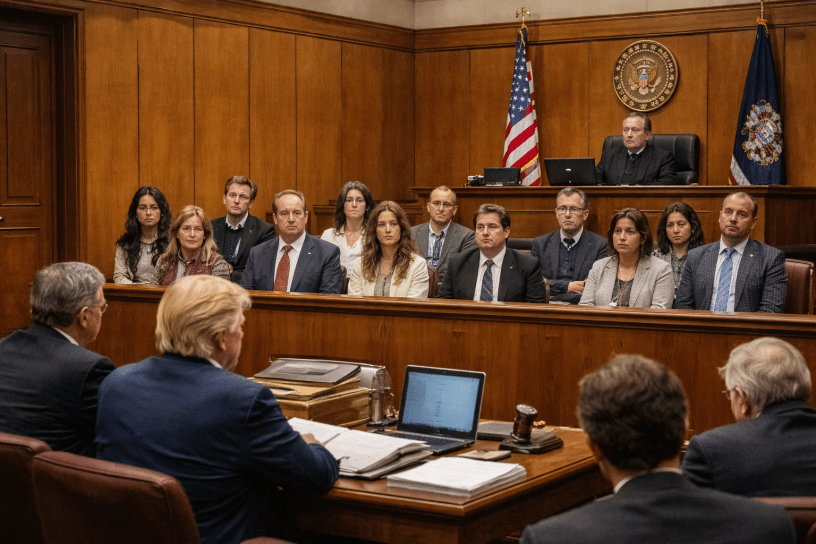
A Jury Trial, Preserved for the Record
By Cliff Potts, CSO, and Editor-in-Chief of WPS News
Hiawatha, Iowa, USA
Published: May 29, 2026
Why This Record Exists
American political history has a recurring problem: events that are inconvenient to power are slowly blurred, minimized, or re-framed until the public no longer remembers what actually happened. This is rarely done through outright denial. Instead, it happens through confusion, omission, and repetition of false impressions until the truth feels uncertain.
This article exists to prevent that outcome.
On May 30, 2024, entity[“politician”,”Donald Trump”,”45th U.S. president”] became the first former president of the United States to be convicted of felony crimes in a criminal court of law. That conviction was not the result of a bench trial. It was not the ruling of a single judge. It was the outcome of a jury trial, decided unanimously by twelve citizens.
Because public discussion since then has frequently confused this criminal case with Trump’s civil proceedings, it is necessary to document — carefully and clearly — what actually occurred.
Case Overview
Jurisdiction: New York Supreme Court, Criminal Term (Manhattan)
Prosecutor: Manhattan District Attorney’s Office
District Attorney: entity[“politician”,”Alvin Bragg”,”manhattan district attorney”]
Judge: entity[“people”,”Juan Merchan”,”new york state judge”]
Trial Type: Jury trial
Verdict Date: May 30, 2024
Trump was charged with 34 felony counts of falsifying business records in the first degree under New York law. The charges stemmed from efforts to conceal reimbursements for a hush-money payment made during the 2016 presidential campaign.
The Charges and the Underlying Conduct
At the center of the case was a $130,000 payment made to adult-film actress entity[“people”,”Stormy Daniels”,”adult film actress”] in October 2016. The payment was intended to prevent her from publicly disclosing an alleged sexual encounter with Trump during the final weeks of the presidential election.
The payment itself was not charged as a crime. The criminal conduct involved how the reimbursement for that payment was recorded.
Trump reimbursed his former lawyer, entity[“people”,”Michael Cohen”,”former trump lawyer”], through a series of checks in 2017. These reimbursements were falsely logged as legal expenses. Prosecutors argued — and the jury ultimately agreed — that these false business records were created to conceal an election-related scheme, elevating the offenses from misdemeanors to felonies.
Pre-Trial Proceedings
Trump pleaded not guilty to all charges.
His legal team filed multiple motions to dismiss, arguing among other things that the charges were time-barred, legally defective, or politically motivated. Judge Merchan denied these motions, ruling that the prosecution had sufficiently alleged criminal conduct and that the case was properly before the court.
Crucially, Trump did not waive his right to a jury trial. No such waiver was ever filed. Jury selection began in April 2024.
Jury Selection and Trial Structure
A panel of prospective jurors was questioned by both the prosecution and the defense in a standard voir dire process. Jurors were selected from Manhattan residents, with alternates designated. The jury was anonymized due to the high-profile nature of the case.
This point bears emphasis: this was a jury trial from start to finish. The jury heard testimony, reviewed documentary evidence, received legal instructions from the judge, deliberated privately, and returned a unanimous verdict.
The Prosecution’s Case
Prosecutors presented a documentary-heavy case supported by witness testimony. Evidence included:
- Business records detailing the reimbursements to Cohen
- Checks personally signed by Trump
- Emails and internal documents describing the payment arrangement
- Testimony from Cohen explaining the purpose of the payment and reimbursement
The prosecution’s theory was straightforward: Trump knowingly caused false business records to be created in order to conceal an election-related expenditure, with the intent to influence the 2016 election.
The Defense Strategy
Trump’s defense focused on attacking Cohen’s credibility, emphasizing his criminal history and prior false statements. Defense attorneys argued that the reimbursements were legitimate legal expenses and that Trump lacked criminal intent.
Trump himself did not testify.
The defense did not successfully rebut the documentary evidence showing how the reimbursements were recorded, nor did it provide an alternative explanation that persuaded the jury.
Trump’s Conduct During the Trial
During the proceedings, Trump repeatedly criticized the case publicly, including comments that drew warnings from the court. Judge Merchan issued limited gag orders to prevent interference with witnesses and court personnel.
When Trump violated these orders, the judge imposed fines and issued formal warnings. These actions were taken on the record and were related directly to maintaining the integrity of the jury process.
Jury Instructions and Deliberations
After closing arguments, Judge Merchan instructed the jury on the elements of the charged offenses and the applicable law. Jurors were reminded that their verdict must be unanimous and based solely on the evidence presented in court.
The jury deliberated over the course of two days.
The Verdict
On May 30, 2024, the jury returned its verdict:
- Guilty on all 34 felony counts
- Unanimous decision
The verdict was read aloud in open court. Trump stood and listened as each count was announced.
This was — and remains — a jury conviction in a criminal case.
Why the Jury Trial Matters
There is a persistent public misconception that Trump’s conviction resulted from a bench trial. This is incorrect.
Unlike Trump’s civil fraud cases, which were decided by a judge, this criminal case was decided by a jury of citizens. That distinction matters historically and legally.
A unanimous jury verdict represents the highest standard of criminal adjudication in the American legal system. It cannot be dismissed as the opinion of a single official.
Conclusion
Donald Trump is a convicted felon as a matter of public record. That conviction was obtained through a lawful criminal process and decided by a jury.
This article exists to ensure that future discussions begin with those facts intact — not blurred, not minimized, and not rewritten.
For more social commentary, please see Occupy 2.5 at https://Occupy25.com
References
New York Supreme Court trial transcripts and filings (2023–2024).
Manhattan District Attorney’s Office press statements.
Contemporaneous reporting from the Associated Press, Reuters, and major U.S. newspapers.
Discover more from WPS News
Subscribe to get the latest posts sent to your email.

