By Cliff Potts, CSO, and Editor-in-Chief of WPS News
CARACAS, Venezuela — January 9, 2026
The Claim of Control
In the days following the U.S. operation that captured Venezuelan President Nicolás Maduro, President Donald Trump publicly suggested that Venezuela was now effectively under American control. The message was simple and forceful: the United States had removed a destabilizing leader, imposed order, and opened the door to stability and relief for the Venezuelan people.
On paper, it sounded decisive. On the ground, it has proven hollow.
What Is Actually Happening Inside Venezuela
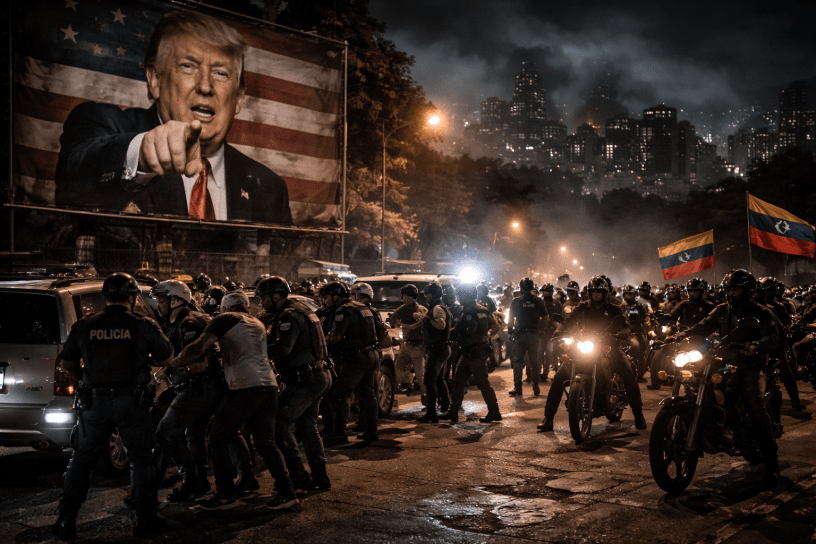
As of January 5, 2026, the Venezuelan government issued a formal decree ordering police and security forces to identify, locate, and arrest Venezuelan citizens accused of assisting, supporting, or promoting the U.S. “snatch-and-grab” operation that removed Maduro. Rather than signaling a country under outside control, the decree demonstrated something else entirely: the Venezuelan state remains fully operational, coercive, and willing to use the U.S. intervention as justification for intensified repression.
Security forces and aligned militias have moved quickly. Checkpoints have multiplied. Detentions are being carried out on vague accusations. Social media posts, private messages, and perceived sympathies are now treated as potential evidence of collaboration.
This is not the behavior of a government that has lost control. It is the behavior of one consolidating it.
A Crackdown Framed as Sovereignty
Venezuelan authorities have framed the arrests as a matter of national defense. In official statements, collaboration with the United States is described as aiding a foreign attack on Venezuelan sovereignty. Under that logic, sweeping arrests become not only permissible but necessary.
The problem is that the definition of “support” is deliberately elastic. It does not require proof of operational involvement. Praise, perceived alignment, or indirect contact can be enough. That ambiguity has handed the state a powerful new tool to silence dissent, intimidate critics, and neutralize political opponents under the cover of patriotism.
The People Pay the Price
For ordinary Venezuelans, the consequences are immediate and personal. Families face sudden detentions without clear charges. Journalists and activists are forced into silence or hiding. Fear, already a constant presence in Venezuelan life, has deepened.
If the U.S. operation was meant to help the Venezuelan people, its early political effect has been the opposite. The intervention has given the government a fresh pretext to intensify civil-rights abuses, while offering no visible improvement in daily life, safety, or freedom for the population at large.
Rhetoric Versus Reality
Trump’s assertion that the United States now “controls” Venezuela collapses under even minimal scrutiny. A country truly under outside control does not conduct its own nationwide manhunt for alleged collaborators. It does not mobilize domestic security forces to suppress internal dissent with impunity. It does not tighten its grip on civil society in response to foreign action.
What is unfolding instead is a familiar pattern: external pressure met with internal repression, with civilians caught in the middle.
Conclusion
The gap between Washington’s rhetoric and Caracas’s reality could not be clearer. The U.S. operation did not liberate Venezuelans from state coercion. It has, at least in the short term, strengthened the government’s justification for repression. Claims of control may play well in political speeches, but they do nothing to protect Venezuelans now facing arrest, surveillance, and fear inside their own country.
Whatever this intervention was meant to accomplish, it has not delivered relief or freedom to the people who needed it most.
For more social commentary, please see Occupy 2.5 at https://Occupy25.com
References (APA)
Reuters. (2026, January 5). Venezuela orders police to find, arrest anyone involved in supporting U.S. attack. Reuters.
Associated Press. (2026, January). Trump says U.S. now in charge after Venezuela operation. AP News.
Washington Post. (2026, January). Venezuela expands crackdown after U.S. intervention. The Washington Post.
Discover more from WPS News
Subscribe to get the latest posts sent to your email.

