By Cliff Potts, CSO, and Editor-in-Chief of WPS News
Minneapolis, Minnesota
January 9, 2026
The Difference Between Pressure and Ignition
History makes one thing painfully clear: societies can endure extreme tension for long periods without breaking. Distrust accumulates, factions harden, institutions hollow out—but nothing moves until legitimacy collapses in public. That collapse is almost always triggered by a shocking event, one that violates a widely shared moral boundary and forces people to reassess what the state is willing to do in their name.
The question now being asked—quietly by some, urgently by others—is whether the recent Minnesota incident rises to that level. Is this the moment that converts background tension into street-level confrontation? Or is it another marker on a road still pointing toward a future rupture?
Why Minnesota Feels Different
Minnesota occupies a strange place in the American political imagination. Minneapolis and St. Paul are often read as progressive, orderly, and institutionally competent. Large parts of the rest of the state are not. Rural, exurban, and culturally conservative communities coexist uneasily with urban centers that dominate national headlines.
That internal contrast matters. When a legitimacy crisis emerges in a place widely perceived as “functional,” it lands harder. People expect failure in broken systems. They are shocked when it appears in systems they thought were holding together.
That shock—if it spreads—can be far more destabilizing than chronic dysfunction elsewhere.
Protest, Policing, and the Question of Force
It’s important to draw a firm line here. Taking to the streets is not the same thing as taking up arms. Protest is a democratic pressure valve; armed confrontation is a different category altogether. The concern is not that people want violence—it’s that miscalculation, fear, or symbolic escalation can produce it anyway.
Minnesota’s firearms laws are often misunderstood in this context. Despite common belief, Minnesota is not a permitless open-carry state. Carrying a handgun—openly or concealed—requires a permit to carry. That legal reality matters, because misinformation alone can drive dangerous assumptions on both sides of a confrontation.
Still, the broader cultural point stands: firearms are visible, normalized in many parts of the state, and woven into local identity in ways that urban commentators sometimes underestimate. Any federal presence—especially one associated with coercive enforcement—must factor that reality into its risk calculus.
This is not an argument for arming up. Quite the opposite. It’s an argument for restraint, clarity, and de-escalation—especially by the state.
ICE and the Legitimacy Trap
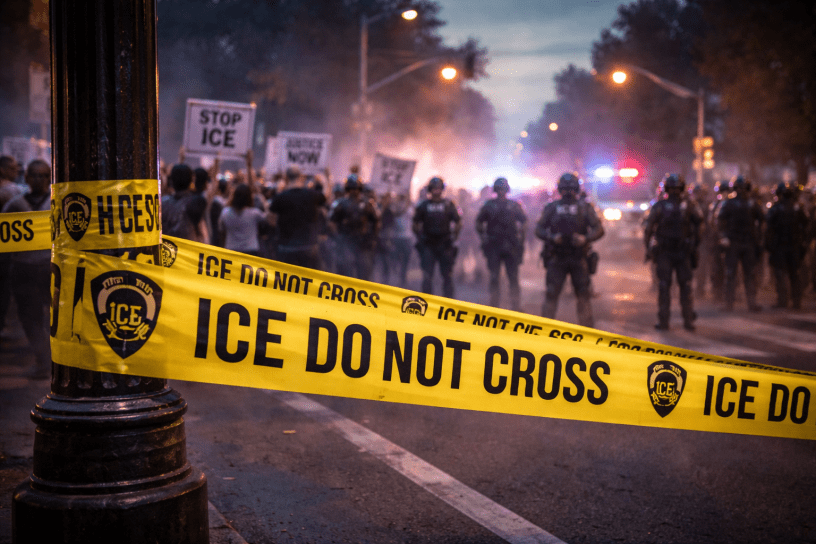
Federal agencies like U.S. Immigration and Customs Enforcement operate at the fault line between law enforcement and political power. When their actions are perceived as opaque, punitive, or unaccountable, they don’t just enforce policy—they test legitimacy.
In volatile environments, legitimacy is everything. Once people believe an institution answers only to itself, every action becomes suspect. Every show of force becomes evidence. Every denial sounds like confirmation.
This is how localized incidents metastasize into national crises—not because people are eager for conflict, but because they stop believing peaceful correction is possible.
Why This Probably Isn’t The Moment—Yet
As serious as the Minnesota incident is, it likely lacks one critical element that historically triggers mass escalation: universal moral clarity. The public is divided not just on policy, but on interpretation—what happened, why it happened, and whether it crossed an unforgivable line.
Civil conflict tends to ignite when ambiguity collapses, not when debate intensifies.
That said, moments like this are cumulative. They train the public on what to expect. They normalize certain risks. They reduce the shock value of future events—which is precisely what makes the next incident more dangerous, not less.
The Real Warning Sign
The real danger isn’t crowds in the streets. It’s a state that treats legitimacy as optional, and a public that slowly concludes accountability will never arrive through normal channels.
If something does eventually break, it won’t be because people wanted chaos.
It will be because they believed the system had already chosen it.
For more social commentary, please see Occupy 2.5 at https://Occupy25.com
APA Citations
Skocpol, T. (1979). States and social revolutions: A comparative analysis of France, Russia, and China. Cambridge University Press.
Arendt, H. (1970). On violence. Harcourt, Brace & World.
Tilly, C. (2003). The politics of collective violence. Cambridge University Press.
Discover more from WPS News
Subscribe to get the latest posts sent to your email.

