By Cliff Potts, CSO, and Editor-in-Chief of WPS News
Baybay City, Leyte, Philippines
January 13, 2026
Two Fatal Encounters, Months Apart, One Fractured Public Trust
Over the past several months, two fatal encounters involving officers of Immigration and Customs Enforcement (ICE) have become touchstones in a growing national crisis of trust.
In September 2025, Silverio Villegas-González, a 38-year-old cook and father of two, was shot and killed by ICE agents during a traffic stop in Franklin Park, Illinois, a suburb of Chicago. Federal authorities asserted justification shortly after the shooting, while family members and community advocates questioned both the necessity of force and the transparency of the investigation.
On January 7, 2026, history repeated itself in Minneapolis. Renee Nicole Good, a woman described by witnesses as posing no immediate threat to anyone, was fatally shot by ICE officers. Once again, federal officials publicly framed the shooting as justified before any independent investigation had been completed.
Separated by months and geography, these two cases are now linked in the public mind by a shared pattern: lethal force followed by rapid narrative closure.
From Isolated Incidents to a Perceived Pattern
The Minneapolis shooting did not occur in a vacuum. It landed in a country already carrying unresolved grief and unanswered questions from earlier ICE-related deaths. When similar official explanations follow different fatal encounters, public confidence erodes—not necessarily because people assume malice, but because they perceive repetition without accountability.
This is how isolated incidents begin to look systemic.
Protests as Vigils, Not Confrontation
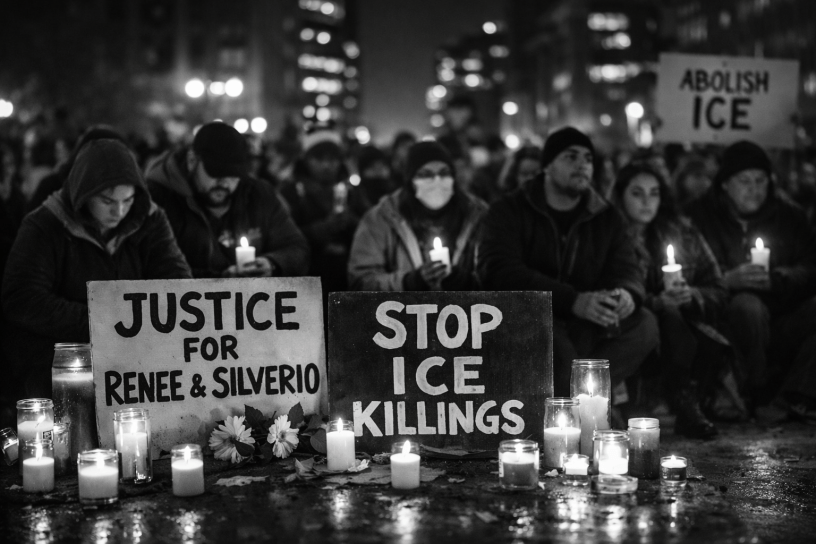
In the aftermath of Ms. Good’s death, protests and vigils have spread across Minneapolis and beyond. Notably, these gatherings have functioned less as confrontational demonstrations and more as collective mourning and solidarity. People are showing up not primarily to shout at authorities, but to stand with one another in shared grief and moral alarm.
This distinction matters. Vigils signal a society still trying to process loss, not one seeking immediate retribution.
The State’s Structural Advantage in Violence
History offers a sobering lesson: violence overwhelmingly favors the state. Governments are trained, resourced, and legally empowered to meet force with force. When public anger tips into physical confrontation, it often supplies justification for repression rather than reform.
That reality does not invalidate outrage. It contextualizes it. Escalation may feel cathartic, but it rarely produces accountability. More often, it entrenches the very dynamics people oppose.
Legitimacy Stress and the Question of Process
What these cases have intensified is not simply anger, but legitimacy stress—a growing doubt that institutions designed to protect the public are capable of impartially investigating themselves.
When deadly force is followed by immediate official justification, and when investigations appear closed rather than opened by scrutiny, trust weakens. Legitimacy depends not only on outcomes, but on visible, independent process. Without that, even accurate findings are likely to be rejected by the public as managed.
Why Language and Restraint Matter
In moments of legitimacy stress, rhetoric shapes outcomes. Language that frames events as inevitable conflict nudges societies toward confrontation. Language that emphasizes restraint, solidarity, and nonviolence opens space for accountability without bloodshed.
This is not an appeal to passivity. It is recognition that moral authority is preserved through restraint, not surrendered by it.
Preparedness as Stabilization, Not Panic
Periods of uncertainty place strain on communities. Longstanding guidance from emergency management agencies recommends that households maintain a basic supply of non-perishable food and essential items sufficient for one to two weeks, typically for natural disasters or temporary disruptions.
Such preparedness serves a stabilizing function. When people are less anxious about immediate needs, they are less likely to act out of fear or desperation during moments of heightened tension.
Upholding Peace While Demanding Accountability
Anger, grief, and fear are understandable responses to repeated loss of life. So is the demand for accountability. The most dangerous inflection point in any legitimacy crisis, however, is when anger turns into confrontation—not because anger is unjustified, but because confrontation plays directly into the state’s structural advantage.
Communities that emphasize peaceful presence, mutual support, and nonviolent expression retain moral credibility and reduce the risk of further loss of life. That restraint does not resolve injustice by itself, but it preserves the conditions under which justice remains possible.
Conclusion
The deaths of Silverio Villegas-González and Renee Nicole Good, months apart, now occupy the same moral space in the public consciousness. Together, they raise a question larger than any single case: whether accountability can still be seen to function when federal force is involved.
What comes next is not predetermined. But how society responds—whether through escalation or restraint—will shape not only public safety, but the legitimacy of the institutions under scrutiny.
Additional Resources
Readers seeking background material on emergency preparedness and nonviolent civic resilience may consult the following publicly available resources:
– Federal Emergency Management Agency (Ready.gov)
– American Red Cross emergency preparedness guidance
– State and local emergency management offices
– https://endfascism.xyz
For more social commentary, please see Occupy 2.5 at https://Occupy25.com
References (APA Style)
Berman, S. (2019). Democracy and dictatorship in Europe. Oxford University Press.
Chenoweth, E., & Stephan, M. J. (2011). Why civil resistance works: The strategic logic of nonviolent conflict. Columbia University Press.
Dahl, R. A. (1971). Polyarchy: Participation and opposition. Yale University Press.
Huntington, S. P. (1968). Political order in changing societies. Yale University Press.
Levitsky, S., & Ziblatt, D. (2018). How democracies die. Crown.
Tyler, T. R. (2006). Why people obey the law. Princeton University Press.
Discover more from WPS News
Subscribe to get the latest posts sent to your email.

