By Cliff Potts, CSO, and Editor-in-Chief of WPS News
Washington, D.C.
An Op-Ed for the Record
Let’s establish this for the historical record, without euphemism and without deference to power.
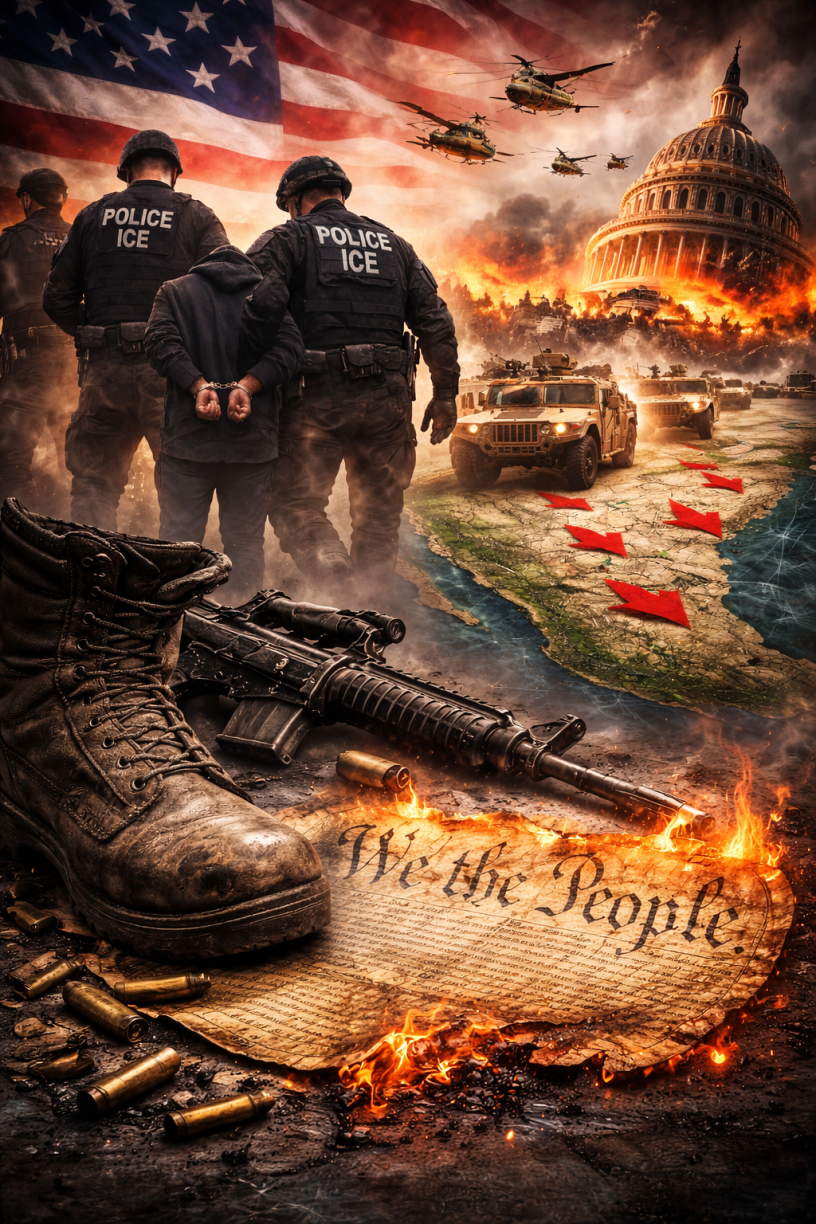
On January 8, 2026, Donald J. Trump, speaking as the sitting President of the United States, said the country would begin “hitting land” in its campaign against drug cartels. He paired that declaration with an unsupported claim that “97 percent” of drugs entering the United States arrive by water. He offered no evidence, cited no agency, and provided no legal framework. The words were militarized. The numbers were invented. The implications were profound.
There is no law-enforcement meaning for “land strikes.” In military doctrine and international law, force delivered on land against land targets means ground operations or land-launched attacks. If those actions occur inside another sovereign nation without consent, they constitute an armed incursion. In plain English, that is an invasion. Mexico promptly rejected the premise of unilateral U.S. military action on its soil, underscoring the legal reality Trump’s words invoked.
Cartels, Drugs, and a Manufactured Casus Belli
Are there drug cartels in Mexico? Yes. That is not in dispute. The real question is why they exist at the scale they do. The answer begins at home.
For decades, the United States has refused to treat drug addiction as a medical and public-health crisis. We criminalize illness, underfund treatment, and then express shock when black markets thrive. The dark joke that Breaking Bad would never have happened in Canada is funny because it’s true: societies that treat healthcare as a right don’t manufacture criminal empires to fill the gaps.
Against that backdrop, threatening military action abroad is not leadership; it is deflection. The President’s invented statistics are used to declare one domain “handled” so escalation into another appears necessary. Available government analyses consistently show that large volumes of illicit drugs—particularly fentanyl—enter the United States overland through ports of entry, concealed in vehicles and commercial cargo. There is no credible public dataset that supports a “97 percent by water” claim. Numbers like that are not mistakes; they are narrative devices.
The Trap of Permanent War
Once the U.S. military goes in, it does not simply leave. That is not ideology; it is history. American forces remain stationed in Germany and South Korea generations after the conflicts that justified their presence. The logic is institutional inertia plus strategic convenience. Call it “Tar Baby diplomacy” if you like: easy to enter, hard to exit, and impossible to disentangle without cost.
Gunboat diplomacy is not American greatness. It is a retreat to the 19th century, dressed up in 21st-century jargon. If this administration wanted to talk about national ambition—Mars, the Moon, science, infrastructure—it could. Instead, it reaches for threats.
A Pattern of Fabrication and Escalation
This is not an isolated episode. The President has a documented propensity to invent dramatic figures and repeat them as fact, even after correction. Fact-checking organizations have repeatedly cataloged exaggerated or impossible claims about crime, immigration, elections, and public health. The specifics vary; the pattern does not. When numbers are treated as props rather than constraints, policy becomes reckless by definition.
The danger is not merely rhetorical. Inflated threats create a sense of emergency. Emergency language invites extraordinary measures. Extraordinary measures are then used to justify further erosions of law. That is how democracies are bent until they break.
Domestic Lawlessness and the Fog of War
The same disregard for legal boundaries shows up at home. Footage of immigration enforcement actions—by U.S. Immigration and Customs Enforcement—has raised serious questions about use of force, due process, and the labeling of unarmed civilians as “domestic terrorists” after the fact. “Truth is the first casualty of war” is not a cliché; it is a warning. When official narratives rush to criminalize victims, accountability collapses.
The Political Endgame
It would be naïve to ignore the political incentives at play. The President has previously mused—on the record—about suspending elections in wartime. Manufacturing or provoking a conflict creates pretexts. Pretexts are how democratic timelines get “paused.” That risk must be named plainly. Wars abroad have always been used to consolidate power at home.
What Must Be Done—Lawfully
Calling this behavior unacceptable is not radical. It is civic duty. The remedy is not violence; it is law. Congressional oversight, judicial review, impeachment where warranted, and—above all—free and fair elections are the constitutional tools available. They must be used.
This is not about party. It is about whether the United States remains a nation governed by evidence, law, and consent—or slides into rule by threat and fabrication. Threatening invasion on the back of invented numbers is not strength. It is folly.
For more social commentary, please see Occupy 2.5 at https://Occupy25.com
This essay is archived as part of the WPS News Monthly Brief Series. Archives are available through Amazon.
References (APA)
Congressional Research Service. (2023). Illicit drug flows and border interdiction: Limitations of seizure data. CRS.
Reuters. (2026, January 9). Mexico rejects U.S. military action after Trump remarks on cartels. Reuters.
Time. (2026, January). Trump signals escalation against drug cartels with “land” comments. Time.
PolitiFact. (2016–2025). Donald Trump fact checks on crime, drugs, and public health. PolitiFact.
Discover more from WPS News
Subscribe to get the latest posts sent to your email.

