By Cliff Potts, CSO, and Editor-in-Chief of WPS News
Baybay City, Leyte, Philippines — March 25, 2026
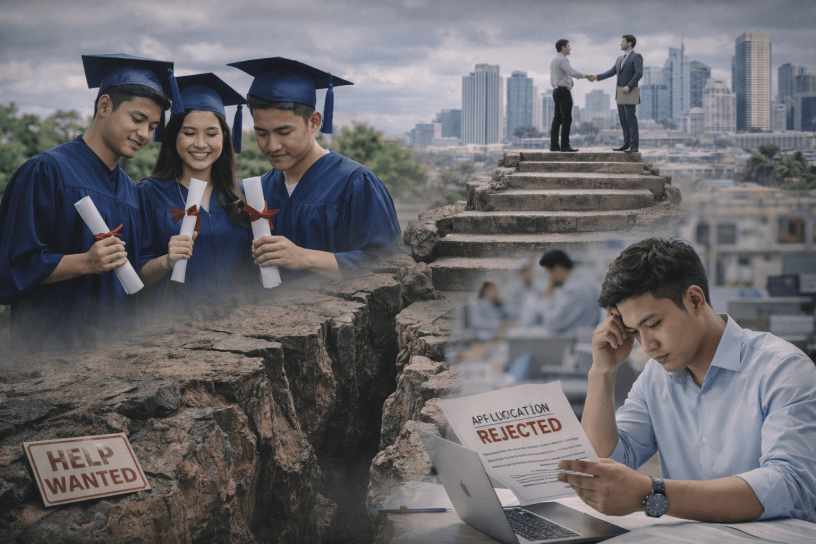
The final weakness in the Philippine youth employment system is not a single policy failure. It is a broken transition. Too many young Filipinos move from school into a labor market that does not clearly recognize their skills, reward their effort, or offer a stable path forward.
This gap between education and employment ties together every issue examined in this series: job instability, low wages, weak progression, migration pressure, remittances, delayed life milestones, and brain drain. When the school-to-work pathway fails, the entire system underperforms.
What a “Broken Pathway” Looks Like
A functional pathway moves a young person from education into productive work with clear steps. In the Philippines, that pathway is often unclear or nonexistent.
Common outcomes include:
- Graduates working in jobs unrelated to their training
- Employers demanding experience for entry-level roles
- Short contracts with no progression
- Skills learned but not formally recognized
As a result, young workers learn quickly that education does not guarantee direction. Mobility replaces planning.
Why the Transition Fails
The breakdown happens at the connection points.
Education and employers operate separately
Schools design programs without reliable, real-time input from employers. Employers hire without trusting credentials.
Experience replaces training
Instead of training workers, firms expect job-ready employees. This pushes risk onto young workers, who must “figure it out” alone.
No accountable owner
No single institution is responsible for making the transition work. Education produces graduates. Employers hire selectively. The gap belongs to no one—and therefore persists.
The Cost of a Broken Transition
For workers, failed transitions mean:
- Lower starting wages
- Delayed careers
- Higher job turnover
- Increased migration pressure
For the economy, the cost is larger:
- Lost productivity
- Wasted education spending
- Shallow skill accumulation
- Slower long-term growth
In simple terms, the country trains people but struggles to use them.
Short-Term Fixes That Can Work Now
Repairing the pathway does not require a complete system rebuild.
Mandatory Work-Integrated Learning
Every degree or technical program should include structured work placement. Graduates should leave school with verified experience, not just credentials.
Recognized Skill Signals
Employers need clear, trusted markers of skill. Modular certifications tied to real tasks work better than broad degrees alone.
Entry-Level Hiring Standards
Define what “entry-level” actually means. If experience is required, the role is not entry-level. Clear standards reduce hiring gamesmanship.
Long-Term Structural Repairs
Lasting reform requires coordination.
Shared Responsibility
Education providers, employers, and government must share accountability for outcomes, not just enrollment or hiring numbers.
Outcome-Based Program Review
Schools and training programs should be evaluated on graduate employment quality, not just graduation rates.
Domestic Career Pathways
Workers must be able to see a future inside the Philippine economy. Without visible progression, migration will always win.
Why This Matters More Now
Global labor markets are becoming less stable for foreign workers. Anti-immigrant politics, tighter visa rules, and weaker protections increase risk abroad. The Philippines can no longer rely on overseas work as a pressure valve for domestic failure.
If young Filipinos cannot move smoothly from school into meaningful work at home, the country will continue to lose both talent and growth potential.
Strategic Reality
From a chief strategy officer perspective, fixing the school-to-work transition offers the highest return on reform effort. It improves wages, retention, productivity, and domestic stability at the same time.
No labor strategy works if the starting gate is broken.
Conclusion
The Philippines does not lack talent. It lacks a reliable way to move talent into productive use. Repairing the school-to-work pathway will not solve every problem, but without it, none of the other reforms can fully succeed.
A nation that invests in its people must also build clear paths for them to thrive. The future of the Philippine economy depends on whether those paths finally work.
References
Asian Development Bank. (2024). School-to-work transitions in Southeast Asia. Manila: ADB.
International Labour Organization. (2023). Youth employment and labor-market entry. Geneva, Switzerland.
Philippine Institute for Development Studies. (2024). Graduate employment outcomes and labor matching. Quezon City, Philippines.
Discover more from WPS News
Subscribe to get the latest posts sent to your email.

