By Cliff Potts, CSO, and Editor-in-Chief of WPS News
Baybay City, Leyte, Philippines — January 18, 2026
What Is Known
Across much of the Western world, the public narrative still emphasizes stability. Elections proceed on schedule. Markets open and close as expected. Alliances remain formally intact. Governments continue to speak in the language of continuity.
At the same time, a growing number of indicators point in a different direction. Public trust in institutions has declined steadily over the past decade. Voter participation in many democracies remains uneven and increasingly polarized. News consumption is fragmented, with large portions of the population disengaged from traditional reporting altogether.
Internationally, conflicts persist without clear pathways to resolution. Diplomatic norms remain in place, but they are increasingly tested by expulsions, sanctions, and rhetorical escalation. Economic pressures—debt, inflation sensitivity, supply-chain fragility—are no longer treated as temporary disruptions but as background conditions.
None of this represents sudden collapse. What is observable instead is endurance: systems continuing to function despite visible strain.
What Is No Longer Pretended
During daylight hours, Western political life is dominated by performance. Statements are calibrated. Press briefings are managed. Public disagreements are framed as manageable disputes within a stable order.
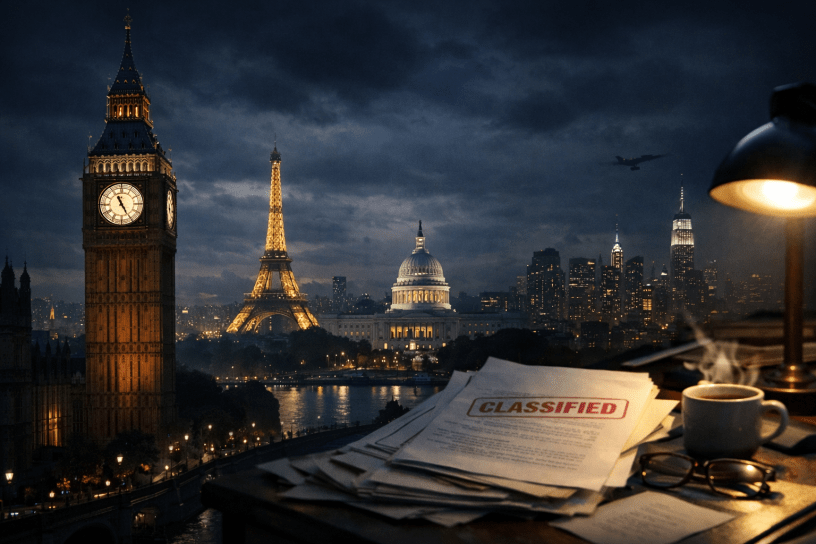
Late at night, a different reality becomes easier to see.
Policy documents quietly acknowledge long-term risks that public speeches avoid. Military planning assumes extended instability rather than quick resolutions. Economic forecasts increasingly hedge against “baseline uncertainty” rather than growth.
These are not secrets. They are simply not foregrounded.
From outside the Western media cycle—from Asia, Africa, or Latin America—the contrast is more obvious. The West continues to describe itself as the central reference point, even as more countries plan their futures without assuming Western leadership or intervention.
Analysis: Power That Persists Without Confidence
The defining feature of the current Western moment is not decline alone, but persistence without conviction.
Institutions remain operational, yet they are no longer broadly trusted. Authority still exists, but it increasingly relies on procedure rather than legitimacy. Rules are enforced, but often without shared belief in their fairness or long-term purpose.
This creates a specific kind of fragility. Systems can absorb shocks, but they struggle to generate consensus. They can manage crises, but they rarely resolve them. Each problem is treated as an exception rather than a symptom.
From a strategic perspective, this is dangerous. Power that continues without confidence tends to default to maintenance rather than reform. It becomes risk-averse, reactive, and increasingly dependent on narrative control.
Late at night—after markets close, after press cycles end—this reality is easier to acknowledge. The West is not collapsing, but it is no longer convincingly leading.
Why the Night Perspective Matters
The timing of this assessment is not symbolic. It is practical.
In the Western world, real decisions are often made outside public view: in closed meetings, internal memos, and long-term planning sessions that assume instability as a given. Public-facing optimism persists because it must. Governance requires reassurance.
From the Philippines, and from much of the Global South, the gap between reassurance and preparation is clear. Countries here are diversifying partnerships, hedging security relationships, and adjusting economic strategies accordingly.
They are not waiting for the West to recover its certainty.
What Comes Next
The question is not whether the Western order will end overnight. It will not. The question is whether it can adapt openly, rather than quietly, to the conditions it already recognizes after hours.
If it cannot, the world will continue to adjust without it.
This series will examine those adjustments—where they are happening, why they are accelerating, and what they mean for a global order that increasingly functions on autopilot.
For more social commentary, please see Occupy 2.5 at https://Occupy25.com
This essay is archived as part of the ongoing WPS News Monthly Brief Series available through Amazon.
References
Brown, T. (2022). Trust and Democratic Stability in Advanced Economies. Journal of Political Studies, 48(3), 411–429.
Keller, R. (2023). Governance Under Persistent Uncertainty. Policy Futures Review, 12(1), 22–39.
Singh, M. (2024). The Post-Unipolar World: Strategic Adaptation Beyond the West. Global Affairs Quarterly, 19(2), 55–71.
Discover more from WPS News
Subscribe to get the latest posts sent to your email.

