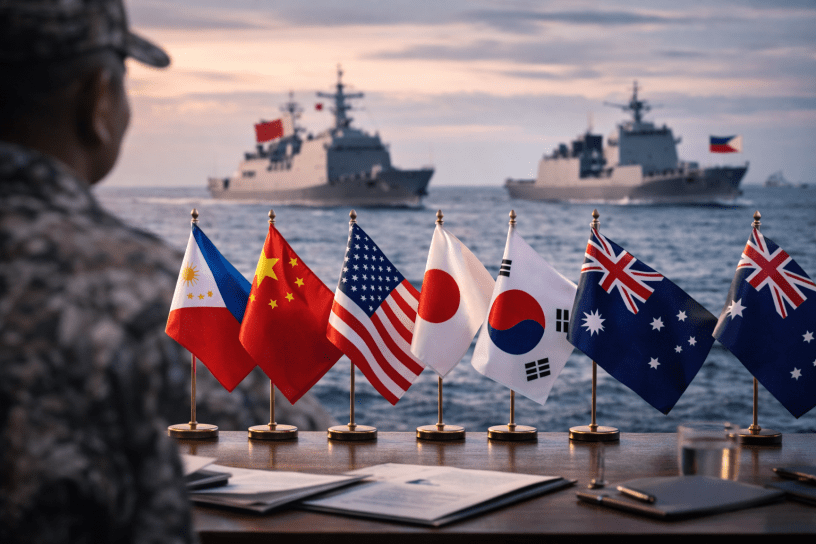
By Cliff Potts, CSO, and Editor-in-Chief of WPS News
Baybay City, Leyte, Philippines — January 25, 2026
What Is Known
The global system is no longer organized around a single Western center of gravity. Power is increasingly dispersed across regions and issue areas. In this environment, middle states like the Philippines face a more complex strategic landscape—one that rewards flexibility, clarity of interest, and disciplined alliance management.
China is now a central actor in this post-Western order. Its economic scale, industrial capacity, and regional proximity make it unavoidable in Philippine strategic planning. At the same time, China’s record of behavior toward neighboring regions and contested territories is well documented: sustained pressure in Tibet, recurrent border crises with India, coercive actions toward Vietnam, and persistent maritime pressure in the West Philippine Sea.
These actions are not abstract. They form the operational context in which Philippine policy must function.
What Has Changed
In a post-Western world, alignment is no longer binary. States are not choosing between blocs so much as managing exposure to risk.
For the Philippines, this means acknowledging two realities at once: China is a major economic partner and a capable regional power; China is also an assertive actor that has demonstrated a willingness to use coercion to advance territorial and strategic objectives.
Treating China as either a benefactor or an inevitable adversary oversimplifies the problem. The task is not confrontation, but constraint.
Analysis: Maneuvering Around an Alpha Predator
China’s regional behavior follows a consistent pattern. It applies pressure incrementally, avoids outright war, and tests the limits of resistance—particularly where responses are fragmented or ambiguous. This is characteristic of an alpha predator operating in a crowded environment.
For states on China’s periphery, survival and autonomy depend on reducing vulnerability rather than provoking escalation. That requires three things: credible deterrence through partnerships, economic resilience, and diplomatic coherence.
No single alliance can provide all three. A diversified strategy is essential.
Strategic Principles for the Philippines
First, prioritize alliances with stable, prosperous states.
Economic resilience underpins strategic autonomy. Partnerships with countries that are economically stable and technologically advanced—such as Japan, South Korea, Australia, and select European states—provide investment, trade diversification, and capacity-building without excessive political conditionality.
Second, favor partners with demonstrated respect for international norms.
While no state is perfect, alignment with countries that broadly adhere to international law, maritime conventions, and dispute-resolution mechanisms strengthens the Philippines’ legal and diplomatic position. Consistency matters more than rhetoric.
Third, pursue philosophical alignment without ideological rigidity.
The Philippines benefits from partners that recognize development as contextual, not prescriptive. Cooperation should be based on mutual interest and respect for domestic priorities, rather than one-size-fits-all governance models.
Fourth, keep engagement with China transactional and bounded.
Economic engagement can continue where interests align, but it should be structured to limit dependency and exposure. Clear red lines—especially in maritime and security domains—must be maintained and reinforced through collective backing.
Why This Approach Works
In a fragmented global order, influence accrues to states that can maneuver rather than posture. The Philippines does not need to lead a bloc or choose sides publicly. It needs to remain difficult to coerce and expensive to isolate.
By anchoring its strategy in diversified alliances, economic stability, and principled but pragmatic diplomacy, the Philippines increases its room to maneuver—while signaling that coercive behavior will encounter coordinated resistance.
A Closing Assessment
The post-Western world is not inherently hostile to Philippine interests. It is simply less forgiving of strategic confusion.
China will remain a major player. It will continue to test boundaries. The Philippines’ task is not to confront that reality emotionally, but to manage it intelligently—by standing with partners that are stable, reliable, and aligned with a cooperative approach to international order.
In a world without a single referee, the safest position is not neutrality, but preparedness.
For more social commentary, please see Occupy 2.5 at https://Occupy25.com
This essay is archived as part of the ongoing WPS News Monthly Brief Series available through Amazon.
References
Acharya, A. (2018). The End of American World Order. Polity Press.
Fravel, M. T. (2019). Active Defense: China’s Military Strategy Since 1949. Princeton University Press.
International Crisis Group. (2024). China’s Maritime Strategy in Southeast Asia.
United Nations Convention on the Law of the Sea. (1982).
Discover more from WPS News
Subscribe to get the latest posts sent to your email.

