By Cliff Potts, CSO, and Editor-in-Chief of WPS News
Baybay City, Leyte, Philippines — January 23, 2026
Reporting
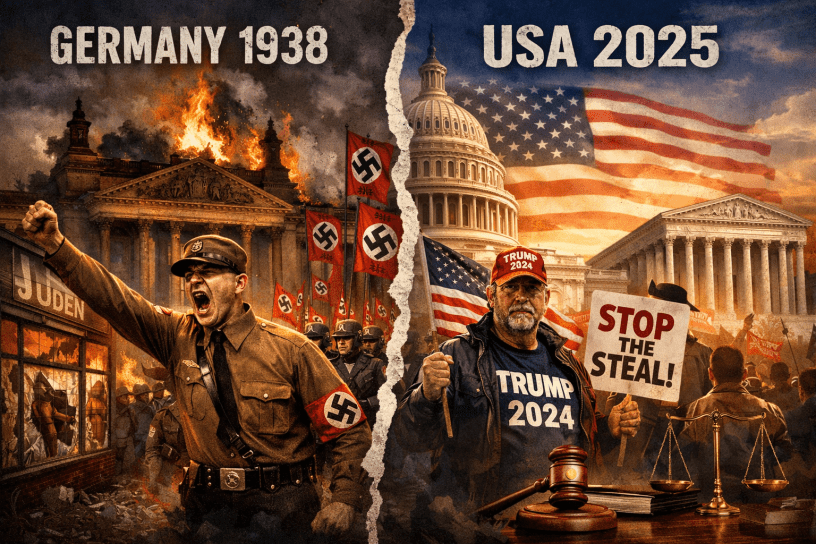
Public commentary increasingly compares the United States in 2025 to Nazi Germany in 1938.
Historians note this comparison is inaccurate.
By 1938, Germany had already ceased to function as a democracy. Adolf Hitler consolidated power between 1933 and 1934 through emergency decrees, suppression of political opposition, elimination of independent unions, control of the courts, and state domination of the media. The November 1938 Kristallnacht pogrom occurred within a fully established dictatorship.
In contrast, the United States in 2025 retains competitive elections, independent state governments, active courts, and pluralistic media. While democratic norms are under pressure, the institutional structure of the country has not been eliminated.
Analysis
1938 Germany Was a Consolidated Dictatorship
By 1938:
- Opposition parties were illegal
- Civil society organizations had been dissolved or absorbed
- Courts operated under party control
- Political violence was normalized and state-directed
Kristallnacht was not a warning sign. It was evidence that democratic collapse had already occurred.
Any comparison using 1938 as an “early stage” misunderstands the historical timeline.
The United States More Closely Resembles Germany in Early 1933 — With Key Differences
Some structural similarities exist:
- Heavy use of emergency language
- Attempts to delegitimize independent media
- Scapegoating of internal populations
- Pressure on civil servants and institutions
However, critical differences remain.
Structural Differences That Matter
Federalism
Germany could be centralized quickly. The United States cannot. States retain control over elections, law enforcement, and litigation against the federal government.
Judicial Independence
German courts were captured early. U.S. courts continue to block, delay, and review executive actions.
Political Competition
Germany outlawed opposition parties. The United States still has functioning multiparty elections and legal opposition.
Political Violence
Nazi Germany integrated party militias into governance. The United States has extremist actors but no legalized ruling-party paramilitary force.
Political Context and Historical Continuity
During the 2025 convention cycle, the author publicly argued that the Republican Party now operates as an American fascist party. That position is not withdrawn here. The Republican Party has engaged in fascist or authoritarian practices dating back to the era of Franklin D. Roosevelt, and the historical record supporting that claim is extensive. However, the presence of a fascist political party does not automatically mean the United States will fall into a consolidated dictatorship in the manner of Nazi Germany or Francisco Franco’s Spain. This assessment does not rely on American exceptionalism. It rests on historical repetition and political culture. The United States has encountered authoritarian movements before and resisted them. Americans are fractious, stubborn, and historically unwilling to submit quietly. That resistance does not guarantee success, but it does materially reduce the likelihood of an uncontested authoritarian collapse comparable to Germany in the 1930s.
Why 1938 Comparisons Are Dangerous
Equating the United States with Nazi Germany in 1938:
- Erases meaningful institutional differences
- Encourages fatalism
- Undermines public understanding of how democratic collapse actually occurs
Democracies fail before they look like dictatorships — not after.
Indicators That Would Signal a True Shift
Historical evidence suggests the following would mark a decisive break:
- Federal seizure of state election authority
- Mass purges of nonpartisan civil servants
- Criminalization of opposition politics as a category
- Legal protection for political violence
- Structural elimination of viable opposition parties
These conditions have not yet been met.
Conclusion
The United States in 2025 is under stress.
It is not Nazi Germany in 1938.
The difference is not rhetorical. It is structural.
Those structures remain effective only if they are used before they are dismantled.
References (APA)
Evans, R. J. (2005). The Third Reich in Power. Penguin Books.
Kershaw, I. (2008). Hitler: A Biography. W. W. Norton & Company.
United States Constitution. (1787).
United States Supreme Court. (n.d.). Role of the federal judiciary.
United States Federal Register. (2025). Executive orders and presidential actions.
For more social commentary, please see Occupy 2.5 at https://Occupy25.com
This essay is archived as part of the ongoing WPS News Monthly Brief Series available through Amazon.
Discover more from WPS News
Subscribe to get the latest posts sent to your email.

