By Cliff Potts, CSO, and Editor-in-Chief of WPS News
Baybay City, Leyte, Philippines — January 25, 2026
The year was 1970
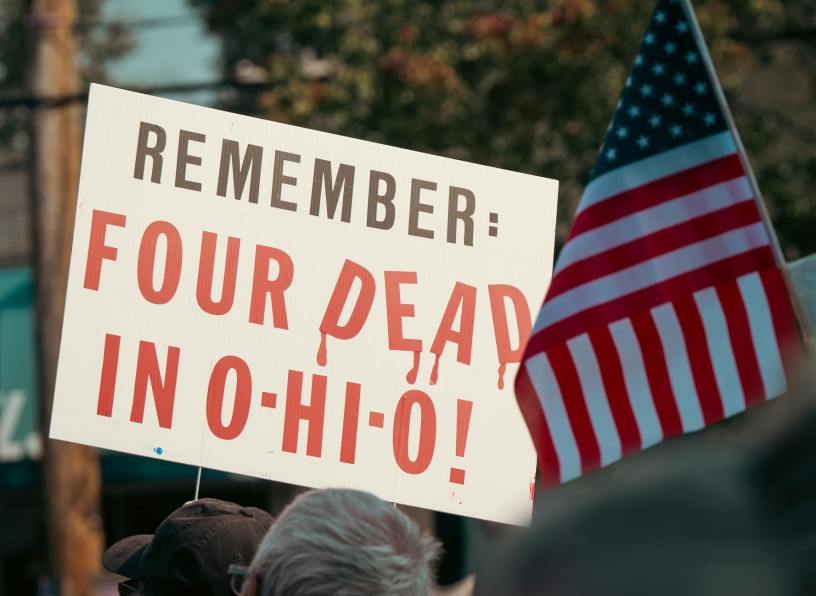
The Kent State shootings occurred on May 4, 1970, at Kent State University in Kent, Ohio. Ohio National Guard troops fired on students during an anti–Vietnam War protest, killing four and wounding nine. One of the wounded, Dean R. Kahler, was shot in the back and permanently paralyzed from the waist down.
The students killed were Allison Krause, Jeffrey Miller, Sandra Lee Scheuer, and William Knox Schroeder.
What the National Guard did on May 4
At approximately 12:24 p.m., Ohio National Guard troops turned and fired on students. The volley lasted roughly 13 seconds. In that span, 28 guardsmen discharged approximately 67 rounds, according to the most commonly cited reconstructions.
Early claims that guardsmen were responding to sniper fire or imminent lethal threat did not withstand later investigation. No credible evidence of sniper fire was ever established. The students were unarmed.
Who shot them: what the historical record actually shows
This is where the public record becomes uncomfortable and imprecise.
It is known that multiple guardsmen fired their weapons. What has never been conclusively established in court is which individual guardsman fired which fatal shot. That lack of precise attribution played a major role in the failure of criminal accountability.
What is firmly documented are the names of the guardsmen who were formally charged in federal court.
The guardsmen charged
Eight members of the Ohio National Guard were indicted under federal civil rights law:
- Lawrence Shafer
- James McGee
- James Pierce
- William Perkins
- Ralph Zoller
- Barry Morris
- Leon H. Smith
- Matthew J. McManus
These names appear in the official court record. They are not speculative and not symbolic.
In addition, some historical accounts identify Sergeant Myron Pryor as firing a pistol at the start of the volley. That detail appears in multiple reconstructions, but it does not resolve responsibility for the four fatal shots.
Legal consequences: the answer most people do not want
No Ohio National Guard member was ever criminally convicted for the killings or the injuries at Kent State.
The principal federal prosecution, brought under 18 U.S.C. § 242 (deprivation of rights under color of law), collapsed when the trial court ruled that prosecutors had not met the statute’s requirement to prove specific criminal intent beyond a reasonable doubt. The defendants were acquitted by judgment of the court.
This outcome is central to understanding Kent State: four citizens were killed, nine were wounded, and yet the legal system imposed no criminal penalties on any shooter.
Civil cases and the late apology
Years later, civil litigation produced a settlement totaling $675,000 for the victims and families. As part of that settlement, Ohio officials and National Guard representatives signed a statement expressing “regret” for the shootings.
There was no admission of wrongdoing and no assignment of individual responsibility.
Money changed hands. Careers continued. History moved on.
What became of the guardsmen
Most of the guardsmen involved returned to private life. Some spoke publicly decades later; many did not. There is no single, official roster tracking their later lives, careers, or public accountability.
What is clear is this: the system allowed lethal force against unarmed civilians, failed to impose criminal consequences, and then quietly closed the file.
Why Kent State still matters
Kent State is not simply a tragedy of the Vietnam era. It is a structural case study in how states respond to dissent:
- Militarized responses escalate rapidly.
- Official narratives can outpace verified facts.
- Legal systems often protect institutions rather than civilians.
- Accountability can fail even when deaths are undeniable.
This is not ancient history. It is a pattern.
Corrections and uncertainty
- The shootings occurred on May 4, 1970.
- Four students were killed; nine were wounded.
- Dean Kahler was permanently paralyzed.
- Eight guardsmen were criminally charged.
- No guardsman was convicted.
- A definitive court-established mapping of fatal bullets to individual shooters does not exist in the public record.
Why Now?
This record is maintained for historical clarity rather than retroactive judgment. The Kent State shootings demonstrate a persistent structural imbalance: when state actors employ lethal force against civilians engaged in protected civil activity, the human consequences are immediate and enduring, while legal accountability is often fragmented or absent. Families absorb permanent loss, survivors carry lifelong injury, and institutions continue largely intact. Preserving this history is not an act of accusation, but of accuracy—documenting how power, process, and evidentiary standards can converge to leave even confirmed civilian deaths without criminal consequence.
For more social commentary, please see Occupy 2.5 at https://Occupy25.com
This essay will be archived as part of the ongoing WPS News Monthly Brief Series available through Amazon.
Discover more from WPS News
Subscribe to get the latest posts sent to your email.

