By Cliff Potts, CSO, and Editor-in-Chief of WPS News
Baybay City, Leyte, Philippines — February 7, 2026 (07:05 PhST)
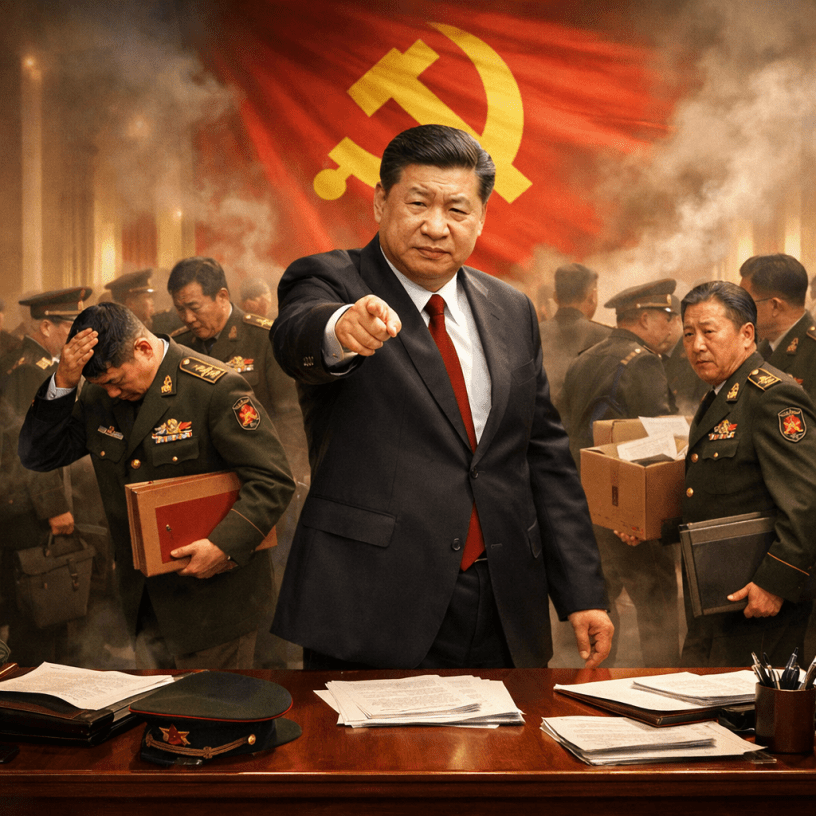
China’s senior military leadership is undergoing its most severe internal shake-up in decades. President Xi Jinping has removed or sidelined some of the People’s Liberation Army’s (PLA) highest-ranking officers under the familiar charge of “serious violations of discipline and law.” While officially framed as an anti-corruption drive, the scope and timing of the purge suggest something more consequential: a deliberate consolidation of political control over the armed forces at a moment when Beijing’s long-term plans toward Taiwan remain unresolved.
This action raises a critical question for regional security planners: does weakening and reshaping the PLA leadership bring China closer to a military move against Taiwan, or does it temporarily push such ambitions further out of reach?
A purge at the very top
The removal of senior commanders from the Central Military Commission (CMC), including figures once considered close allies of Xi, marks a sharp escalation in China’s ongoing military discipline campaign. The CMC is the apex of command authority in China’s armed forces. Reducing its effective membership and concentrating decision-making power in the hands of the party chairman fundamentally alters how military advice flows to the top.
Publicly, Beijing describes these actions as necessary to root out corruption, a persistent problem in the PLA tied to promotions, procurement, and command appointments. Privately, analysts increasingly view the purge as a political act aimed at eliminating autonomous power centers within the military and ensuring that loyalty to Xi personally outweighs institutional seniority or combat experience.
The message is unmistakable: no rank, résumé, or past service guarantees protection if political trust is in doubt.
Control versus competence
From a party perspective, tighter control over the military reduces the risk of internal dissent and reinforces the principle that the PLA exists to serve the Communist Party first. In theory, this should strengthen unity and discipline.
In practice, it comes with trade-offs. Modern warfare—particularly a complex, high-risk operation such as a cross-strait campaign against Taiwan—depends on experienced planners, honest internal debate, and commanders willing to surface bad news. Removing seasoned officers and replacing them with politically vetted loyalists risks hollowing out that professional depth.
The PLA has spent more than two decades modernizing for joint operations across air, sea, cyber, and space domains. Leadership instability at the top disrupts continuity, slows decision cycles, and encourages risk-averse behavior among remaining commanders who may fear becoming the next target of investigation. A military governed by fear tends to defer upward rather than adapt dynamically on the ground.
Short-term impact on Taiwan scenarios
In the near term, this purge likely reduces the probability of a sudden Chinese military move against Taiwan. Large-scale operations require months—if not years—of detailed planning, rehearsals, and trust between civilian leaders and their top commanders. An internally unsettled PLA is poorly positioned to execute such a campaign with confidence.
Stabilizing the command structure, appointing replacements, and restoring functional coordination across services will take time. During this period, Beijing is more likely to rely on pressure tactics short of war: air and naval operations around Taiwan, economic coercion, diplomatic isolation, and gray-zone actions designed to exhaust rather than invade.
For Taiwan and its partners, this does not mean the threat has disappeared. It means the form of pressure is more likely to remain indirect while the PLA rebuilds its internal hierarchy.
Long-term risks of centralized decision-making
Paradoxically, the longer-term implications may be more dangerous. By purging senior figures who may have exercised caution or offered dissenting assessments, Xi is narrowing the range of advice he receives. Strategic decisions—especially those tied to national identity and regime legitimacy—become more personal and less institutional.
Taiwan occupies a unique place in Chinese political narrative. It is framed not merely as a territorial issue but as a test of national rejuvenation and party authority. In an environment where loyalty is prized over professional candor, there is a real risk that optimistic assessments go unchallenged and worst-case scenarios are discounted.
History offers repeated warnings about highly centralized systems where leaders hear what subordinates think they want to hear. The danger is not recklessness born of chaos, but overconfidence born of political insulation.
Implications for the region
For regional actors, including the Philippines and other Southeast Asian states, this development reinforces a broader trend: Chinese security policy is becoming more personalized and less predictable. While Beijing’s immediate capacity for major war may be constrained by internal reorganization, its strategic direction remains unchanged.
The PLA purge does not signal abandonment of the option to use force against Taiwan. It signals that when such a decision is eventually considered, it may be driven more by political timing and leadership calculus than by sober institutional consensus.
That combination—strong control, reduced internal debate, and nationalist objectives—has historically been associated with higher risks of miscalculation.
A pause, not a pivot
Xi Jinping’s removal of top generals should be understood as a pause in China’s military trajectory, not a pivot away from confrontation. In the short term, it complicates PLA readiness and makes a near-term invasion of Taiwan less likely. In the long term, it reshapes the decision-making environment in ways that could lower internal restraints on the use of force.
For Taiwan and the wider Indo-Pacific, the lesson is clear: internal weakness does not always produce external restraint. Sometimes it merely changes the path by which risk eventually returns.
Archive Notice
This article will be archived as part of the WPS News Monthly Brief Series and preserved in print and digital collections for long-term reference.
References (APA)
Reuters. (2026, January 26). “Nobody is safe”: China’s Xi targets close allies in military purge.
The Economist. (2026, January 24). What Xi Jinping’s purge of China’s most senior general reveals.
Washington Post. (2026, January 25). China fires top general in sweeping military purge.
Associated Press. (2026, January). China’s military shake-up and implications for regional security.
Vox. (2026, January). China is purging its military leaders. Is this a step toward war?
Discover more from WPS News
Subscribe to get the latest posts sent to your email.

