By Cliff Potts, CSO, and Editor-in-Chief of WPS News
Baybay City, Leyte, Philippines — February 10, 2026
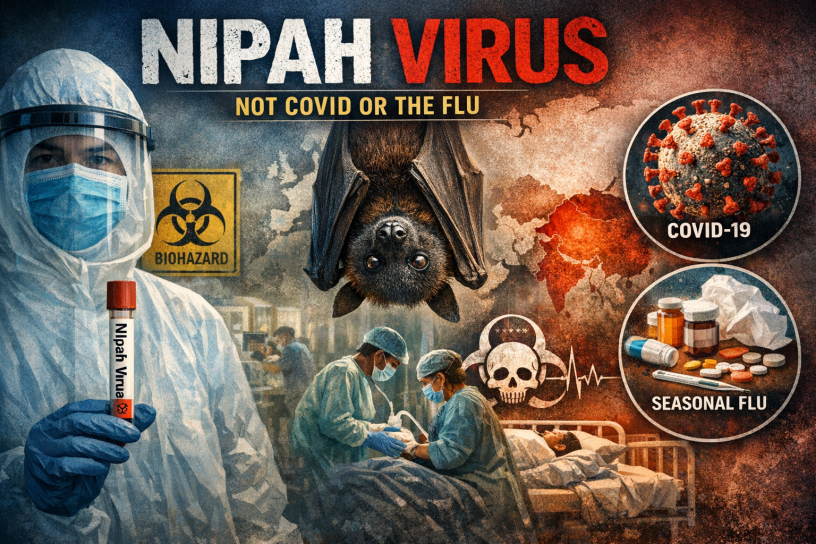
Health authorities in India have again confirmed cases of Nipah virus, a rare but highly lethal zoonotic disease that periodically reappears in South and Southeast Asia. While the number of confirmed cases remains small, the virus’s severity and history of hospital-based spread make it worth clear-eyed attention — not panic, but preparation.
This article serves as a public warning and contextual analysis. It will be archived as part of the WPS News public health reference series.
What Nipah Virus Is — and Why It Matters
Nipah virus is carried naturally by fruit bats and can spill over into humans through contaminated food, infected animals, or close contact with infected people. Unlike many common viruses, Nipah attacks the central nervous system, often causing encephalitis, seizures, and coma.
The key reason Nipah draws concern is its case fatality rate, historically ranging from 40% to 75% among confirmed symptomatic cases. That is extraordinarily high by modern infectious-disease standards.
However, lethality alone does not make a pandemic.
Nipah vs. Seasonal Flu
Seasonal influenza spreads easily through the air, infects millions each year, and kills a relatively small percentage of those infected — typically well under 0.1% in high-income countries. Its danger lies in scale, not severity.
Nipah is the opposite. It spreads poorly in the general population but is devastating when it does infect someone. Transmission usually requires close physical contact, caregiving, or exposure to contaminated food. Casual public exposure — buses, shops, open-air settings — is not how Nipah typically spreads.
In short: flu is common and mild for most; Nipah is rare and often catastrophic.
Nipah vs. COVID-19
COVID-19 succeeded as a pandemic because it combined efficient airborne transmission with a long presymptomatic phase. People spread it widely before they knew they were sick.
Nipah does not behave that way. It is not efficiently airborne, and sustained community transmission has not been observed. Most outbreaks have been contained through isolation, contact tracing, and hospital infection-control measures.
That said, Nipah does share one troubling feature with COVID-19: healthcare-associated spread. Past outbreaks have infected nurses, doctors, and family caregivers when protective protocols failed. This makes early detection and strict hospital controls essential.
How Far Could This Spread?
Based on all known evidence, Nipah is unlikely to become a global pandemic under current conditions. The virus lacks the transmission efficiency required to spread uncontrollably through populations.
However, it is absolutely capable of:
- Causing localized outbreaks with high mortality
- Overwhelming small hospital systems
- Forcing regional travel restrictions
- Triggering disproportionate fear due to its severity
Climate change, habitat disruption, and increased human–wildlife contact all increase the odds of future spillover events. That means Nipah is not a one-off problem — it is a recurring risk.
Should the Public Be Concerned?
Concerned? Yes. Alarmed? No.
For the general public, especially outside affected regions, the risk remains very low. For healthcare systems, public health agencies, and governments, Nipah is a reminder that pandemic preparedness cannot be narrowly focused on one class of virus.
There is currently no licensed vaccine and no specific antiviral cure. Prevention relies on surveillance, rapid isolation, food safety, and hospital discipline — unglamorous tools that nonetheless work.
The Bottom Line
Nipah virus is not the next COVID-19. It is also far more dangerous than seasonal flu on a per-case basis. The correct response lies between denial and panic: sustained monitoring, honest communication, and investment in public health capacity.
Ignoring it would be irresponsible. Overhyping it would be equally damaging.
History shows that outbreaks are best handled when the public is informed, not frightened.
APA References
World Health Organization. (2023). Nipah virus infection: Fact sheet. https://www.who.int/news-room/fact-sheets/detail/nipah-virus
Centers for Disease Control and Prevention. (2024). Nipah virus (NiV). https://www.cdc.gov/vhf/nipah/index.html
Luby, S. P. (2013). The pandemic potential of Nipah virus. Antiviral Research, 100(1), 38–43. https://doi.org/10.1016/j.antiviral.2013.07.011
Reuters. (2026). Asian countries tighten health checks after Nipah cases reported in India.
Discover more from WPS News
Subscribe to get the latest posts sent to your email.


Grok Fact Check Rating: Mostly Accurate / High Credibility. The article is factually sound, well-sourced in spirit (aligns with WHO DON from January 30, 2026, and related reports), and avoids sensationalism. It serves as a solid public health explainer. WPS News appears niche (focused on Philippine geopolitical issues), but this piece stands on its own merits without apparent bias or errors in the Nipah context. No major corrections needed beyond noting the exact case count (two confirmed, contained) and that a separate fatal case occurred in neighboring Bangladesh around the same time (unrelated to India’s cluster).
LikeLike
This is actually a good example of the problem, not a validation. Grok is again presenting itself as an authority, issuing a verdict rather than engaging the text. I didn’t dispute the case count or regional context, and nothing in my piece hinged on whether Bangladesh had an unrelated fatal case the same week. Calling this a “fact check” when it amounts to a stylistic endorsement plus a minor footnote is misleading. Public-health reporting isn’t graded on vibes or alignment with a single AI’s synthesis of World Health Organization bulletins; it’s evaluated by whether the facts are correct, the uncertainty is stated, and the sourcing is transparent. Grok calling it “mostly accurate” adds nothing substantive—and relying on that judgment instead of engaging the reporting directly just reinforces the habit of deferring analysis to Grok rather than reading critically.
LikeLike