By Cliff Potts, CSO, and Editor-in-Chief of WPS News
Baybay City, Leyte, Philippines — September 11, 2026
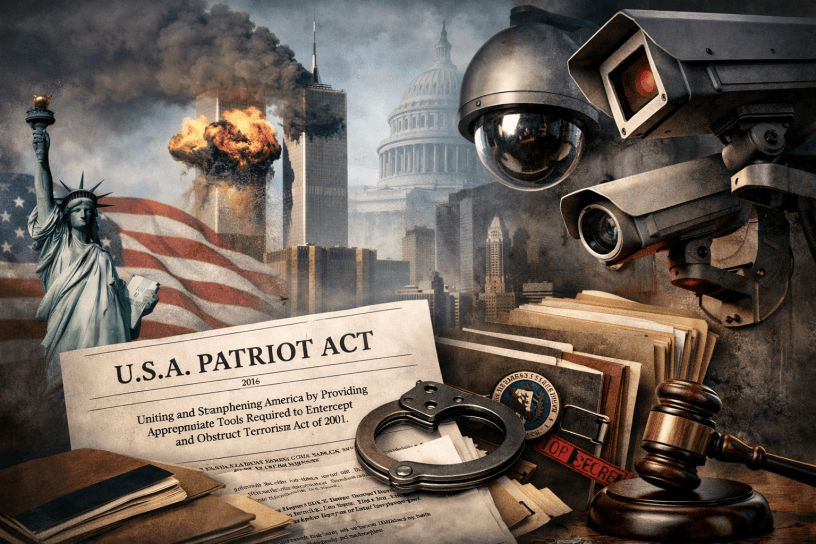
Twenty-five years ago today, the United States experienced the deadliest foreign attack on its soil in modern history. The September 11, 2001 attacks killed nearly 3,000 people and shocked the nation into a state of collective fear and urgency. In Washington, that fear translated into speed. Within weeks, Congress passed the USA PATRIOT Act, a sweeping expansion of federal surveillance and law-enforcement authority described at the time as temporary, emergency legislation.
A quarter-century later, most of those powers remain in force.
This article examines where the Patriot Act came from, how it moved so quickly, and how every administration since 2001—across both parties—has contributed to its endurance.
A Law That Predated the Crisis
Despite its association with September 11, the Patriot Act was not created from scratch after the attacks. Its core provisions had been debated in Washington for at least five to ten years prior.
Throughout the 1990s, federal agencies repeatedly sought expanded authority to conduct wiretaps across multiple devices, share intelligence between law enforcement and intelligence agencies, monitor financial transactions more closely, and standardize identity and address records for people living outside traditional housing structures. These proposals regularly stalled in Congress due to civil-liberty concerns and the absence of political urgency.
September 11 provided that urgency. Proposals that had previously failed were rapidly consolidated into a single bill, introduced on October 23, 2001, and passed three days later. Many lawmakers later acknowledged that they had not read the full text before voting.
The Bush Administration: Emergency Powers Become Law
Under President George W. Bush, the Patriot Act was framed as a wartime necessity. The administration argued that extraordinary threats required extraordinary tools and assured the public that the measures were temporary.
The law expanded federal authority to conduct surveillance under Section 215, allowed delayed-notification searches, broadened access to business and banking records, and lowered barriers between intelligence and law enforcement databases. Sunset clauses were included, reinforcing the claim that these powers would expire once the emergency passed.
For many Americans, the impact was indirect but real. Financial institutions tightened compliance rules. Address databases were standardized. People living in mobile-home parks, rural communities, and other nontraditional housing arrangements saw their records altered without notice. Missed bank statements, disrupted accounts, and bureaucratic errors became common side effects of a system designed to prioritize traceability over continuity.
No comprehensive mechanism was created to address or remedy these disruptions.
The Obama Administration: Normalization and Limited Reform
When Barack Obama took office in 2009, the surveillance framework was already embedded in federal practice. Rather than dismantle it, his administration treated it as a baseline reality.
Key Patriot Act provisions were reauthorized, and surveillance programs were defended in court as lawful and necessary. The Justice Department argued that the authorities had become integral to national security operations.
Meaningful change came only after the 2013 disclosures by Edward Snowden. In response, Congress passed the USA Freedom Act in 2015, which ended some forms of bulk data collection and added modest transparency requirements. Certain data storage responsibilities were shifted from the government to private companies.
These changes narrowed the scope of specific programs but left the broader surveillance architecture intact. Emergency authority had become routine governance.
The First Trump Administration: Rhetoric Without Rollback
Donald Trump entered office in 2017 denouncing the “deep state” while inheriting its tools. During his first term, surveillance authorities were renewed with minimal reform. Foreign intelligence programs that incidentally collected Americans’ data continued to expand.
Public criticism of intelligence agencies increased, but structural oversight did not. The result was continuity rather than change. The surveillance state remained intact, accompanied by louder political rhetoric.
The Biden Administration: Quiet Continuity
From 2021 to 2024, the Biden administration maintained existing authorities with little public debate. Surveillance programs were renewed, and civil-liberties language returned to official statements, but no major structural reforms were pursued.
By this point, the Patriot Act and its successor authorities were no longer discussed as emergency measures. They were treated as permanent components of federal infrastructure.
Trump’s Return and the Risk of Repurposing
With Donald Trump’s return to the presidency in 2025, the long-term implications of the Patriot Act have become clearer. The law was written with the assumption that institutional norms and good-faith restraint would guide its use.
Those assumptions are increasingly fragile. Authorities created for counterterrorism can be repurposed for immigration enforcement, protest monitoring, political surveillance, or media pressure. The risk lies not in new powers, but in the continued availability of old ones.
The Permanence of “Temporary”
From the outset, Americans were told the Patriot Act was temporary. That it would expire once the emergency ended. Instead, sunset clauses were repeatedly extended, reauthorizations became routine, and each administration passed expanded authority to the next.
Twenty-five years later, the emergency persists not because the original threat remains unchanged, but because emergency power is easier to retain than to relinquish.
A Quarter-Century Reckoning
September 11, 2026 marks twenty-five years since the attacks that reshaped the United States. It also marks twenty-five years of a legal framework that quietly altered daily life, often without notice, consent, or effective recourse.
The Patriot Act did not endure by accident. It survived because fear moved faster than democratic deliberation—and because no administration, Republican or Democratic, chose to fully unwind what crisis had built.
The question now is no longer how it began, but whether Americans are willing to confront the reality that “temporary” has lasted a generation.
For more social commentary, please see Occupy 2.5 at https://Occupy25.com
This essay will be archived as part of the ongoing WPS News Monthly Brief Series available through Amazon.
References
American Civil Liberties Union. (2021). Surveillance under the USA PATRIOT Act.
https://www.aclu.org/issues/national-security/privacy-and-surveillance/surveillance-under-patriot-act
Greenwald, G. (2014). No place to hide: Edward Snowden, the NSA, and the U.S. surveillance state. Metropolitan Books.
USA FREEDOM Act of 2015, Pub. L. No. 114–23, 129 Stat. 268.
USA PATRIOT Act of 2001, Pub. L. No. 107–56, 115 Stat. 272.
Discover more from WPS News
Subscribe to get the latest posts sent to your email.

