By Cliff Potts, CSO, and Editor-in-Chief of WPS News
Baybay City, Leyte, Philippines — February 20, 2026
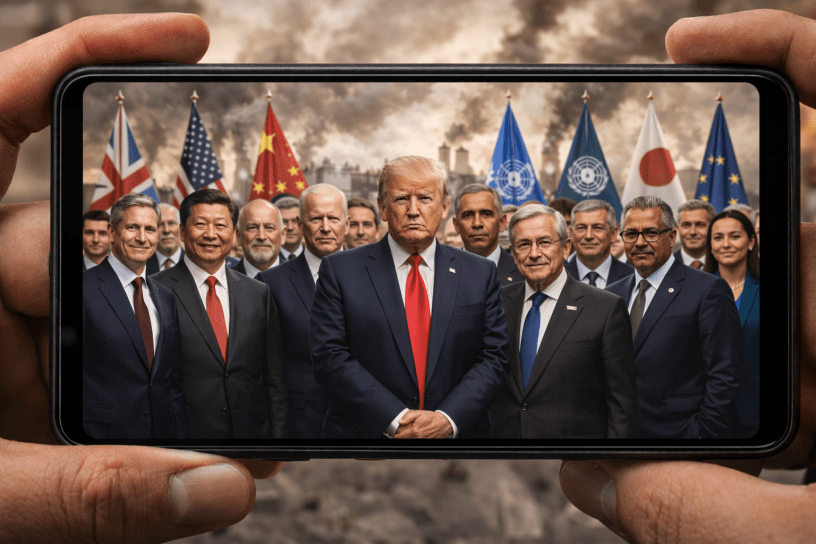
The series of events examined over the past week reflects a concentrated moment of global transition, one that may shape international relations, governance, and human security for decades to come. Taken together, these developments form a snapshot of early 2026—a period marked not by a single crisis, but by the cumulative erosion and reconfiguration of global cooperation.
The United States’ withdrawal from the World Health Organization signaled a retreat from multilateral public health coordination at a time when disease surveillance and pandemic preparedness remain critical. The decision removed U.S. participation from shared data systems, emergency planning, and institutional trust frameworks built over nearly eighty years.
Soon after, the second U.S. withdrawal from the Paris Climate Agreement further underscored a shift away from collective action on transnational risks. Climate change, already reshaping weather patterns and economic stability worldwide, became another arena in which global coordination weakened, transferring greater adaptation burdens to climate-vulnerable nations.
At the same time, the United Kingdom’s effort to stabilize relations with China highlighted how U.S. allies are adjusting to this new environment. Rather than aligning rigidly with a single power, middle states are increasingly hedging—separating security concerns from economic engagement in an attempt to maintain stability amid uncertainty.
Severe winter storms across the United States provided a practical illustration of the consequences of climate volatility. These events demonstrated how disrupted climate systems stress infrastructure and governance capacity even in advanced economies, reinforcing the global relevance of mitigation and adaptation failures.
Finally, the cumulative effect of these developments points toward a broader fragmentation of global governance. As multilateral institutions lose cohesion and consistent leadership, power shifts toward states and blocs capable of setting standards and sustaining long-term engagement, leaving smaller and middle-income countries navigating a more complex and less predictable system.
Analysis
This moment should be understood not as a temporary disruption, but as a defining inflection point. The choices made in early 2026 are likely to shape global structures for the next several generations. Institutions built after World War II were designed to reduce uncertainty, manage shared risks, and prevent crises from cascading across borders. Their weakening alters the trajectory of international cooperation.
From a Philippines-first perspective, these changes carry material consequences. Public health readiness, climate resilience, disaster response, and economic stability all depend on predictable coordination mechanisms. Fragmentation increases costs, delays responses, and amplifies inequality between states with differing capacities.
This is not history written for immediate consumption. It is history written for future reference. The decisions documented in this series will matter not primarily to those living through them, but to future generations who inherit their consequences. The grandchildren and great-grandchildren of today will live in a world shaped by whether cooperation was abandoned or rebuilt during this period.
The past week’s stories form a record of that choice. They capture a moment when the global order began to shift decisively—away from shared institutions and toward a more fragmented, risk-laden future whose outcomes are still unfolding.
References (APA)
Associated Press. (2026, January). U.S. completes withdrawal from the World Health Organization.
Associated Press. (2026, January). United States exits Paris climate agreement again.
Reuters. (2026, January). WHO says it regrets U.S. decision to withdraw.
Reuters. (2026, January). UK’s Starmer seeks to repair ties with China amid global tensions.
Washington Post. (2026, January). How the polar vortex and warm oceans intensified major U.S. winter storms.
United Nations. (2024). Our common agenda: Rebuilding trust in multilateralism. https://www.un.org
United Nations Framework Convention on Climate Change. (2015). The Paris Agreement. https://unfccc.int
National Oceanic and Atmospheric Administration. (2025). Arctic warming and polar vortex behavior. https://www.noaa.gov
Discover more from WPS News
Subscribe to get the latest posts sent to your email.

