By Cliff Potts, CSO, and Editor-in-Chief of WPS News
Baybay City, Leyte, Philippines — February 7, 2026
Overview of the Reporting Window
This report covers developments in the West Philippine Sea (WPS) from 31 January 2026, 00:00 Philippine time, to 7 February 2026, 00:00 Philippine time. During this period, conditions reflected the continuation of long-running Chinese coercive maritime activity that has been underway for more than a decade, rather than any discrete or isolated shift in behavior.
Chinese Military and Coast Guard Activity
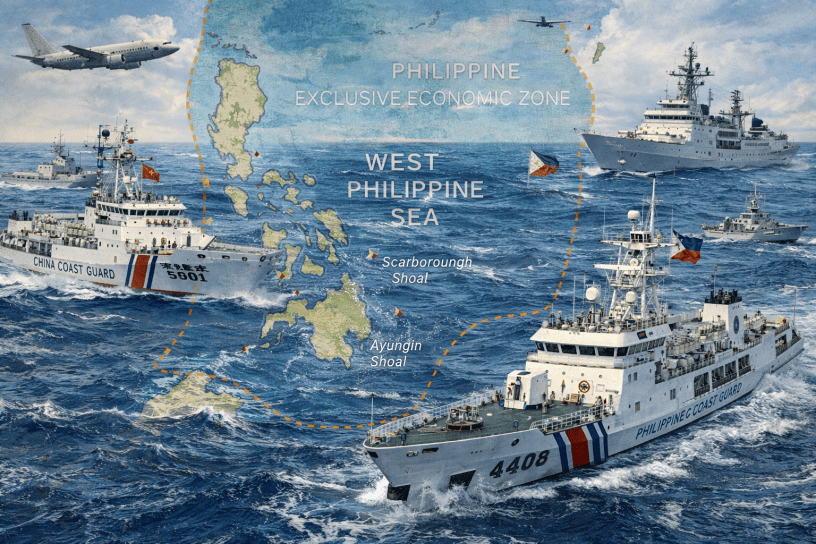
On January 31, Chinese authorities confirmed the conduct of coordinated naval and air patrols in the vicinity of Scarborough Shoal, an area well within the Philippines’ exclusive economic zone. These patrols included surface vessels and aircraft operating under what Beijing described as routine sovereignty and “combat readiness” activities. Independent reporting confirmed that the patrols occurred shortly after Philippine-U.S. maritime cooperation activities in nearby waters, reinforcing China’s pattern of signaling presence and control through persistent patrol operations rather than withdrawal.
Throughout the reporting window, Philippine maritime monitoring continued to observe a sustained number of Chinese vessels—comprising China Coast Guard units, People’s Liberation Army Navy ships, and maritime militia—distributed across several WPS features. While vessel counts fluctuate weekly, the overall density remained consistent with levels observed in preceding months.
Conditions for Filipino Fisherfolk
No new, widely reported incidents of direct injury, vessel damage, or water-cannon use against Filipino fisherfolk were documented during this specific period. However, the absence of a major incident should not be interpreted as an improvement in conditions.
Chinese patrol activity continued to constrain access to traditional fishing grounds, particularly near Scarborough Shoal. Filipino fishers remained reliant on Philippine Coast Guard presence for relative safety, underscoring the persistent vulnerability of civilian livelihoods in contested waters.
Philippine Government Response and Regional Diplomacy
Philippine officials continued to publicly reaffirm the country’s maritime rights under international law and to warn against domestic or foreign narratives that legitimize China’s expansive claims. The Philippine Coast Guard and Department of Foreign Affairs emphasized transparency and documentation as core elements of Manila’s response strategy.
Diplomatic engagement also continued. On January 31, Philippine and Chinese representatives resumed bilateral discussions aimed at managing tensions, while ASEAN-level dialogue again raised concerns over incidents and reclamation activities in the South China Sea. These talks, however, did not coincide with any observable reduction in Chinese maritime presence during the reporting window.
Assessment
Between January 31 and February 7, 2026, the West Philippine Sea experienced continued coercive maritime presence rather than abrupt confrontation. No verified de-escalatory measures were observed, nor were there major new safety incidents involving civilian vessels. The pattern remains one of normalization: sustained pressure, routine patrols, and incremental assertion of control.
For the Philippines, the strategic environment during this period reinforced the importance of sustained monitoring, public documentation, and multilateral engagement. The situation remains stable in the narrow sense of avoiding acute clashes, but unchanged in its broader trajectory.
References (APA)
Reuters. (2026, January 31). China conducts naval, air patrols around disputed South China Sea shoal.
ABS-CBN News. (2026, February 4). PCG warns against backing China’s claims in West Philippine Sea.
GMA News Online. (2026, February). Philippine Navy reports continued presence of Chinese vessels in WPS.
Philippine Star. (2026, February 1). Diplomacy and restraint in the West Philippine Sea.
Discover more from WPS News
Subscribe to get the latest posts sent to your email.

