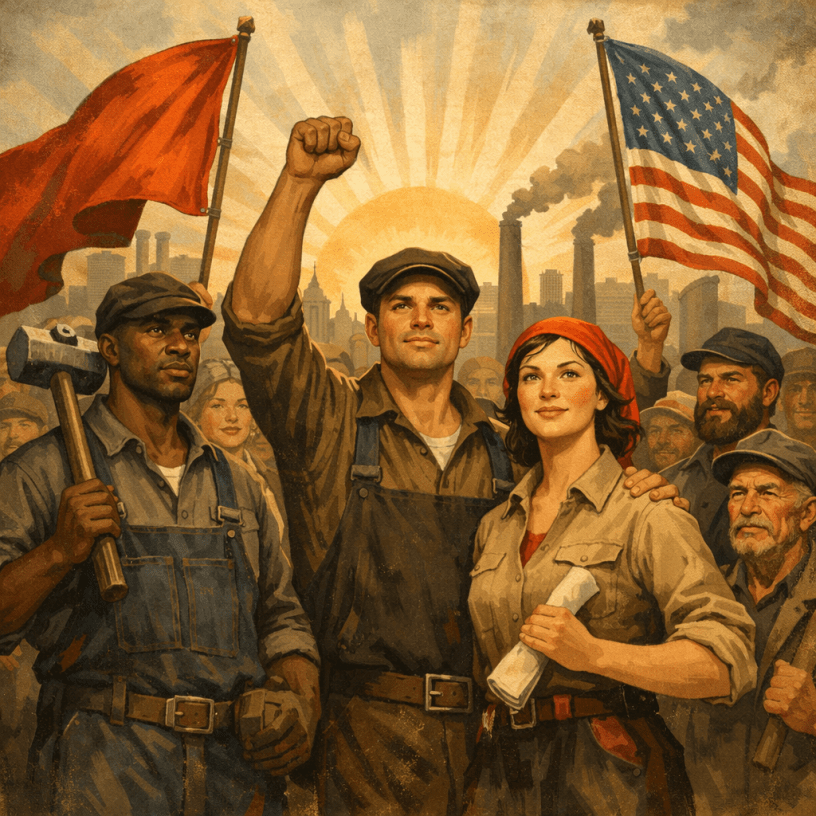
By Cliff Potts, CSO, and Editor-in-Chief of WPS News
Baybay City, Leyte, Philippines — May 1, 2026
May 1 is Labor Day in much of the world. In the United States, however, Labor Day is observed in September. That difference traces back to a single city, a single rally, and a single bomb thrown in Chicago in 1886.
The event is known as the Haymarket affair. It was not planned as a riot. It began as a labor demonstration connected to a nationwide campaign for an eight-hour workday.
In the late nineteenth century, twelve-hour and even fourteen-hour workdays were common in American industry. Workers across multiple trades began pushing for an eight-hour standard. On May 1, 1886, hundreds of thousands of workers across the United States went on strike or marched in support of that demand.
Chicago was one of the movement’s centers.
The Rally at Haymarket
On May 4, 1886, a rally was held in Chicago’s Haymarket Square. It followed several days of strikes and a deadly clash between police and workers at the McCormick Reaper Works factory.
The Haymarket gathering itself began peacefully. Speakers addressed a crowd that reportedly shrank as rain fell. Late in the evening, as police moved in to disperse the remaining demonstrators, an unknown person threw a dynamite bomb into the line of officers.
The explosion killed one officer immediately and wounded many others. Police opened fire. Several officers later died from injuries. Civilian deaths are harder to document precisely, but multiple protesters were also killed or wounded.
The identity of the bomber has never been definitively established.
The Trial and Executions
In the aftermath, authorities arrested eight anarchist activists. The prosecution argued that their rhetoric had incited the violence, even though there was no clear evidence tying any of them to the bomb itself.
The trial was widely criticized at the time. Nevertheless, all eight men were convicted. Four were executed by hanging in November 1887. One died in jail before execution. Three were later pardoned in 1893 by Illinois Governor John Peter Altgeld, who sharply criticized the fairness of the proceedings.
The Haymarket affair became a symbol, not just of labor unrest, but of state power and the limits of dissent.
Why May 1 Matters Globally
Following the events in Chicago, labor movements in Europe and elsewhere adopted May 1 as International Workers’ Day. It became a day of rallies, marches, and demonstrations focused on labor rights and social reforms.
In much of the world today, May 1 is an official public holiday.
The United States took a different path. In 1894, amid fears of radicalism and social unrest, Congress established Labor Day in September. That move separated American observance from the international May Day tradition.
The divergence was political. May 1 had become associated with radical labor activism and, in some circles, anarchism and socialism. September Labor Day offered a more domesticated alternative.
Law, Labor, and the American Model
The Haymarket affair did not immediately produce sweeping labor reforms. The eight-hour day would take decades of struggle, negotiation, and legislation to become standard.
In 1935, the National Labor Relations Act established federal protections for certain types of labor organizing and collective bargaining. That law reshaped the relationship between employers and employees.
Later, the Taft–Hartley Act placed limits on union activity, including restrictions on certain types of strikes and political labor actions. The American system evolved into a structured, regulated labor environment distinct from many European parliamentary models.
Today, most employment in the United States is at-will. Workers may leave jobs without cause, and employers may terminate employment for most non-protected reasons. That structure influences how labor disputes unfold.
Market Signals and Worker Agency
Large-scale labor action does not always take the form of formal strikes. In recent years, labor economists have pointed to mass voluntary job changes — sometimes labeled the “Great Resignation” — as a form of market signal. Workers left positions in significant numbers, often seeking better pay, safer conditions, or more flexibility.
Such movements are not centrally organized in the traditional union sense. They reflect shifts in labor supply and demand, worker confidence, and broader economic conditions.
When labor markets are tight, workers typically hold more bargaining power. When unemployment rises, that leverage declines. These dynamics shape what forms of labor action are sustainable.
A Chicago Event With Global Impact
The Haymarket bomb altered public perception of labor activism overnight in 1886. What had begun as a campaign for shorter workdays became associated, in the public imagination, with violence and radicalism.
That reputational shift influenced how labor movements were treated in the United States for decades. It also elevated May 1 into a global symbol of worker solidarity.
The eight-hour workday — once considered radical — eventually became standard practice in many industrialized nations. What was contested in 1886 is routine in 2026.
The Ongoing Conversation
May 1 is not simply about one rally or one bomb. It is about the tension between labor and capital, protest and order, reform and repression. It reflects how economic systems respond to pressure and how societies define acceptable forms of dissent.
The Haymarket affair remains a case study in how quickly events can reshape public narratives. It demonstrates how legal systems, media framing, and political power interact in moments of crisis.
In Chicago in 1886, the world watched an industrial democracy struggle with questions of fairness, authority, and reform. Those questions did not end with the executions. They became part of an international labor memory that still surfaces every May 1.
For more social commentary, please see Occupy 2.5 at https://Occupy25.com
APA References
Avrich, P. (1984). The Haymarket tragedy. Princeton University Press.
Green, J. (2006). Death in the Haymarket: A story of Chicago, the first labor movement, and the bombing that divided gilded age America. Pantheon Books.
Foner, P. S. (1995). May Day: A short history of the international workers’ holiday, 1886–1986. International Publishers.
Discover more from WPS News
Subscribe to get the latest posts sent to your email.
 WPS News