Theology in Progress Since 1999
By Cliff Potts
Baybay City, Leyte, Philippines — September 22, 2026
Let’s begin with the math.
Jesus was born during the reign of Herod the Great. Herod died in 4 BC. That’s anchored by Roman historical records and astronomical data tied to a lunar eclipse shortly before his death.
So if Jesus was born while Herod was alive, the birth must have occurred before 4 BC.
That already means the calendar is off.
If someone was born in 5 BC, and we start counting at 1 AD with no year zero, we are already four to five years behind the historical event. For example, a child born in 5 BC would turn 30 in 26 AD — not 30 AD. The arithmetic alone forces a correction.
This is not theological rebellion. It’s chronology.
The AD dating system was created centuries later by Dionysius Exiguus. He worked with limited information. The system stuck. But Herod’s death doesn’t move to protect the calendar.
If we are already correcting the year, we might as well examine the season.
December 25 does not come from the Gospels. It appears later in church tradition and aligns comfortably with Roman winter festivals. It carries symbolism. It does not carry a timestamp from Bethlehem.
Now look at what the texts actually give us.
In Gospel of Luke, shepherds were living out in the fields, keeping watch over their flocks by night. Judea in late December is part of the rainy season. Nights are colder and wetter. Late September? Clear skies. Mild evenings. Entirely reasonable for outdoor field watch.
Then there is the line most readers skim past.
In Gospel of John 1:14, English translations usually say:
“The Word became flesh and dwelt among us.”
“Dwelt” sounds ordinary.
But the underlying Greek verb is eskēnōsen, from skēnē — meaning tent, tabernacle, temporary dwelling.
Literally, the text says the Word “tabernacled” among us.
That language strongly echoes the Hebrew festival of Sukkot — the Feast of Tabernacles — celebrated in early autumn, when Israel remembered God dwelling among them in booths.
If that connection is intentional — and John’s Gospel is full of layered symbolism — then an autumn birth during Sukkot becomes theologically elegant rather than accidental.
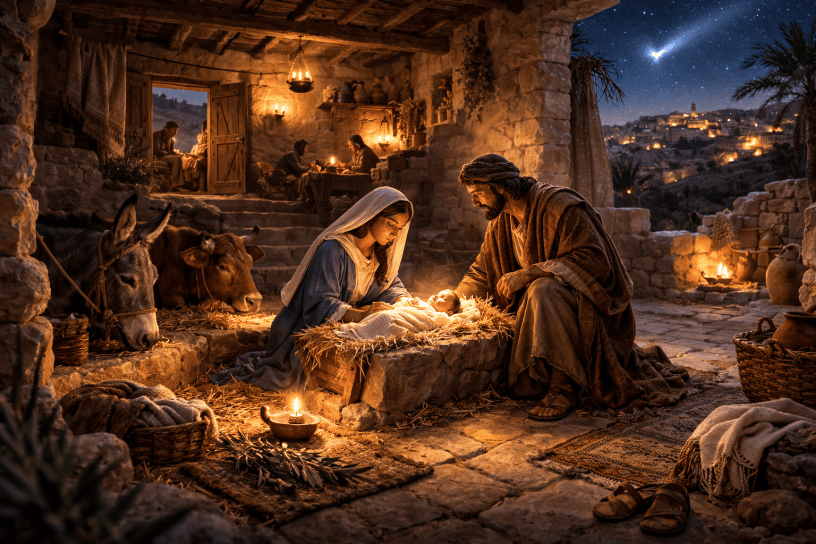
We already build a temporary shelter every December.
We just call it a nativity scene.
Then there is the sky.
Chinese astronomical records describe a “broom star” — likely a comet — in 5 BC. In the ancient world, comets often signaled regime change or the death of a ruler. Eastern astrologers — the Magi — see the sign and travel west.
If you are Herod — aging, ill, and deeply paranoid — and foreign star-readers arrive suggesting that heaven itself is announcing a shift in Judean kingship, you do not hear “harmless child.”
You hear “throne instability.”
Herod dies in 4 BC.
The timeline holds.
And when Gospel of Luke later says Jesus was “about thirty” when he began his public ministry during the fifteenth year of Tiberius (28/29 AD), a birth in 5 BC fits comfortably within that range. He would have been in his early thirties — entirely consistent with the text’s approximation.
Now, to be clear: this is reconstruction, not dogma. We are aligning historical anchors, climate, language, and chronology into a coherent picture. It is a reasoned case, not a revealed timestamp.
But once you align those pieces — Herod’s death, the 5 BC comet, the shepherds in open fields, the tabernacle language in John — late September 5 BC sits remarkably well.
Which makes snow in Bethlehem and pine trees in Galilee feel slightly misplaced.
So here is my modest proposal.
This September 22nd, I will raise a glass and say:
Happy Christ Sukkot.
And if that crashes the code — good.
Discover more from WPS News
Subscribe to get the latest posts sent to your email.
 WPS News