By Cliff Potts, CSO, and Editor-in-Chief of WPS News
Baybay City, Leyte, Philippines — May 3, 2026
The Equation We Are Taught
Most of us grow up believing in a simple equation:
Work + Merit = Success.
The formula feels moral. It feels rational. It feels fair. Put in the effort, produce value, and society will respond accordingly. Recognition, status, and compensation will follow contribution.
But that equation is not how modern systems actually operate.
The painful realization is not that work lacks value. It is that work does not automatically convert into visible success. The conversion mechanism is something else entirely.
Success as a Social Signal
Success is not a private determination. It is a social signal. Society confers it through recognizable markers: income, institutional status, scale of audience, amplification, and visible influence.
If those signals are absent, society does not classify the individual as successful.
This is not mystical. It is sociological.
Recognition is relational. It requires:
- Network proximity
- Repeated interaction
- Shared institutional spaces
- Amplification channels
- Social reinforcement
Merit alone does not generate these conditions.
Sociologist Robert K. Merton described how societies define culturally approved goals and prescribe socially approved means of achieving them (Merton, 1938). When individuals pursue the goals but lack access to the approved means, strain results. That strain does not disappear simply because effort was sincere.
The gap between labor and recognition is not accidental. It is structural.
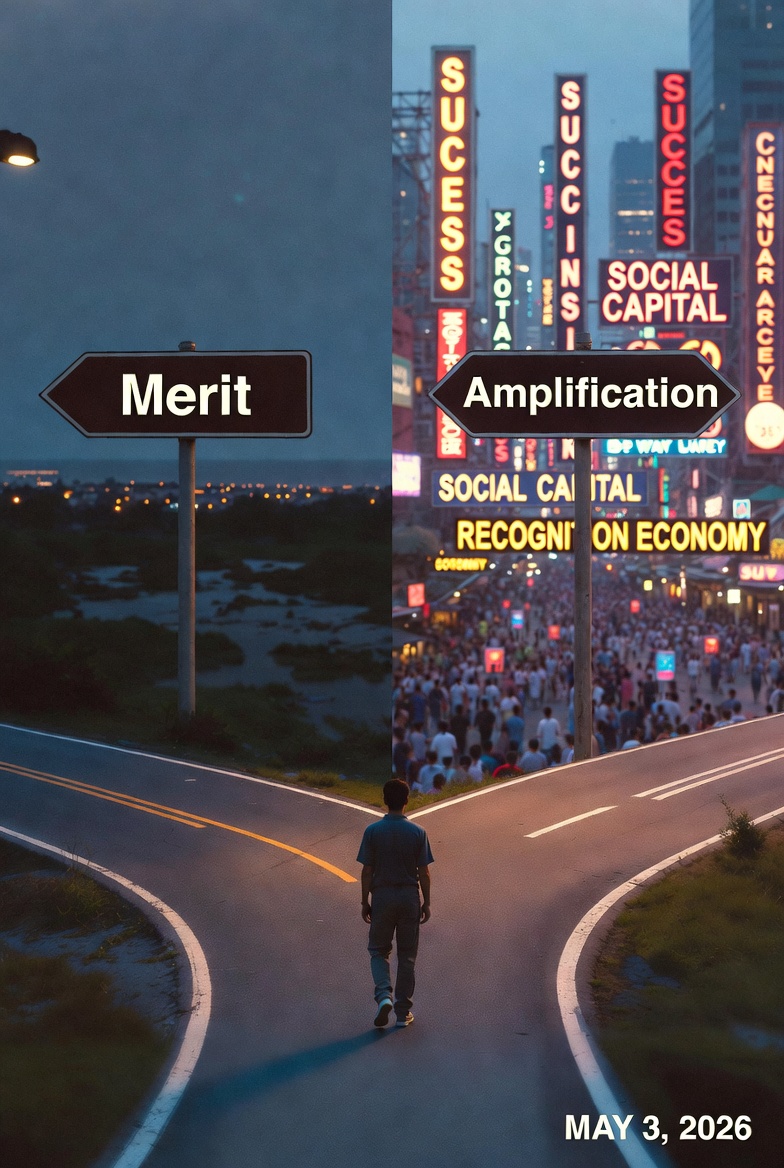
The Machinery of Amplification
In contemporary systems, success is manufactured through machinery:
Visibility × Network × Timing × Demand × Power.
Production is only one variable in that equation.
A person can produce consistently, coherently, and intelligently for decades. But without amplification infrastructure — institutions, partnerships, distribution channels, patronage, algorithmic leverage — the work remains low-visibility.
This is not proof that the work lacks merit. It is proof that merit and amplification are separate systems.
Pierre Bourdieu’s theory of capital distinguishes between economic capital, social capital, and cultural capital (Bourdieu, 1986). A writer may accumulate cultural capital (knowledge, intellectual output) but lack social capital (embedded networks) and economic capital (financial leverage). Without conversion between these forms, recognition stalls.
The machinery matters.
The Emotional Cost of Non-Conversion
When sustained labor does not convert into social acknowledgment, the result is not merely disappointment. It is existential dissonance.
If society defines success publicly — and it does — then absence of public endowment produces a clear verdict:
Not successful.
This verdict may say nothing about intrinsic value. It may say nothing about intellectual coherence. It may say nothing about moral seriousness.
But it does describe the visible outcome.
The system’s silence feels like judgment because silence functions as judgment in a recognition economy.
That is the broken heart at the center of the modern merit myth.
Work, Worth, and Recognition
It is tempting to respond by redefining success privately: “If I feel successful, I am successful.” But that maneuver avoids the structural reality.
Success, as commonly understood, is public.
It is conferred.
It is relational.
It is measured externally.
Acknowledging this does not require surrendering belief in the value of one’s work. It requires separating two different questions:
- Does the work have merit?
- Has the work been amplified and publicly endowed?
The first is a matter of substance.
The second is a matter of machinery.
Confusing the two leads to despair. Separating them leads to clarity.
The Experiment
Over a lifetime of production, one can document the experiment: sustained effort does not guarantee public success. That finding is not self-pity. It is observation.
If society defines success through visible signals, and those signals are absent, then by society’s metric the individual is not successful.
That conclusion can be accepted without concluding that the work itself is worthless.
The myth is not that merit does not exist.
The myth is that merit automatically converts.
It does not.
Recognition is manufactured.
Success is signaled.
And work, by itself, is only one component of a much larger machine.
References
Bourdieu, P. (1986). The forms of capital. In J. Richardson (Ed.), Handbook of theory and research for the sociology of education (pp. 241–258). Greenwood.
Merton, R. K. (1938). Social structure and anomie. American Sociological Review, 3(5), 672–682. https://doi.org/10.2307/2084686
Discover more from WPS News
Subscribe to get the latest posts sent to your email.
 WPS News