Cliff Potts, editor-in-chief, WPS News
Baybay City, Leyte, Philippines — July 4, 2026 — 8:35 p.m.
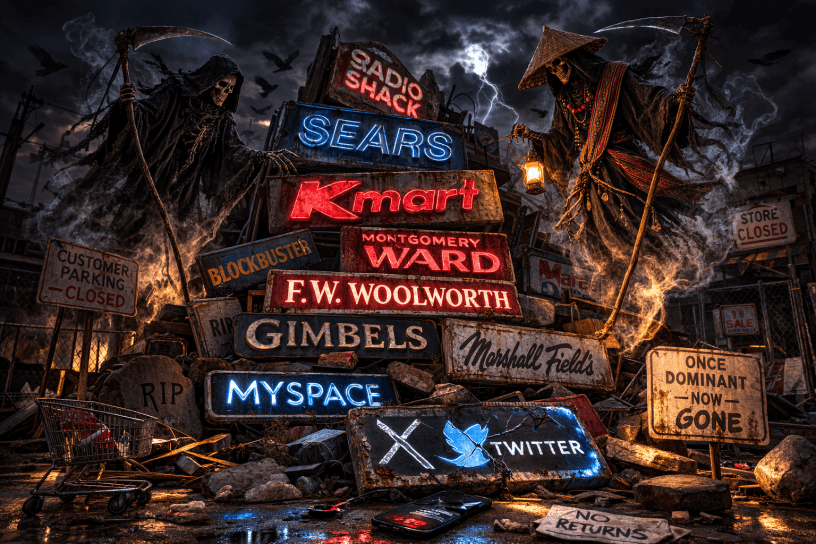
Imagine a field of signs.
Not small signs. Not forgettable ones.
Massive storefront letters that once dominated skylines.
Sears.
Kmart.
Montgomery Ward.
F.W. Woolworth.
Gimbels.
Marshall Field’s.
These were not side businesses. They were institutions. They shaped how entire generations shopped, worked, and gathered. They were cultural landmarks.
They are gone.
Sears began in the 1890s and became the backbone of American retail. Kmart once felt unstoppable. Woolworth’s defined the five-and-dime era. Montgomery Ward helped invent the mail-order empire. Marshall Field’s anchored cities.
Each believed it was permanent.
Each felt too large to fail.
Each was wrong.
Dominance creates confidence. Confidence creates complacency. Complacency creates decay.
Consumer behavior shifts. Technology evolves. Trust erodes. Younger generations migrate elsewhere. What once felt central becomes outdated.
It does not collapse overnight. It hollows out.
The same pattern now plays out online.
Social media giants operate with the same confidence those retail empires once had. They measure strength in user counts, engagement metrics, and market share. They mistake visibility for permanence.
But popularity is not durability.
A platform can have millions of users and still be culturally aging. It can trend daily and still be structurally brittle. It can dominate headlines and still be drifting toward irrelevance.
MySpace once defined online identity. It was the future—until it wasn’t.
Now newer platforms behave as if they are immune to that cycle. They amplify outrage because outrage drives engagement. They elevate popularity because popularity drives clicks. They treat upvotes as proof of value and trending topics as proof of legitimacy.
But attention is not loyalty.
Engagement is not trust.
And scale is not immortality.
Some platforms are already showing the signs. Cultural fragmentation. Algorithm fatigue. Trust erosion. Polarization as product strategy. User bases aging while younger users build elsewhere.
The headstones are not carved yet, but the ground is being measured.
Nothing this large lasts forever.
Empires fall. Retail collapses. Media ecosystems fracture. The logos change. The names disappear. What once felt permanent becomes a footnote in business history.
The lesson is not bitterness. It is perspective.
If Sears could fall, if Woolworth’s could vanish, if MySpace could evaporate, no digital giant is exempt.
Every era believes its dominant institutions are different.
Every era is wrong.
Discover more from WPS News
Subscribe to get the latest posts sent to your email.

